
Imagine you are trying to finish an assignment, complete a project at work, or deal with a personal problem, and someone keeps asking when you will finish. You may eventually say, “Get off my back.” The phrase is easy to understand in conversation, but its tone can be stronger than the speaker intends.
“Get off my back” means asking someone to stop bothering, pressuring, criticizing, or repeatedly reminding you about something. It is common in everyday English, especially when a person feels annoyed or frustrated. However, it is generally casual and somewhat confrontational, so choosing a softer alternative can make communication more respectful and professional.
This guide explains the meaning, history, tone, alternatives, regional usage, and practical applications of “get off my back,” helping students, professionals, ESL learners, and content writers choose the right expression for each situation.
What Does “Get Off My Back” Mean?
“Get off my back” is an informal expression used to tell someone to stop bothering, criticizing, pressuring, or repeatedly reminding you about something. It usually communicates frustration or irritation and is common in conversations between friends, family members, coworkers, or other people who have an established relationship.
Origin & History of “Get Off My Back”
The exact origin of “get off my back” is not documented with complete certainty, but the expression is generally associated with the idea of someone creating unwanted pressure or interference. The word “back” has long appeared in English expressions describing burdens, responsibility, or unwanted pressure.
The phrase became increasingly recognizable in modern informal English during the twentieth century. Its meaning developed into a direct request for another person to stop interfering, criticizing, supervising, or applying pressure.
Today, “get off my back” is firmly established as an informal idiom. It is especially common in spoken American English and can also be understood easily by British English speakers. Although the expression is not normally considered offensive, it can sound rude, defensive, or irritated, depending on the relationship between the speakers.
Its continued popularity reflects a broader feature of conversational English: short idiomatic expressions can communicate an entire emotional situation quickly. Instead of explaining, “I feel that you are putting too much pressure on me,” a frustrated speaker may simply say, “Get off my back.”
Synonyms & Alternatives by Tone
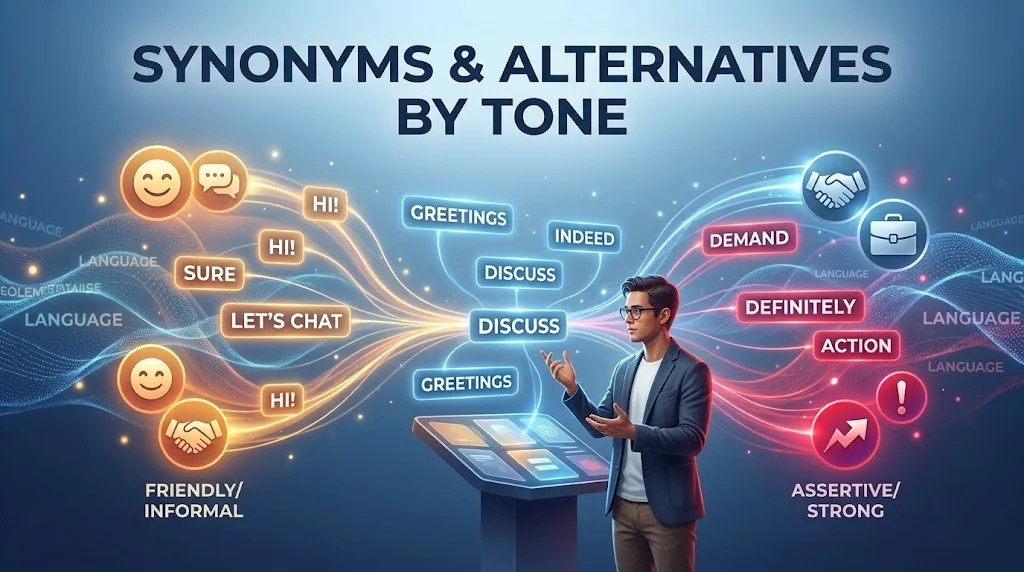
Professional & Neutral Alternatives
- Please stop pressuring me.
- I need some space to handle this.
- Please give me some time.
- I would appreciate some time to work on this.
- Please let me handle it.
- I can take care of it.
Polite & Supportive Alternatives
- Could you give me a little time?
- I understand your concern, but I need some space.
- Please give me a chance to work through this.
- I appreciate your patience.
- I’ll let you know when I need help.
Encouraging & Reassuring Alternatives
- I’ve got this.
- I’m taking care of it.
- Don’t worry; I’m handling it.
- I’ll take care of it.
- I’m working on it.
Casual, Playful & Idiomatic Alternatives
- Give me a break.
- Back off a little.
- Cut me some slack.
- Leave me alone for a bit.
- Stop riding me.
When Should You Use “Get Off My Back”?
“Get off my back” works best when the conversation is informal, and the relationship allows direct language. It is particularly useful when someone repeatedly pressures, criticizes, or reminds you about something and you want them to stop.
Professional settings
Use it cautiously at work. Among close colleagues who regularly communicate informally, it may be understood as a frustrated but temporary reaction. With a manager, client, teacher, customer, or unfamiliar colleague, a more neutral alternative is usually better.
For example, instead of saying:
“Get off my back about the report.”
a professional speaker could say:
“I’m working on the report and would appreciate some time to finish it.”
Casual conversations
The expression is more natural among friends, siblings, or people who are comfortable with direct language.
Writing, presentations, and digital communication
It can appear naturally in dialogue, social media posts, informal messages, and fictional writing. It is less suitable for formal reports, academic essays, business proposals, and official correspondence.
When it is especially effective
It is effective when the speaker deliberately wants to communicate strong frustration and a clear desire for the pressure to stop.
When Should You Avoid “Get Off My Back”?
Avoid the phrase when the situation requires diplomacy, respect, or careful emotional communication.
- Overly formal situations: Business letters, official emails, academic writing, and formal presentations usually require softer wording.
- Legal contexts: Ambiguous emotional language can be less useful than precise factual language.
- Academic contexts: Academic writing generally favors neutral and objective wording.
- Sensitive conversations: Someone who is concerned about your wellbeing may interpret the phrase as hostility.
- With authority figures: Saying it to a teacher, supervisor, manager, or official may sound disrespectful.
- With unfamiliar people: The phrase can create unnecessary tension when there is no established relationship.
- When nuance matters: If you only want less frequent reminders rather than complete disengagement, “get off my back” may sound stronger than intended.
Is “Get Off My Back” Professional, Polite, or Casual?
“Get off my back” is primarily casual and informal. It is not normally considered profanity, but it can sound confrontational because it directly tells another person to stop interfering.
Its emotional subtext often includes annoyance, frustration, impatience, or defensiveness. The meaning also depends heavily on delivery. A close friend may say it jokingly, while the same words during a workplace disagreement can sound openly hostile.
In professional communication, alternatives such as “Please give me some time,” “I’m handling it,” or “I’d appreciate some space to work on this” preserve the underlying message while reducing defensiveness.
Pros and Cons of Using “Get Off My Back”
Advantages
- Clarity: The listener can quickly understand that the pressure needs to stop.
- Efficiency: It communicates frustration in only a few words.
- Accessibility: Most native English speakers understand the expression immediately.
- Strong boundary: It can clearly signal that repeated pressure is unwelcome.
Potential Drawbacks
- Oversimplification: It may make a complicated disagreement sound like a simple request to stop bothering someone.
- Tone mismatch: The expression can be too aggressive for professional or sensitive situations.
- Repetition: If used frequently, it can make a speaker sound consistently irritated or defensive.
- Relationship impact: The listener may focus on the rudeness rather than the actual problem.
- Lost nuance: It does not explain whether the speaker needs time, privacy, fewer reminders, or practical help.
Real-Life Examples of “Get Off My Back” by Context
Emails
Informal:
“I know the deadline is Friday. Please get off my back about it—I’m already working on the final section.”
For a professional email, a better choice would be:
“I’m aware of the Friday deadline and am currently working on the final section.”
Meetings
“I understand the concern, but I’m already working on the issue. Give me some time to resolve it.”
This is usually more constructive than saying, “Get off my back.”
Presentations
The expression can be used when presenting dialogue or quoting an informal conversation, but it is rarely appropriate as the speaker’s own formal presentation language.
Conversations
“I told you I’ll clean my room. Get off my back about it.”
This is a natural informal use between people who know each other well.
Social Media
“Everyone keeps asking when the next update is. Get off my back—I’m working on it!”
Here, the phrase can sound humorous or exaggerated because social media often encourages casual language.
“Get Off My Back” vs Similar Expressions (Key Differences)
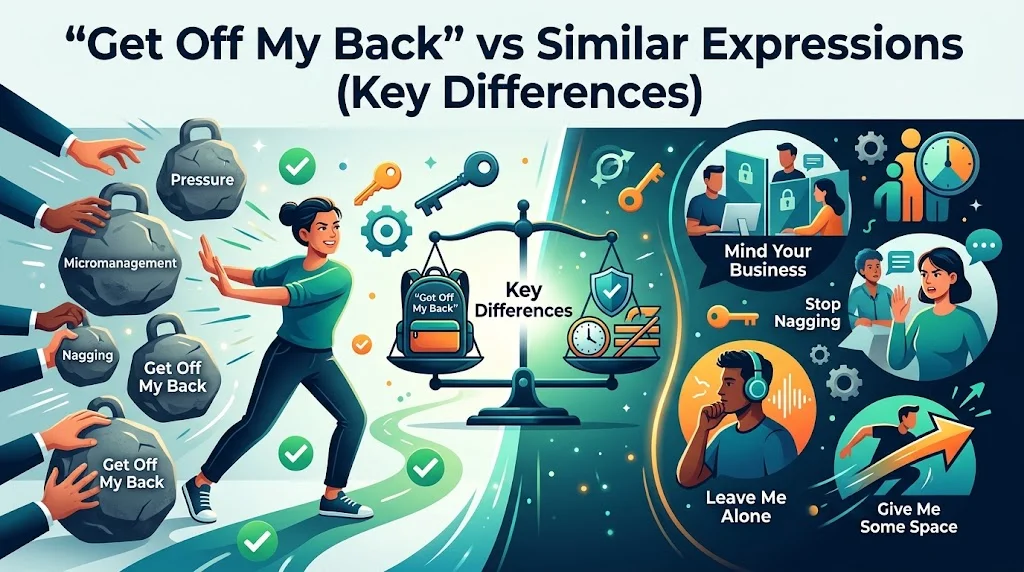
| Phrase | Meaning Difference | Tone Difference | Best Use Scenario |
| Give me a break | Asks someone to stop being unreasonable or demanding | Casual, frustrated | Friends and informal conversations |
| Give me some space | Requests physical, emotional, or conversational distance | Polite to moderately direct | Personal or sensitive situations |
| Back off | Tells someone to reduce pressure or interference | Direct and strong | Informal conflict or boundary-setting |
| Cut me some slack | Asks for greater tolerance or less criticism | Casual and friendly | Mistakes, delays, or difficult circumstances |
| Please stop pressuring me | Explicitly identifies pressure as the problem | Neutral and direct | Workplace or serious conversations |
| Leave me alone | Requests that someone stop interacting altogether | Direct, potentially harsh | Situations requiring immediate distance |
The key difference is that “get off my back” specifically suggests ongoing pressure, criticism, monitoring, or unwanted reminders. Other expressions can focus on space, fairness, interference, or complete disengagement.
Common Mistakes & Misuse of “Get Off My Back”
Overuse
Using the expression every time someone asks a question can make normal communication sound like unwanted pressure. Not every reminder is harassment or criticism.
Incorrect context
A learner may use the phrase with a manager, teacher, customer, or interviewer without realizing how confrontational it can sound.
Contradictory usage
The phrase communicates a desire for someone to stop applying pressure. Pairing it with an invitation for continued involvement can create confusion.
For example:
“Get off my back, but keep reminding me every hour.”
The two requests conflict.
Cultural misunderstandings
ESL learners may translate the expression literally or assume it is neutral. In many English-speaking contexts, the idiom carries noticeable emotional force, even though it is not a swear phrase.
Psychological Reason People Prefer “Get Off My Back”
Cognitive load reduction
Short expressions allow speakers to communicate a complicated emotional situation quickly. Instead of explaining every source of frustration, a person can use a familiar idiom.
Trust and authority signals
Direct language can signal confidence or strong boundaries. However, excessive directness may reduce perceived cooperation, particularly in professional settings.
Attention economy
Modern communication is fast. Messages on phones, workplace chats, and social platforms reward concise expressions. Idioms such as “get off my back” communicate an emotional position quickly.
Modern communication habits
People increasingly communicate through short messages where tone must be inferred from limited context. As a result, familiar expressions can be efficient, but they can also be misinterpreted because the reader cannot hear the speaker’s voice.
US vs UK Usage of “Get Off My Back”
“Get off my back” is understood in both American and British English. It is especially familiar in informal speech and does not require major translation between the two varieties.
In American English, it can sound strongly conversational and may be used jokingly among friends. British speakers also understand it naturally, although other expressions such as “leave me alone,” “give me a break,” or “stop hassling me” may appear depending on the speaker and situation.
The important distinction is not meaning but individual preference, age, region, and context. In both varieties, the phrase can sound too blunt for formal workplace communication.
“Get Off My Back” in Digital & Modern Communication
Emails
In informal emails, the expression may communicate frustration efficiently. In workplace emails, however, it is usually safer to explain the issue directly and politely.
Slack / WhatsApp
The phrase can work naturally in casual team chats or personal conversations. Without vocal tone, however, readers may interpret it more seriously than intended.
Social media
It is common in informal posts because social media favors conversational language. Emojis, punctuation, and surrounding context can make the intended tone clearer.
AI-generated summaries
AI-generated summaries should generally replace the idiom with a precise explanation when the goal is clarity. For example, “get off my back” could be summarized as “asked the other person to stop applying pressure.”
This preserves the meaning without assuming that the reader understands the emotional tone of the original idiom.
Linguistic & Communication Insight
Emotional weight & subtext
Native speakers generally hear more than the literal request. “Get off my back” often suggests that the speaker feels repeatedly pressured, watched, criticized, or annoyed.
The emotional weight can range from playful irritation to genuine anger. Context determines which interpretation is most likely.
Direct vs indirect phrasing
The phrase is highly direct. It tells the other person to stop rather than explaining why their behavior is uncomfortable.
Compare:
“Get off my back.”
with:
“I’m working on it, so I’d appreciate some time.”
The first creates a strong boundary immediately. The second communicates the same basic concern while encouraging cooperation.
Professional communication perspective
At work, word choice can influence whether a message is interpreted as boundary-setting or hostile. A professional communicator usually considers the relationship, power difference, urgency, and desired outcome before choosing a strong idiom.
Pragmatic reasons for alternatives
Experienced communicators often choose alternatives because they want to preserve the relationship while addressing the problem. “Please give me some time” focuses on a practical need, while “I’m handling it” provides reassurance.
These alternatives reduce the chance that the listener will become defensive.
Social signaling
Language signals more than information. A blunt expression may communicate independence or frustration, while a softer expression can signal cooperation and respect.
Choosing an alternative does not necessarily weaken the message. It can make the intended boundary more effective because the listener is less likely to focus on the speaker’s tone.
Tone & context guidance
Use “get off my back” when informality and directness are appropriate. Choose a softer expression when you want the other person to understand your concern without feeling personally attacked.
A useful rule is simple: the more formal, sensitive, or unfamiliar the relationship, the less suitable the phrase becomes.
Meaning, Usage & Examples for Each Alternative
Please Stop Pressuring Me
Meaning: This expression directly asks someone to stop creating pressure through repeated demands, reminders, or expectations.
Why This Phrase Works: It identifies the specific problem—pressure—rather than attacking the person. That makes it clearer and more appropriate for serious conversations.
Real-World Usage Insight: It is especially useful when you need to establish a boundary while keeping the conversation respectful.
Best Use: Workplace discussions, family conversations, deadlines, and serious personal situations.
Avoid When: You want to sound playful or extremely casual.
Tone: Direct, neutral, and assertive.
US vs UK Usage: Natural and widely understood in both American and British English.
Example (Email / Message / Meeting): “I understand that the deadline is important, but please stop pressuring me while I finish the remaining work.”
Give Me Some Space
Meaning: This asks another person to allow you time or distance without continued interaction or pressure.
Why This Phrase Works: It focuses on the speaker’s need rather than blaming the other person.
Real-World Usage Insight: It is flexible because “space” can refer to emotional, conversational, or practical distance.
Best Use: Personal conversations, stressful situations, and moments when someone needs uninterrupted time.
Avoid When: You actually need the person to provide specific help or information.
Tone: Polite, direct, and moderately emotional.
US vs UK Usage: Common and natural in both varieties.
Example (Email / Message / Meeting): “I know you’re trying to help, but I need some space to think this through before we talk about it again.”
Please Give Me Some Time
Meaning: This asks another person to wait before expecting an answer, decision, result, or action.
Why This Phrase Works: It makes the requested boundary specific without sounding hostile.
Real-World Usage Insight: It is one of the safest alternatives when the real issue is timing rather than the person’s behavior.
Best Use: Work, school, family discussions, and professional messages.
Avoid When: Someone needs an immediate response for a genuine urgent matter.
Tone: Polite, neutral, and respectful.
US vs UK Usage: Equally natural in American and British English.
Example (Email / Message / Meeting): “I’ve received your questions. Please give me some time to review everything before I respond.”
Please Let Me Handle It
Meaning: This tells someone that you are willing and able to take responsibility for a task without further interference.
Why This Phrase Works: It reassures the listener while establishing independence.
Real-World Usage Insight: It is particularly useful when another person keeps checking your progress.
Best Use: Work assignments, household responsibilities, and routine tasks.
Avoid When: You genuinely need assistance or have not yet taken responsibility for the task.
Tone: Professional, confident, and direct.
US vs UK Usage: Common in both varieties.
Example (Email / Message / Meeting): “Thanks for checking in. Please let me handle it, and I’ll send you an update once it’s finished.”
I Can Take Care of It
Meaning: This expression reassures someone that you will manage a task or problem yourself.
Why This Phrase Works: Rather than focusing on unwanted pressure, it gives the listener confidence that the issue is being addressed.
Real-World Usage Insight: It can prevent repeated follow-ups by clearly communicating responsibility.
Best Use: Workplace communication, customer service, family matters, and everyday tasks.
Avoid When: You are uncertain whether you can actually complete the task.
Tone: Calm, confident, and reassuring.
US vs UK Usage: Widely understood in both American and British English.
Example (Email / Message / Meeting): “Thanks for flagging the issue. I can take care of it and will let you know when the update is complete.”
I Appreciate Your Patience
Meaning: This acknowledges that someone is waiting and thanks them for allowing you additional time.
Why This Phrase Works: It transforms a potentially tense situation into a cooperative one.
Real-World Usage Insight: It is especially effective when the other person has a legitimate reason to expect progress.
Best Use: Professional emails, customer communication, projects, and delays.
Avoid When: You need to tell someone firmly to stop interfering immediately.
Tone: Polite, professional, and appreciative.
US vs UK Usage: Natural in both varieties, particularly in professional communication.
Example (Email / Message / Meeting): “The final figures are taking longer to verify than expected. I appreciate your patience while I make sure everything is accurate.”
I’m Working on It
Meaning: This tells someone that a task or problem is currently receiving attention.
Why This Phrase Works: It directly answers the concern that may be causing repeated reminders.
Real-World Usage Insight: A short status update can often prevent the need for a stronger boundary.
Best Use: Workplace chats, project updates, messages, and everyday conversations.
Avoid When: You need to explain a delay or give a specific completion time.
Tone: Neutral, concise, and practical.
US vs UK Usage: Common and natural in both.
Example (Email / Message / Meeting): “I’m working on it now and should have the revised document ready this afternoon.”
I’ve Got This
Meaning: This informal expression means that the speaker believes they can manage the situation without additional assistance.
Why This Phrase Works: It is brief and reassuring while communicating independence.
Real-World Usage Insight: It works particularly well when someone keeps offering help that is not currently needed.
Best Use: Casual conversations and informal workplace communication.
Avoid When: Speaking in highly formal situations.
Tone: Casual, confident, and reassuring.
US vs UK Usage: Widely understood, with especially strong familiarity in American conversational English.
Example (Email / Message / Meeting): “Thanks for checking in—I’ve got this. I’ll send you the finished version once I’ve reviewed it.”
Give Me a Break
Meaning: This can ask someone to stop demanding too much, criticizing, or behaving unreasonably.
Why This Phrase Works: It communicates frustration quickly and is familiar to most English speakers.
Real-World Usage Insight: Depending on delivery, it can be serious or playful.
Best Use: Informal conversations with friends, relatives, or close colleagues.
Avoid When: Communicating with customers, managers, teachers, or unfamiliar people.
Tone: Casual, frustrated, sometimes humorous.
US vs UK Usage: Common in both varieties.
Example (Email / Message / Meeting): “Give me a break—I’ve been working on this since early this morning.”
Conclusion
Understanding “get off my back” is about more than knowing its dictionary meaning. The phrase is a familiar informal expression that tells someone to stop pressuring, criticizing, reminding, or interfering with you. Its directness can make it effective in casual conversations, but the same quality can make it sound irritated or confrontational in professional and sensitive situations.
Choosing the right alternative depends on your relationship with the listener and the result you want. Expressions such as “please give me some time,” “I’m handling it,” and “please let me handle it” communicate similar ideas while creating a more cooperative tone. For casual situations, “give me a break” or “cut me some slack” may feel more natural. Understanding these differences helps students, professionals, ESL learners, and writers communicate boundaries without creating unnecessary tension. Ultimately, effective communication is not simply about choosing a synonym; it is about matching meaning, tone, audience, and context.
FAQs
What does “get off my back” mean?
“Get off my back” means asking someone to stop bothering, pressuring, criticizing, supervising, or repeatedly reminding you about something. It is an informal English idiom that often expresses frustration. The phrase is common in everyday conversations but can sound rude or confrontational in professional settings, so a softer alternative may be preferable.
Is “get off my back” rude?
“Get off my back” is not profanity, but it can sound rude, irritated, or confrontational depending on the situation and speaker’s tone. It is generally acceptable among close friends or family members when used casually. In professional communication, expressions such as “Please give me some time” are usually more respectful and effective.
Is “get off my back” professional?
No, “get off my back” is generally considered informal rather than professional. It can be understood in workplace conversations, especially between close colleagues, but it may sound disrespectful when directed toward a manager, client, teacher, or customer. Professional alternatives include “I’m handling it,” “Please give me some time,” and “I appreciate your patience.”
What is a polite way to say “get off my back”?
Polite alternatives include “Please give me some time,” “I appreciate your patience,” “Please let me handle it,” and “I’ll let you know when I need help.” These expressions communicate a similar boundary without directly accusing someone of being annoying or overly demanding. They are especially useful in professional, academic, and sensitive conversations.
What is another word for “get off my back”?
Depending on the context, alternatives include “back off,” “give me a break,” “cut me some slack,” “give me some space,” and “please stop pressuring me.” Each expression has a slightly different tone. “Back off” is stronger, while “give me some time” and “please stop pressuring me” are more suitable for professional communication.
Can “get off my back” be used jokingly?
Yes. Among friends, siblings, or close colleagues, “get off my back” can be used humorously to show mild annoyance without serious hostility. The speaker’s relationship, facial expression, voice, and surrounding context usually determine whether it sounds playful or genuinely angry. In text messages, however, the intended humor may be less obvious.
Is “get off my back” an idiom?
Yes, “get off my back” is an English idiom. Its meaning cannot be understood completely by interpreting each word literally. The expression means to stop pressuring, bothering, criticizing, or interfering with someone. It is mainly used in informal spoken English and casual digital communication rather than formal academic or business writing.
What is the difference between “get off my back” and “give me a break”?
Both expressions can communicate frustration, but their meanings are not identical. “Get off my back” specifically asks someone to stop pressuring or interfering with you. “Give me a break” can also mean that someone is being unreasonable, unfair, or overly demanding. Both are informal and may sound confrontational depending on delivery.
Is “get off my back” common in American and British English?
Yes, the expression is understood in both American and British English. It is particularly associated with informal conversation and can be used by speakers in either variety. Differences are more likely to involve individual preference and regional vocabulary than meaning. In both forms of English, the phrase can sound too blunt for formal situations.
What is the best professional alternative to “get off my back”?
There is no single best alternative for every situation, but “Please give me some time” is a strong general choice. If you want to reassure someone, use “I’m handling it” or “I’ll take care of it.” If repeated pressure is the problem, “Please stop pressuring me” communicates the issue clearly and professionally.