
Imagine a friend is about to walk onto a stage for an important performance. Instead of saying “Good luck,” you might hear someone say, “Break a leg!” To a learner of English, the phrase can sound surprisingly negative because its literal words suggest injury. In everyday English, however, “break a leg” means “good luck,” especially before a performance, presentation, audition, or other important event.
Understanding expressions such as “break a leg” matters because English communication is not always literal. An idiom can carry a meaning that differs from the individual words it contains. Choosing an alternative also matters: “Good luck” is straightforward, while “You’ve got this” sounds warmer and more personal, and “Best wishes for your presentation” is more suitable for a professional setting.
What Does “Break a Leg” Mean?
“Break a leg” is an idiomatic way of wishing someone good luck, particularly before a performance, audition, presentation, or other important event. It is commonly used in theater and entertainment, but it can also appear in casual conversations before exams, speeches, competitions, or challenging tasks. The expression is generally friendly, informal, and encouraging rather than literal.
Origin & History of “Break a Leg”
The exact origin of “break a leg” is uncertain, and several explanations have been proposed over time. The expression is strongly associated with theater, where performers traditionally developed unusual ways of wishing one another success without directly saying “good luck.”
One common explanation is connected to the theatrical superstition that openly wishing someone good luck could bring bad luck. Saying the opposite was therefore considered a way of avoiding the unwanted result. This explanation fits the broader tradition of avoiding direct good-luck wishes in theatrical culture.
Another theory connects the expression with the idea of a performer “breaking” the line of the stage or bending a leg during a bow. Some explanations have also attempted to connect the phrase with historical actors, stage curtains, or performers waiting in the wings. However, these theories are not equally well supported, and no single origin has been definitively established.
The expression became increasingly recognizable in 20th-century English, particularly in American theater. Over time, it moved beyond the stage and became familiar in broader English-speaking culture.
Today, “break a leg” does not normally communicate a desire for physical harm. Native speakers generally understand it as an idiomatic expression meaning “good luck.” Its theatrical history also explains why it remains especially natural before performances and auditions.
The phrase illustrates an important feature of language: expressions can retain their cultural identity even after their original circumstances become less important. Modern speakers may use “break a leg” without knowing the historical theories behind it.
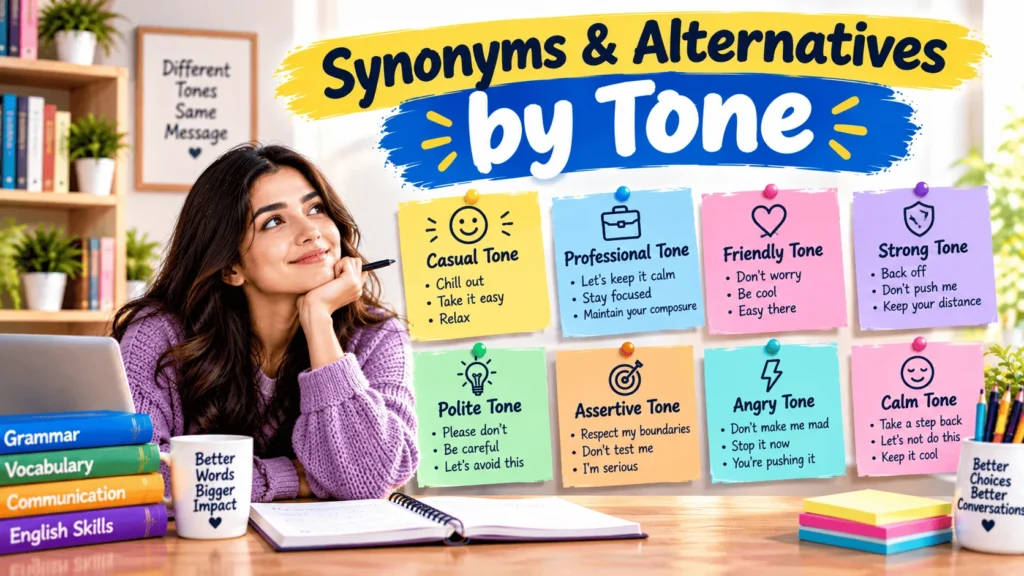
Synonyms & Alternatives by Tone
Professional & Neutral Alternatives
- Good luck
- Best of luck
- Best wishes
- Wishing you success
- I wish you all the best
Polite & Supportive Alternatives
- Best wishes for your performance
- I hope everything goes well
- Wishing you the very best
- I’m wishing you success
- All the best for today
Encouraging & Reassuring Alternatives
- You’ve got this
- You’ll do great
- I know you can do it
- You’re going to do well
- Have confidence in yourself
Casual, Playful & Idiomatic Alternatives
- Knock ’em dead
- Go for it
- Go get ’em
- Give it your best shot
- Show them what you can do
When Should You Use “Break a Leg”?
Professional settings
“Break a leg” can work in professional settings when the workplace culture is relaxed and the situation involves a performance or presentation. For example, a colleague might say it before a conference presentation, public speech, theater performance, or important pitch.
However, it is not automatically the best choice for every professional interaction. A formal email to a senior executive, client, professor, or unfamiliar business contact may sound more polished with “Best of luck,” “Wishing you success,” or “Best wishes for your presentation.”
Casual conversations
This is one of the most natural environments for “break a leg.” Friends, classmates, teammates, and colleagues who know one another well can use it as a friendly expression of encouragement.
For example:
“Your audition is tomorrow, right? Break a leg!”
The speaker is simply wishing the person success.
Writing, presentations, and digital communication
In text messages, group chats, Slack conversations, and social media posts, the phrase can sound warm and conversational.
For example:
“Good luck with your presentation tomorrow—break a leg!”
Because digital communication often lacks facial expressions and vocal tone, adding context can make the intention especially clear.
When it is especially effective
“Break a leg” is especially effective when the audience understands idiomatic English, and the situation has a performance-related or informal atmosphere. It is memorable, concise, and friendly.
If the recipient is an ESL learner who may interpret the expression literally, however, “Good luck” may be clearer.
When Should You Avoid “Break a Leg”?
There are several situations in which another expression is safer or more appropriate.
Overly formal situations
A highly formal business letter, academic recommendation, official announcement, or formal presentation may call for direct language.
Instead of:
“Break a leg with the board meeting.”
consider:
“Wishing you a successful meeting.”
Legal, academic, or sensitive contexts
Legal documents, academic research, official notices, and sensitive communications generally benefit from precise language rather than idioms.
For example, “We wish you success in your examination” is clearer than an informal theatrical expression.
Situations where nuance may be lost
Idioms can confuse people who are still learning English. Someone unfamiliar with the phrase might initially understand “break a leg” literally.
It is also worth avoiding the expression when the audience may not understand its cultural background or when there is a particularly sensitive reason to avoid language involving injury.
Is “Break a Leg” Professional, Polite, or Casual?
“Break a leg” is primarily casual and idiomatic. It is generally polite when used in an appropriate context, but it is not a highly formal expression.
Its tone is usually:
- Friendly
- Encouraging
- Informal
- Playful
- Supportive
- Theatrical
The emotional subtext is positive. The speaker is communicating something like “I hope you succeed” or “I’m rooting for you.”
In a workplace, perception depends heavily on the relationship between the speakers. A manager saying “Break a leg!” to a colleague before a presentation may sound encouraging and relaxed. The same expression in a formal client email may sound unnecessarily casual.
For ESL learners, the most important point is this: do not judge an idiom only by its literal vocabulary. “Break a leg” is not normally a warning or threat. It is a conventional expression of good wishes.
Pros and Cons of Using “Break a Leg”
Advantages
- Clarity within the right cultural context: Theater professionals and experienced English speakers usually recognize the intended meaning immediately.
- Efficiency: Two or three words can communicate encouragement without a long explanation.
- Accessibility: Among familiar English speakers, it is a widely recognized idiom.
- Warmth: It can make a simple good-luck message feel more personal.
- Memorability: Its unusual wording makes it distinctive.
Potential Drawbacks
- Possible confusion: Literal interpretation can be a problem for some ESL learners.
- Tone mismatch: It can sound too casual in formal professional communication.
- Cultural differences: Not every English speaker uses theatrical idioms regularly.
- Overuse: Repeating the same expression can make communication feel automatic.
- Context limitations: It is less suitable when precise, formal wording is required.
Real Life Examples of “Break a Leg” by Context
Emails
“Hi Sara,
I heard your presentation is tomorrow. Break a leg! You’ve put a lot of work into it, and I’m sure you’ll handle the questions well.”
This works in a friendly workplace or academic environment where the sender and recipient already know each other.
Meetings
“Your part of the client presentation starts at ten. Break a leg!”
This is short, natural, and supportive in a relaxed team.
Presentations
“Before you go up there, just remember that you know the material. Break a leg!”
The phrase works particularly well before a presentation because presentations have a performance like quality.
Conversations
“You have your audition tonight? Break a leg!”
This is a classic casual use.
Social media
“Big day tomorrow! Break a leg on your first live performance!”
The expression can add an upbeat, conversational quality to a social media post.
“Break a Leg” vs Similar Expressions (Key Differences)
| Phrase | Meaning Difference | Tone Difference | Best Use Scenario |
| Good luck | Directly wishes someone success | Neutral and versatile | Almost any situation |
| Best of luck | Expresses a strong but straightforward good wish | Polite and friendly | Work, school, competitions |
| You’ve got this | Emphasizes confidence in the person’s ability | Warm and reassuring | Exams, presentations, challenges |
| Knock ’em dead | Wishes someone great success, especially in performance | Playful and highly idiomatic | Theater, comedy, entertainment |
| Best wishes | Offers general positive wishes | Polite and somewhat formal | Messages, cards, professional writing |
| Wishing you success | Explicitly focuses on achieving a successful result | Professional and neutral | Work, applications, formal communication |
“Break a leg” is distinctive because it combines a positive intention with unusual wording. “Good luck” is clearer and more universal, while “You’ve got this” provides more emotional reassurance. “Best wishes” and “Wishing you success” are better choices when formality matters.
Common Mistakes & Misuse of “Break a Leg”
Overuse
Using “break a leg” before every minor task can make the expression lose its impact. It is most natural when someone is facing something meaningful, challenging, or performance-related.
Incorrect context
The phrase is not normally used as a literal instruction. If someone says “break a leg” in ordinary conversation, they generally mean “good luck.”
Contradictory usage
Avoid pairing it with language that makes the meaning genuinely confusing.
For example:
“Break a leg—I hope you fail.”
The second part contradicts the conventional meaning and can make the message sound hostile or sarcastic.
Cultural misunderstandings
An ESL learner may not know that the expression is idiomatic. Similarly, someone unfamiliar with theatrical English may find it strange.
When clarity matters more than style, use “Good luck” instead.
Psychological Reason People Prefer “Break a Leg”
Cognitive load reduction
Idioms allow familiar speakers to communicate a broader social meaning with very few words. Once the expression is learned, the listener does not need to analyze each word literally.
Trust and authority signals
Shared expressions can signal familiarity with a particular social or professional culture. In theater, for example, using established theatrical language can demonstrate participation in the community.
Attention economy
Modern communication rewards short messages. A phrase such as “Break a leg!” is brief, recognizable, and emotionally expressive.
Modern communication habits
Messaging platforms have encouraged shorter, more conversational communication. Expressions that convey encouragement quickly can fit naturally into texts, group chats, and workplace messaging.
However, people do not choose words based only on efficiency. Relationship, audience, cultural familiarity, and emotional intent all influence language choice.
US vs UK Usage of “Break a Leg”
“Break a leg” is recognized in both American and British English, particularly in theatrical contexts.
In the United States, the expression is widely familiar and can be used casually outside theater as well. In the United Kingdom, it is also associated with performance culture and may be heard before theatrical or musical events.
The main difference is not meaning but frequency, context, and individual preference. Some speakers strongly associate the expression with theater, while others use it more generally as a playful way to say good luck.
There is no major difference in its basic meaning between US and UK English.
“Break a Leg” in Digital & Modern Communication
Emails
In a friendly email, “Break a leg!” can provide warmth without requiring a long closing message.
Slack / WhatsApp
The phrase fits short workplace or personal messages:
“Presentation starts in 20 minutes. Break a leg!”
Social media
It works well when publicly supporting someone before a performance, competition, speech, or major event.
AI generated summaries
AI-generated communication often favors direct expressions such as “Good luck” because they are unambiguous. When an AI system is writing for a specific audience, it should consider whether an idiom like “break a leg” matches the desired tone and cultural context.
For professional content, direct alternatives may be preferable when the goal is maximum clarity.
Linguistic & Communication Insight

Emotional weight & subtext
The literal wording of “break a leg” is negative, but its social meaning is positive. Native speakers generally process the expression as a conventional unit rather than interpreting the physical meaning of “break” and “leg.”
Its subtext can communicate:
“I support you.”
“I hope your performance goes well.”
“I’m rooting for you.”
The exact emotional strength depends on the relationship between the speakers.
Direct vs indirect phrasing
“Good luck” is direct. It clearly identifies the speaker’s intention.
“Break a leg” is indirect because the positive meaning is carried through an established idiom. This indirectness can make the message feel more playful and culturally marked.
“You’ve got this” takes another approach. Instead of focusing on luck, it emphasizes the person’s capability.
These distinctions matter because communication is not only about information. It is also about how the speaker positions the relationship with the listener.
Professional communication perspective
In professional communication, experienced writers usually select expressions according to the audience.
A close colleague might appreciate:
“Break a leg!”
A client may respond better to:
“Wishing you a successful presentation.”
A student may find this more motivating:
“You’ve got this!”
There is no single universally “best” alternative. The best wording is the one that matches the relationship, purpose, medium, and expected level of formality.
Pragmatic reasons for alternatives
Professionals may choose alternatives to reduce ambiguity, sound more respectful, or emphasize collaboration.
For example:
- “Good luck” reduces cultural ambiguity.
- “Wishing you success” increases formality.
- “You’ve got this” increases personal reassurance.
- “Best wishes” creates a polite and restrained tone.
- “Knock ’em dead” adds playful energy.
Social signaling
Word choice helps establish social distance. Formal phrases can create professionalism, while informal idioms can create familiarity.
That is why the same intention—wishing someone success—can sound different depending on the wording.
Tone & context guidance
Use “break a leg” when the relationship is comfortable, the setting is relatively informal, and the audience understands idiomatic English.
Choose a more direct alternative when the communication is formal, culturally mixed, sensitive, or important enough that ambiguity would be unhelpful.
Meaning, Usage & Examples for Each Alternative
Good Luck
Meaning: “Good luck” is the clearest and most widely understood alternative to “break a leg.” It directly expresses a wish that someone succeeds or has a positive outcome.
Why This Phrase Works: It is simple, familiar, and appropriate for almost every everyday situation. It does not require the listener to understand an idiom.
Real-World Usage Insight: Native speakers use “good luck” before exams, interviews, performances, competitions, appointments, presentations, and difficult conversations.
Best Use: Everyday conversations, workplace messages, school, interviews, presentations, and general encouragement.
Avoid When: Very formal contexts may benefit from a slightly more polished expression such as “Wishing you success.”
Tone: Neutral, friendly, direct, and universally understandable.
US vs UK Usage: Extremely common in both US and UK English with no meaningful difference in basic meaning.
Example (Email / Message / Meeting):
“Good luck with your interview tomorrow. You’ve prepared well, so go in with confidence.”
Conclusion
The idiom “break a leg” is a popular way to wish someone good luck before a performance, audition, presentation, or important event. Despite its unusual wording, the expression conveys encouragement and positive wishes rather than harm. Originating in theatrical tradition, it has become a familiar phrase in everyday English.
Choosing the right alternative depends on the occasion and your relationship with the person. “Good luck” works in almost any situation, while “best of luck” sounds warm and polished. Professional settings may call for “wishing you success,” whereas “you’ve got this” offers personal encouragement. Understanding these differences helps students, ESL learners, and professionals express support naturally and choose words that suit the context and tone.
FAQs
What does “break a leg” mean?
“Break a leg” means “good luck.” It is an English idiom traditionally associated with theater and performances. People commonly say it before an audition, play, presentation, speech, or other important event. Despite its literal wording, the phrase is normally positive and does not mean that the speaker wants someone to get hurt.
Why do people say “break a leg” instead of “good luck”?
“Break a leg” is traditionally associated with theatrical superstition. One widely discussed explanation is that performers avoided directly saying “good luck” because it was considered unlucky. Over time, the unusual expression became established as a friendly way to wish someone success, especially in performance settings.
Is “break a leg” a professional phrase?
“Break a leg” is generally informal rather than highly professional. It can work among friendly colleagues, particularly before presentations or performances. However, formal business communication is usually clearer with alternatives such as “Best of luck,” “Best wishes,” or “Wishing you success.” The relationship and workplace culture should guide the choice.
Is “break a leg” rude?
No. “Break a leg” is normally not considered rude. It is an encouraging idiom used to wish someone success. However, someone unfamiliar with English idioms could misunderstand the literal wording. In formal or culturally mixed communication, “Good luck” may be a clearer and safer alternative.
Can you say “break a leg” before an exam?
Yes. Although the expression originated in performance-related contexts, people sometimes use “break a leg” more broadly before exams, interviews, competitions, speeches, and other challenging events. For an exam, however, “Good luck on your exam” or “You’ve got this” may sound more natural and immediately understandable.
What is the best synonym for “break a leg”?
The simplest synonym is “good luck.” Other alternatives include “best of luck,” “best wishes,” “wishing you success,” “you’ve got this,” and “you’ll do great.” The best choice depends on the situation. “Good luck” is the most versatile, while “wishing you success” is more suitable for formal professional communication.
Is “break a leg” used in American and British English?
Yes. “Break a leg” is understood in both American and British English. It is particularly associated with theater and entertainment in both varieties. Speakers in either region may also use it more generally before important events. Differences are mainly related to individual preference and context rather than meaning.
What can I say instead of “break a leg” in a professional email?
For a professional email, consider “Best of luck,” “Best wishes,” “Wishing you success,” or “I hope everything goes well.” These expressions communicate support without relying on a theatrical idiom. “Wishing you success” is especially useful when writing to clients, managers, colleagues, professors, or other professional contacts.
Is “you’ve got this” the same as “break a leg”?
The two expressions both communicate encouragement, but their emphasis differs. “Break a leg” wishes someone good luck, while “you’ve got this” expresses confidence in the person’s ability to succeed. “You’ve got this” is especially common in informal modern communication and can sound more personal and reassuring.
What are some casual alternatives to “break a leg”?
Common casual alternatives include “Good luck,” “You’ve got this,” “You’ll do great,” “Go for it,” “Go get ’em,” “Give it your best shot,” and “Knock ’em dead.” The best option depends on the situation. “You’ve got this” is reassuring, while “knock ’em dead” is more playful and performance oriented.