
Imagine a friend teasing you about losing a bet or a coworker challenging your opinion in a group chat. In a playful exchange, you might respond with a cheeky expression to show disagreement, confidence, or defiance. Such phrases can add humor to conversations, but their meaning and tone depend on the situation and the people involved.
Popularized by Bart Simpson in The Simpsons, “eat my shorts” is an informal expression used to dismiss, challenge, or annoy someone in a humorous or rebellious way. Although it may sound funny among friends, it can seem rude or immature in professional settings. Exploring alternatives such as “no way,” “I disagree,” and “not a chance” helps you express your attitude naturally while choosing words that suit your audience and purpose.
What Does “Eat My Shorts” Mean?
“Eat My Shorts” is an informal, irreverent expression used to reject, challenge, or dismiss another person, often in a joking or rebellious way. It does not normally have a literal meaning. The phrase is commonly used in humorous conversations, pop-culture references, teasing, and situations where someone wants to express strong disagreement without using a more explicit insult.
Origin & History of “Eat My Shorts”
The expression is strongly associated with Bart Simpson, but The Simpsons did not create the phrase from nothing. The expression existed before the television series became popular. Historical references show that “eat my shorts” appeared in American usage before The Simpsons, including a documented 1970s example. The phrase was also used in films during the 1980s, including The Breakfast Club.
Its strongest association with modern popular culture came through The Simpsons, which premiered in 1989. Bart Simpson adopted “Eat My Shorts!” as one of his signature rebellious expressions. The phrase was used to communicate defiance, particularly toward authority figures.
The story behind Bart’s version is especially interesting. Voice actor Nancy Cartwright has explained that she remembered chanting “eat my shorts” as a joke while participating in her high-school marching band. She later improvised the expression during an early Simpsons table read, and it became associated with Bart.
This distinction matters: the phrase predates Bart Simpson, but Bart helped make it internationally recognizable as a humorous, rebellious catchphrase. Today, people may use it as an obvious pop-culture reference even when they are not familiar with its earlier history.
Synonyms & Alternatives by Tone
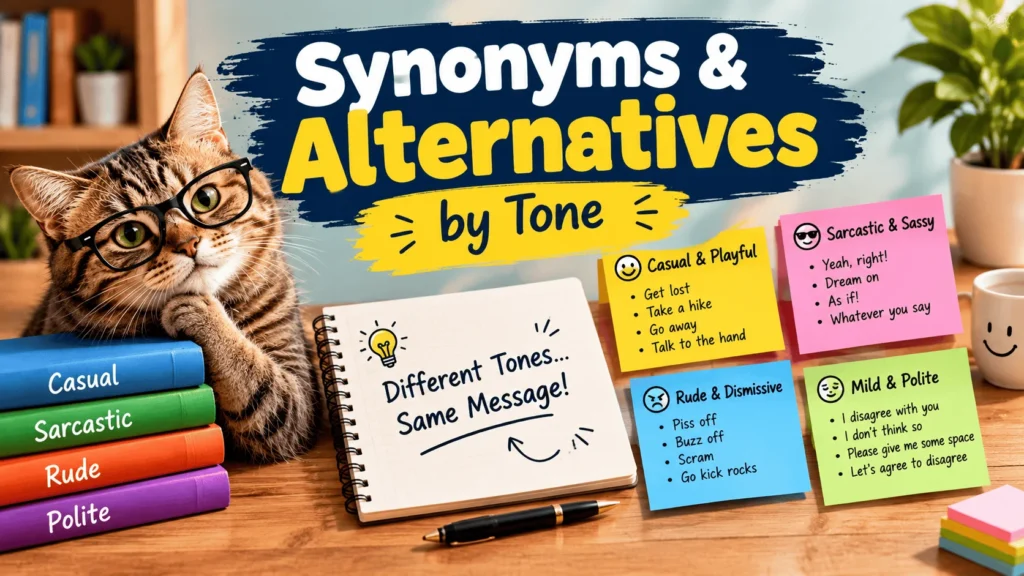
Professional & Neutral Alternatives
- I disagree.
- I don’t agree.
- I can’t agree with that.
- That’s not going to happen.
- I don’t think that’s acceptable.
- I respectfully disagree.
- That’s not an option.
- I don’t support that idea.
Polite & Supportive Alternatives
- I see it differently.
- I’m not convinced.
- I have a different view.
- Let’s consider another option.
- I don’t think that’s the best approach.
- Perhaps we should reconsider.
Encouraging & Reassuring Alternatives
- You don’t have to accept that.
- Stand your ground.
- Trust your judgment.
- Keep your position.
- Don’t let that discourage you.
Casual, Playful & Idiomatic Alternatives
- No way!
- Not a chance!
- Forget it!
- Get real!
- Dream on!
- Yeah, right!
- As if!
- Give me a break!
- Get lost!
- In your dreams!
When Should You Use “Eat My Shorts”?
“Eat My Shorts” is best reserved for informal, humorous, or deliberately rebellious situations.
Professional settings
Generally, avoid it in professional communication. It can sound disrespectful toward a manager, client, teacher, customer, or colleague. If you need to reject an idea, “I disagree” or “I don’t think that’s the best approach” is safer.
Casual conversations
The expression can work between friends who understand the joke. Its humorous effect depends heavily on familiarity and relationship.
Writing, presentations, and digital communication
It can be useful in creative writing, fictional dialogue, humorous posts, entertainment commentary, or discussions of The Simpsons. It is usually inappropriate for formal reports, academic assignments, professional presentations, and official messages.
When it is especially effective
The phrase works best when:
- The relationship is informal.
- The context is clearly humorous.
- The speaker intentionally wants to sound rebellious.
- The audience understands the pop-culture reference.
- No professional respect or authority is at stake.
When Should You Avoid “Eat My Shorts”?
Overly formal situations
Avoid the phrase in job interviews, business proposals, formal emails, academic writing, official complaints, and professional meetings.
Legal, academic, or sensitive contexts
The expression is too informal and potentially disrespectful for legal documents, academic arguments, serious complaints, or sensitive discussions.
Situations where nuance may be lost
An audience unfamiliar with the expression may interpret it simply as an insult. Even people familiar with the phrase may not recognize that you intended it as a joke.
If you need to communicate disagreement clearly, choose a phrase such as “I disagree,” “I don’t think that’s appropriate,” or “Let’s consider another option.”
Is “Eat My Shorts” Professional, Polite, or Casual?
“Eat My Shorts” is casual, irreverent, and potentially rude. It is not normally considered professional language.
Its emotional subtext is usually stronger than the literal wording. A listener may understand it as:
- “I strongly reject what you just said.”
- “I don’t care about your opinion.”
- “I’m challenging you.”
- “I’m being deliberately rebellious.”
- “I’m joking around.”
The exact interpretation depends on delivery and relationship. A friend saying it with a laugh may sound playful. A student saying it seriously to a teacher would likely sound disrespectful.
Its association with Bart Simpson also gives it a childlike, rebellious, pop-culture quality. That can make it funny in the right setting but unsuitable when credibility and professionalism matter.
Pros and Cons of Using “Eat My Shorts”
Advantages
- Clarity: The listener can usually recognize that the speaker is rejecting something.
- Efficiency: It communicates strong disagreement in only a few words.
- Accessibility: The phrase is widely recognizable, particularly among people familiar with American pop culture.
- Humor: In the right context, it can make a disagreement playful.
- Personality: It can deliberately create a rebellious or cheeky voice.
Potential Drawbacks
- Oversimplification: It communicates rejection without explaining the reason.
- Tone mismatch: It can sound rude when a respectful response is expected.
- Repetition: Frequent use can make writing or speech sound childish or predictable.
- Professional risk: It can damage credibility in formal environments.
- Cultural ambiguity: People unfamiliar with the expression may not understand its humorous intention.
Real Life Examples of “Eat My Shorts” by Context
Emails
It is generally better avoided in professional emails. In a humorous email between close friends, however, someone might write:
“You think you’re going to beat me at the quiz again? Eat my shorts ”
Meetings
It would rarely be appropriate in a formal meeting. In a fictional or humorous meeting scene, it could represent a deliberately rebellious character:
“You want me to redo the entire presentation tonight? Eat my shorts.”
Presentations
The phrase can work in a presentation about slang, pop culture, or The Simpsons, but not as a serious response to audience criticism.
Conversations
Among friends, it can be playful:
“You said I couldn’t finish the project before Friday. Eat my shorts I submitted it this morning.”
Social media
It may appear in humorous posts or memes:
“They said I wouldn’t make it through finals week. Eat my shorts. One exam left.”
“Eat My Shorts” vs Similar Expressions (Key Differences)
| Phrase | Meaning Difference | Tone Difference | Best Use Scenario |
| I disagree | Clearly states disagreement without insulting anyone. | Neutral, professional. | Meetings, emails, academic discussion. |
| No way! | Expresses strong disbelief or rejection. | Casual, energetic. | Friends and informal conversations. |
| Not a chance! | Strongly rejects the possibility of something happening. | Casual, confident. | Informal disagreements and challenges. |
| Forget it! | Tells someone to abandon an idea or request. | Direct, sometimes irritated. | Casual conversations. |
| Get real! | Suggests that someone’s idea is unrealistic or unreasonable. | Casual, dismissive. | Informal arguments or teasing. |
| Dream on! | Suggests that someone’s expectation is unrealistic. | Playful, sarcastic. | Friendly teasing and informal exchanges. |
Meaning differences
“Eat My Shorts” is primarily a rebellious dismissal. “I disagree” simply identifies a difference of opinion. “Not a chance!” rejects a possibility, while “Dream on!” suggests that another person’s expectation is unrealistic.
Tone differences
The original phrase is much more irreverent and confrontational than professional alternatives. “I disagree” is controlled and respectful. “No way!” is casual but less insulting. “Get real!” and “Dream on!” add sarcasm.
Best-use scenarios
Choose the alternative based on your goal. If you need professional disagreement, use “I disagree.”They are joking with a friend, “No way!” or “Dream on!” may work. If you want to retain the rebellious flavor of the original, informal expressions are closer.
Common Mistakes & Misuse of “Eat My Shorts”
Overuse
Using the phrase repeatedly can make a speaker sound immature or overly influenced by a cartoon catchphrase. Its humor is strongest when used sparingly.
Incorrect context
The biggest mistake is using it with someone who expects professional respect. A manager, customer, professor, or interviewer is unlikely to interpret it as appropriate workplace language.
Contradictory usage
The phrase communicates rejection or defiance. Pairing it with language that expresses strong agreement can confuse the intended meaning.
Cultural misunderstandings
Because the expression is strongly linked to American pop culture, international English learners may assume it is a normal way to say “I disagree.” It is not. The phrase carries attitude and social meaning, not merely disagreement.
Psychological Reason People Prefer “Eat My Shorts”
People sometimes prefer expressive phrases because they communicate an attitude more efficiently than a full explanation.
Cognitive load reduction
A short phrase such as “No way!” or “Eat My Shorts!” immediately communicates rejection. The listener does not need a long sentence to understand the speaker’s basic reaction.
Trust and authority signals
In informal communication, confident language can signal certainty. However, confidence should not be confused with credibility. In professional situations, respectful disagreement usually communicates competence more effectively than an insult.
Attention economy
Short, memorable expressions work well in modern digital communication. They are easy to type, quote, remember, and reuse.
Modern communication habits
Social media, messaging apps, memes, and entertainment culture have increased the popularity of short expressions that carry a recognizable personality. “Eat My Shorts” fits that pattern particularly well because of its strong association with Bart Simpson.
US vs UK Usage of “Eat My Shorts”
The expression is primarily associated with American English and American popular culture. It is understandable in British English, but its cultural association with The Simpsons is often more important than any regional difference in literal meaning.
In American English, it can sound like a deliberately cheeky or rebellious dismissal. In British English, the same expression may be recognized as an American pop-culture catchphrase rather than an everyday native expression.
There is no major difference in its core meaning. The main distinction is frequency, cultural association, and perceived naturalness.
“Eat My Shorts” in Digital & Modern Communication
Emails
Use it only when the relationship and context clearly support joking. It is not a safe choice for workplace disagreement.
Slack / WhatsApp
In casual group chats, the phrase may work as humorous banter:
“You really think you’re winning this game? Eat my shorts ”
Social media
The expression can function as a humorous caption, meme phrase, or The Simpsons reference.
AI-generated summaries
AI-generated professional content should generally replace the phrase with a neutral alternative when summarizing disagreement. For example, “The speaker strongly rejected the proposal” is more suitable than reproducing an informal insult in a business summary.
Linguistic & Communication Insight
Emotional weight & subtext
Native speakers generally understand that “Eat My Shorts” is not a literal request. The important information is the attitude behind it. It communicates rejection, defiance, and sometimes playful disrespect.
Because the expression is linked with Bart Simpson, it can also signal rebellion against authority. This cultural association gives it more personality than a simple phrase such as “I disagree.”
Direct vs indirect phrasing
The phrase is direct in its rejection but indirect in its actual meaning. It does not explicitly say, “I reject your proposal because…” Instead, it uses an exaggerated insult to signal opposition.
Compare:
“I disagree with your proposal.”
with:
“Eat my shorts!”
The first gives information. The second gives attitude.
Professional communication perspective
Professionals usually need to communicate disagreement while preserving relationships. That is why “I see it differently” or “I have some concerns about this approach” is often more effective than a dismissive expression.
The issue is not simply politeness. Professional language helps preserve collaboration, credibility, and clarity.
Pragmatic reasons for alternatives
Experienced communicators often choose softer alternatives because they want to disagree without turning the disagreement into a personal conflict.
For example:
“I don’t think that’s the best approach.”
Rejects an idea without attacking the person who suggested it.
That distinction is particularly important in workplaces, classrooms, and collaborative projects.
Social signaling
Word choice tells listeners how they should interpret the relationship. “I disagree” signals professional distance. “No way!” signals informal familiarity. “Eat my shorts!” signals rebellious humor or deliberate provocation.
Tone & context guidance
Before using the phrase, ask:
- Do I know this person well?
- Is the situation genuinely humorous?
- Could the listener interpret this as disrespect?
- Is there a power difference between us?
- Would a neutral alternative communicate my meaning better?
If the answer to the last two questions is yes, choose another expression.
Meaning, Usage & Examples for Each Alternative
I Disagree
Meaning: “I disagree” directly states that your opinion differs from another person’s.
Why This Phrase Works: It communicates opposition without adding an insult or unnecessary emotion.
Real-World Usage Insight: This is one of the safest replacements for “Eat My Shorts” when the real goal is simply to express disagreement.
Best Use: Meetings, academic discussions, professional emails, and respectful debates.
Avoid When: You want playful teasing rather than serious disagreement.
Tone: Neutral, professional, controlled.
US vs UK Usage: Completely natural in both US and UK English.
Example (Meeting): “I disagree with that conclusion. The latest customer feedback suggests we should test the idea before moving forward.”
I Don’t Agree
Meaning: “I don’t agree” communicates disagreement in plain, everyday English.
Why This Phrase Works: It is clear without sounding unnecessarily confrontational.
Real-World Usage Insight: It is especially useful for ESL learners because its meaning is direct and uncomplicated.
Best Use: Conversations, meetings, classroom discussions, and messages.
Avoid When: You need to explain a detailed objection and the phrase would be too brief on its own.
Tone: Neutral, straightforward.
US vs UK Usage: Common in both varieties.
Example (Email): “I don’t agree with the proposed timeline because it leaves very little time for testing.”
No Way!
Meaning: “No way!” expresses strong disbelief, refusal, or rejection.
Why This Phrase Works: It preserves some of the energy of “Eat My Shorts” without being as insulting.
Real-World Usage Insight: The meaning depends heavily on context and voice; it can be serious or playful.
Best Use: Friends, informal chats, reactions, and casual conversations.
Avoid When: Speaking to customers, senior colleagues, or people you do not know well.
Tone: Casual, energetic, emphatic.
US vs UK Usage: Very common in both.
Example (Conversation): “You finished the whole assignment in one night? No way!”
Not a Chance!
Meaning: “Not a chance!” means that something is extremely unlikely or that the speaker strongly refuses it.
Why This Phrase Works: It communicates firm rejection without using an insult.
Real-World Usage Insight: It is useful when someone asks whether you will accept or permit something.
Best Use: Informal conversations, friendly challenges, and strong refusals.
Avoid When: A diplomatic response is required.
Tone: Firm, casual, confident.
US vs UK Usage: Natural in both regions.
Example (Meeting): “Not a chance! We can’t launch the update without completing the security checks first.”
Forget It!
Meaning: “Forget it!” tells someone to stop pursuing a request, idea, or subject.
Why This Phrase Works: It is short and immediately communicates rejection.
Real-World Usage Insight: Depending on delivery, it can sound playful, annoyed, or final.
Best Use: Informal conversations and situations where a request has clearly been rejected.
Avoid When: You need to preserve a highly diplomatic tone.
Tone: Direct, casual, sometimes irritated.
US vs UK Usage: Widely understood in both.
Example (Message): “You want me to share the answer before the test? Forget it—I studied for this all week.”
Get Real!
Meaning: “Get real!” tells someone that their idea, expectation, or statement seems unrealistic.
Why This Phrase Works: It communicates skepticism quickly and strongly.
Real-World Usage Insight: It is often more about challenging someone’s assumptions than simply disagreeing.
Best Use: Informal arguments, teasing, and casual conversations.
Avoid When: You are speaking to someone who may take criticism personally.
Tone: Dismissive, casual, sometimes sarcastic.
US vs UK Usage: Understood in both, with a somewhat more American pop-culture feel.
Example (Conversation): “You think we can finish all of that in twenty minutes? Get real!”
Dream On!
Meaning: “Dream on!” sarcastically suggests that someone’s expectation is unrealistic or unlikely to happen.
Why This Phrase Works: It retains the playful, teasing quality found in “Eat My Shorts.”
Real-World Usage Insight: The expression is often used between people who already have a comfortable relationship.
Best Use: Friendly teasing, informal conversations, humorous dialogue.
Avoid When: The person’s goal is serious, and they are looking for genuine encouragement.
Tone: Playful, sarcastic, dismissive.
US vs UK Usage: Familiar in both.
Example (Conversation): “You think you’re going to beat my score after missing three questions? Dream on!”
Conclusion
The expression “eat my shorts” conveys defiance, sarcasm, or playful rejection in informal English. Popularized by Bart Simpson in The Simpsons, it is widely recognized as a humorous yet rebellious response. Depending on the situation, the phrase can sound funny among friends but rude or immature in professional, academic, or formal settings.
Choosing a suitable alternative depends on your intention and audience. “I disagree” expresses respectful disagreement, “that’s not an option” communicates a firm decision, and “dream on” keeps the tone playful. Understanding these differences helps students, ESL learners, professionals, and content writers choose expressions that match their message, maintain appropriate tone, and communicate confidently in different situations.
FAQs
What does “Eat My Shorts” mean?
“Eat My Shorts” is an informal expression used to show rejection, defiance, or disagreement, usually in a humorous or rebellious way. It is not intended literally. The phrase became especially famous through Bart Simpson in The Simpsons. Depending on context and delivery, it can sound playful among friends or rude and disrespectful in formal situations.
Is “Eat My Shorts” a rude phrase?
Yes, “Eat My Shorts” can be considered rude or disrespectful, especially when directed seriously at someone. However, its connection with The Simpsons often gives it a humorous or playful quality. Among close friends, it may be harmless teasing, but using it with a teacher, manager, customer, or professional contact can create a negative impression.
Is “Eat My Shorts” professional?
No. “Eat My Shorts” is generally not considered professional language. It is an informal, rebellious expression and can sound childish or confrontational in workplace communication. If you need to disagree professionally, alternatives such as “I disagree,” “I see it differently,” or “I don’t think that’s the best approach” are much safer and clearer.
Who made “Eat My Shorts” famous?
Bart Simpson from The Simpsons made “Eat My Shorts” widely recognizable. Bart frequently used the expression as a rebellious catchphrase. However, the phrase existed in American usage before The Simpsons premiered in 1989. The television series played a major role in connecting the expression with humorous teenage-style rebellion and American popular culture.
What are the best alternatives to “Eat My Shorts”?
Useful alternatives include “I disagree,” “I don’t agree,” “No way,” “Not a chance,” “Get real,” “Dream on,” “I see it differently,” “I’m not convinced,” and “That’s not an option.” The best choice depends on your intended tone. Professional settings call for neutral language, while casual conversations allow more playful or sarcastic expressions.
Can “Eat My Shorts” be used jokingly?
Yes. “Eat My Shorts” can be used jokingly, particularly between friends or in humorous writing. The speaker and listener need to share enough familiarity for the playful intention to be clear. Because the phrase can also sound disrespectful, it should be avoided when the relationship, situation, or power difference makes a joke risky.
What is a professional way to say “Eat My Shorts”?
A professional alternative depends on the intended meaning. For disagreement, say “I disagree” or “I see it differently.” For rejecting a proposal, “That’s not an option” may work. If you want to express concern without sounding confrontational, try “I don’t think that’s the best approach.” These phrases preserve clarity while maintaining professionalism.
Is “Eat My Shorts” American English?
“Eat My Shorts” is strongly associated with American English and American popular culture, particularly because of The Simpsons. British English speakers generally understand the phrase, but it is not as strongly associated with everyday British speech. Its meaning remains essentially the same across both varieties, while its cultural associations may differ.
What is the difference between “Eat My Shorts” and “I disagree”?
“Eat My Shorts” expresses defiance or dismissive rejection, often with humor or sarcasm. “I disagree” simply states that two people have different opinions. The latter is neutral and professional, while the former is informal and potentially rude. Therefore, “I disagree” is usually better for workplace, academic, and respectful discussions.
Is “Eat My Shorts” still commonly used today?
“Eat My Shorts” remains recognizable, especially among people familiar with The Simpsons, but it is more strongly associated with pop culture, humor, and nostalgic references than with formal everyday communication. People may use it jokingly online, in memes, or among friends. In professional contexts, clearer and more respectful alternatives are generally preferred.