
Imagine a colleague has just received disappointing news, a student is struggling with a difficult semester, or a friend is going through a stressful period. You want to offer reassurance, but simply saying “everything will be fine” can sound vague or dismissive. This is where “This Too Shall Pass” can be useful.
The phrase communicates a simple idea: a difficult, stressful, or unpleasant situation is temporary and will eventually change. It is widely understood in everyday English and is often used to provide perspective without making promises about exactly how or when circumstances will improve.
However, the phrase is not suitable for every situation. In a workplace email, for example, a more direct expression may sound professional and practical. In a conversation with someone who needs emotional support, a gentler alternative may feel more considerate. Choosing the right synonym depends on audience, relationship, context, and tone.
What Does “This Too Shall Pass” Mean?
“This Too Shall Pass” means that a current difficult, unpleasant, or stressful situation is temporary and will eventually come to an end or change. The phrase is commonly used to reassure someone during hardship, uncertainty, disappointment, or emotional difficulty. “This Too Shall Pass” focuses on the temporary nature of present circumstances rather than predicting a specific outcome.
Origin & History of “This Too Shall Pass”
The exact origin of “This Too Shall Pass” is difficult to establish because similar ideas appear in several older literary and religious traditions. The wording is commonly associated with the Persian expression “in ham migzarad,” meaning approximately “this too will pass.” The idea also resembles teachings found in medieval Persian literature and later became familiar in English-speaking culture.
A popular story connects the phrase with King Solomon, who supposedly wanted a ring bearing words that could make a happy person sad and a sad person happy. Another version says the inscription reminded the wearer that changing circumstances should not be treated as permanent. However, this story is better understood as a traditional tale than as a securely documented historical origin.
The phrase is also frequently attributed to Abraham Lincoln, but historians have found no reliable evidence that Lincoln originated the expression. Its popularity in English grew through literary, religious, philosophical, and cultural references rather than from a single confirmed speaker.
Over time, “This Too Shall Pass” developed into a widely recognized expression of perspective and reassurance. Today, it appears in conversations, personal writing, motivational content, workplace communication, social media, and popular culture.
Synonyms & Alternatives by Tone
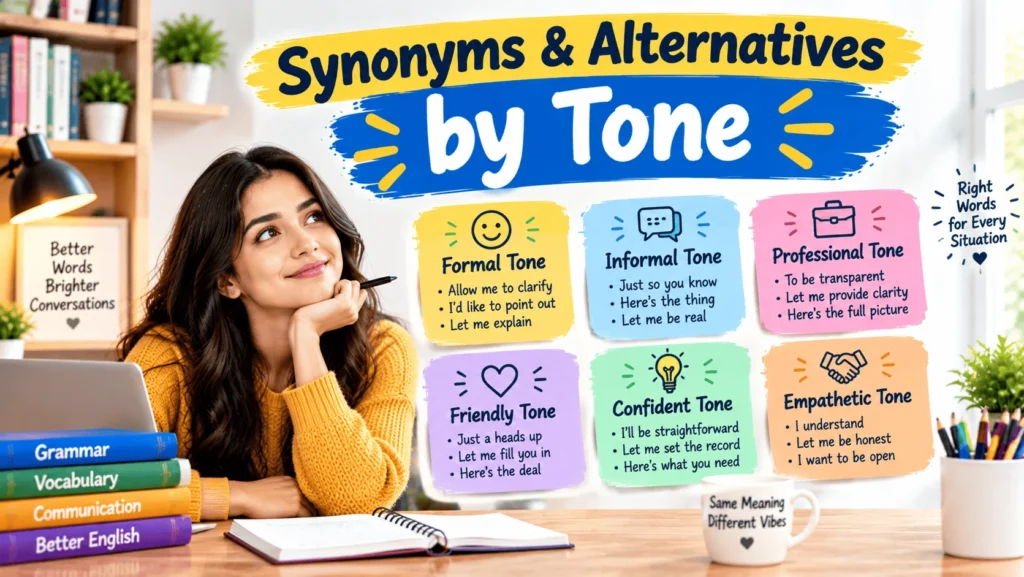
Professional & Neutral Alternatives
- This is temporary.
- This situation will change.
- Things will improve.
- The situation should improve.
- We will get through this period.
- This will eventually come to an end.
Polite & Supportive Alternatives
- You will get through this.
- Things will get better.
- Give yourself time.
- Take things one day at a time.
- You do not have to handle everything at once.
Encouraging & Reassuring Alternatives
- Better days are ahead.
- It will not last forever.
- You can get through this.
- Brighter days are ahead.
- Keep going.
- Things will improve with time.
Casual, Playful & Idiomatic Alternatives
- This is just a phase.
- It won’t last forever.
- Hang in there.
- Keep your chin up.
- Things will turn around.
- It’s a rough patch, not the whole road.
When Should You Use “This Too Shall Pass”?
“This Too Shall Pass” works best when you want to acknowledge that a difficult experience is temporary without becoming overly detailed.
Professional settings
In professional communication, the phrase can work in informal relationships, particularly when colleagues already know each other well. However, a direct alternative such as “This situation is temporary” may be better in formal emails or sensitive workplace discussions.
Casual conversations
The phrase is natural in conversations between friends, classmates, relatives, and acquaintances. It can provide reassurance when someone is dealing with a temporary problem.
Writing, presentations, and digital communication
It can work well in reflective writing, motivational content, presentations about resilience, personal blogs, and social media posts. Its familiar wording makes the message easy to understand.
When it is especially effective
The phrase is particularly effective when:
- Someone needs perspective rather than a detailed solution.
- The problem is likely to change with time.
- You want to acknowledge difficulty without exaggerating it.
- You want a short, memorable expression.
- The audience already understands idiomatic English.
When Should You Avoid “This Too Shall Pass”?
There are situations where the phrase can sound too general or emotionally distant.
Overly formal situations
A formal report, business proposal, academic paper, or official announcement usually benefits from precise language rather than an idiom.
Instead of saying “This too shall pass,” consider explaining exactly what is expected to change.
Legal, academic, or sensitive contexts
Legal and academic writing generally requires specific, evidence-based language. Similarly, sensitive personal situations may require acknowledgment rather than a quick reassurance that circumstances will pass.
Situations where nuance may be lost
The phrase can unintentionally minimize someone’s experience if the person needs practical support, active listening, or acknowledgment of a serious problem.
For example, saying “This too shall pass” immediately after someone describes a major difficulty may sound as though you are trying to end the conversation rather than understand it.
Is “This Too Shall Pass” Professional, Polite, or Casual?
“This Too Shall Pass” is generally neutral-to-casual and reassuring rather than strongly professional. It is familiar, polite, and widely understood, but its idiomatic style makes it less suitable for highly formal communication.
Its emotional subtext is important. The phrase communicates perspective, patience, and reassurance. Depending on context, it can also imply that the speaker believes the current difficulty does not need an immediate solution.
In a friendly conversation, that can be comforting. In a workplace setting, however, it may sound too philosophical if the listener is expecting concrete action.
A professional communicator might therefore choose:
- “This is a temporary situation.”
- “We should see improvement over time.”
- “Let’s focus on the steps we can take now.”
These alternatives retain the idea of temporary difficulty while adding clarity or practicality.
Pros and Cons of Using “This Too Shall Pass”
Advantages
- Clarity: Most English speakers understand the basic message immediately.
- Efficiency: Four simple words communicate a complete idea.
- Accessibility: It is familiar to many audiences, including ESL learners.
- Reassurance: It can provide perspective during temporary difficulties.
- Memorability: Its rhythmic structure makes it easy to remember.
Potential Drawbacks
- Oversimplification: Not every difficult situation resolves simply with time.
- Tone mismatch: It may sound insensitive when someone needs active support.
- Repetition: Frequent use can make the expression feel predictable or clichéd.
- Lack of specificity: It does not explain what will change or what action should be taken.
- Context limitations: It is less effective in formal, technical, legal, or academic writing.
Real-Life Examples of “This Too Shall Pass” by Context
Emails
“I know the current workload has been frustrating. Let’s work through the immediate priorities first. This too shall pass, and we’ll have a more manageable schedule once the deadline is behind us.”
Meetings
“The next few weeks will be demanding, but this too shall pass. Let’s concentrate on getting the launch completed one stage at a time.”
Presentations
“Periods of uncertainty are part of professional growth. The important thing is to keep perspective and remember that this too shall pass.”
Conversations
“I know you’re having a rough week. Take it one day at a time. This too shall pass.”
Social media
“Some seasons are harder than others. Keep moving forward and remember: this too shall pass.”
“This Too Shall Pass” vs Similar Expressions (Key Differences)
| Phrase | Meaning Difference | Tone Difference | Best Use Scenario |
| This will pass | Directly states that the current situation will end or change. | Neutral and straightforward. | Everyday reassurance and simple professional communication. |
| Things will get better | Suggests improvement rather than merely the end of a situation. | Warm and optimistic. | Supporting a friend, colleague, or student. |
| It won’t last forever | Emphasizes that the difficulty is not permanent. | Reassuring and conversational. | Personal conversations and supportive messages. |
| You will get through this | Focuses on the person’s ability to cope or continue. | Personal and encouraging. | Emotional support and difficult moments. |
| Better days are ahead | Suggests that future circumstances will be more positive. | Hopeful and motivational. | Speeches, social posts, and encouragement. |
| Take it one day at a time | Encourages focusing on the present rather than the entire problem. | Gentle and supportive. | Stressful situations and personal conversations. |
Meaning differences
The key difference is what each expression emphasizes. “This Too Shall Pass” emphasizes temporary circumstances. “Things will get better” emphasizes improvement. “You will get through this” emphasizes personal resilience, while “Take it one day at a time” focuses on managing the present.
Tone differences
Some alternatives are more personal, while others are more neutral. “This will pass” sounds factual. “You will get through this” sounds emotionally supportive. “Better days are ahead” has a more optimistic and motivational quality.
Best-use scenarios
Choose the expression according to your purpose. If you want perspective, use “This Too Shall Pass.” If you want to express confidence in someone’s ability to cope, “You will get through this” is usually stronger.Its want a practical communication style, “This will pass” may be preferable.
Common Mistakes & Misuse of “This Too Shall Pass”
Overuse
An expression becomes less meaningful when it appears in every difficult situation. Repeated use can make your communication sound automatic rather than thoughtful.
Incorrect context
Avoid using it when the person needs specific action, information, or accountability. Reassurance does not replace practical help.
Contradictory usage
The phrase suggests that circumstances are temporary. Using it to describe a permanent condition or an established long-term reality can create confusion.
Cultural misunderstandings
Although the expression is widely recognized in English, not every audience will interpret its emotional meaning in the same way. ESL learners should pay attention to context and relationship before using it.
Psychological Reason People Prefer “This Too Shall Pass”
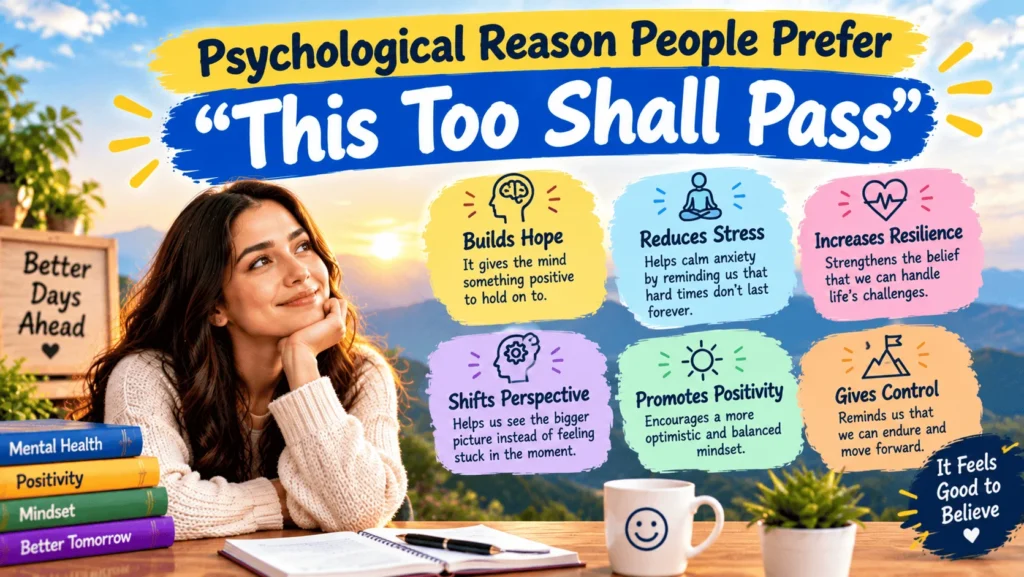
People often prefer concise expressions such as “This Too Shall Pass” because they reduce the amount of language needed to communicate a familiar idea.
Cognitive load reduction
A short, familiar phrase allows readers or listeners to understand the basic message quickly. This can be especially useful during stressful conversations when lengthy explanations are difficult to process.
Trust and authority signals
Traditional expressions can sound established and familiar. Their long-standing presence in language can give a message a sense of stability, although that does not necessarily make the statement factually certain.
Attention economy
Modern communication often rewards brevity. A short phrase can communicate an emotional position without requiring a long explanation.
Modern communication habits
Text messages, workplace chats, captions, and short-form content have encouraged people to communicate complex feelings through compact expressions. “This Too Shall Pass” fits naturally into that environment.
US vs UK Usage of “This Too Shall Pass”
The expression is understood in both American and British English. There is no major difference in its basic meaning.
In the United States, it frequently appears in motivational, personal-development, conversational, and social-media contexts. In the UK, it is also familiar, although speakers may choose more understated alternatives depending on the situation.
The larger difference is usually context rather than geography. In both varieties of English, the phrase can sound reflective, reassuring, or slightly proverbial. Formal professional communication in either region may favor a more direct alternative.
“This Too Shall Pass” in Digital & Modern Communication
Emails
The phrase can add warmth to an informal professional email, but it should not replace practical information.
Slack / WhatsApp
Its short length makes it suitable for quick supportive messages:
“It’s been a hectic week, but this too shall pass!”
Social media
The phrase works particularly well in reflective captions, motivational posts, and discussions about temporary challenges.
AI-generated summaries
AI-generated writing frequently favors familiar reassuring expressions because they communicate sentiment efficiently. Human editors should still check whether the phrase genuinely fits the situation rather than using it as a generic emotional conclusion.
Linguistic & Communication Insight
Emotional weight & subtext
The literal meaning is simple, but native speakers often hear an additional message: “Do not treat the present situation as permanent.” That can be comforting, but it can also sound dismissive if the listener wants their problem recognized in greater depth.
Direct vs indirect phrasing
“This too shall pass” is indirect because it does not identify exactly what will happen. It provides perspective rather than a concrete prediction.
Compare it with:
“The deadline will be over next Friday.”
That sentence provides specific information. By contrast:
“This too shall pass.”
provides emotional perspective.
The first communicates certainty about an event; the second communicates perspective about change.
Professional communication perspective
In professional environments, word choice can affect whether reassurance sounds supportive or dismissive. A manager saying, “This is a challenging period, but we have a clear plan to get through it,” combines acknowledgment with action.
That may be more effective than simply saying, “This too shall pass.”
Pragmatic reasons for alternatives
Experienced communicators often select alternatives because they want to reduce defensiveness, show collaboration, or balance reassurance with authority.
For example:
“Let’s take this one step at a time.”
signals collaboration.
By comparison:
“This too shall pass.”
signals perspective but does not necessarily communicate involvement.
Social signaling
Language tells people not only what we think, but also how we relate to them. A personal phrase can signal empathy. A neutral phrase can signal professionalism. A practical phrase can signal readiness to act.
Tone & context guidance
Use “This Too Shall Pass” when perspective is useful, and the audience is likely to appreciate a familiar expression. Choose another alternative when the situation requires specificity, accountability, empathy, or concrete action.
Meaning, Usage & Examples for Each Alternative
This Will Pass
Meaning: This will pass means the current situation, problem, or difficult period will eventually end or change. It is a more direct version of “This Too Shall Pass.”
Why This Phrase Works: It is short, clear, and easy for both native and non-native English speakers to understand.
Real-World Usage Insight: This expression works particularly well when you want reassurance without sounding overly philosophical.
Best Use: Everyday conversations, informal workplace communication, supportive messages, and short written responses.
Avoid When: A situation requires a precise explanation or a guaranteed outcome.
Tone: Neutral, calm, and reassuring.
US vs UK Usage: Common and easily understood in both US and UK English.
Example (Meeting): “The software migration has created a few problems, but this will pass once the new system is fully settled.”
Things Will Get Better
Meaning: “Things will get better” expresses the expectation that circumstances will improve rather than simply end.
Why This Phrase Works: It communicates optimism in plain English and focuses on improvement.
Real-World Usage Insight: It feels warmer and more hopeful than a purely factual statement.
Best Use: Conversations with friends, classmates, coworkers, and people facing temporary difficulties.
Avoid When: You cannot reasonably suggest that improvement is likely.
Tone: Warm, optimistic, supportive.
US vs UK Usage: Natural in both varieties of English.
Example (Email): “I know the first few weeks in the new role have been overwhelming, but things will get better as you become more familiar with the process.”
This Is Temporary
Meaning: “This is temporary” states directly that the current condition is not expected to continue permanently.
Why This Phrase Works: It removes the idiomatic element and gives the message a factual, professional quality.
Real-World Usage Insight: It is especially useful when communicating with people who prefer clear, literal language.
Best Use: Workplace communication, reports, formal discussions, and practical reassurance.
Avoid When: The permanence of a situation is genuinely unknown.
Tone: Neutral, professional, measured.
US vs UK Usage: Widely used in both US and UK English.
Example (Meeting): “The revised schedule is demanding, but this is temporary while we complete the transition.”
It Won’t Last Forever
Meaning: This expression emphasizes that a difficult situation has a limit and will not continue indefinitely.
Why This Phrase Works: It directly addresses the fear that an unpleasant situation might continue permanently.
Real-World Usage Insight: It sounds natural when someone needs emotional reassurance rather than technical information.
Best Use: Personal conversations, supportive messages, and informal communication.
Avoid When: The statement could be interpreted as a promise about a situation you cannot predict.
Tone: Reassuring, conversational, empathetic.
US vs UK Usage: Familiar in both regions.
Example (Conversation): “The exam period feels endless right now, but it won’t last forever. You’ll have your normal routine back soon.”
You Will Get Through This
Meaning: “You will get through this” expresses confidence that someone can cope with or overcome a difficult situation.
Why This Phrase Works: Unlike “This Too Shall Pass,” it focuses on the person’s ability rather than only on changing circumstances.
Real-World Usage Insight: It feels more personal because it directly addresses the listener.
Best Use: Encouraging friends, students, coworkers, or relatives during difficult periods.
Avoid When: Someone has asked for practical advice and reassurance alone would be insufficient.
Tone: Personal, encouraging, supportive.
US vs UK Usage: Natural and common in both American and British English.
Example (Message): “You’ve handled difficult deadlines before. You will get through this one too.”.”
Conclusion
Temporary challenges and difficult moments are a natural part of life, but they rarely last forever. The expression “this too shall pass” offers a gentle reminder that hardships are temporary and better days may lie ahead.Its central message is simple: present circumstances can change, and difficult experiences do not necessarily last forever. The phrase works particularly well in casual conversations, supportive messages, reflective writing, presentations, and social media. However, context matters.
In formal workplace, academic, legal, or sensitive situations, a clearer alternative such as “This is temporary,” “Things will improve,” or “We will get through this” may communicate the intended message more effectively. Choosing the right expression also depends on whether you want to provide reassurance, encourage action, acknowledge someone’s feelings, or simply offer perspective. Understanding the differences between similar phrases helps students, professionals, ESL learners, and content writers communicate more naturally.
FAQs
What does “This Too Shall Pass” mean?
“This Too Shall Pass” means that a difficult, stressful, or unpleasant situation is temporary and will eventually change or come to an end. It is commonly used to reassure someone during challenging circumstances. The expression focuses on the temporary nature of the present situation rather than promising a specific result or exact timeframe.
Is “This Too Shall Pass” a synonym for “everything will be fine”?
Not exactly. “This Too Shall Pass” means that the current situation will eventually change or end, while “everything will be fine” suggests that the outcome will be positive. The first expression offers perspective without guaranteeing a particular result, making it more cautious and broadly applicable.
Is “This Too Shall Pass” professional?
“This Too Shall Pass” is generally neutral to casual rather than strongly professional. It can work in informal workplace conversations, especially among familiar colleagues, but formal emails and reports usually benefit from clearer wording. Alternatives such as “This is temporary” or “Things will improve” often sound more appropriate in professional communication.
What are the best synonyms for “This Too Shall Pass”?
Useful alternatives include “This will pass,” “This is temporary,” “Things will get better,” “It won’t last forever,” “You will get through this,” “Things will improve,” and “Take it one day at a time.” The best choice depends on whether you want to sound professional, supportive, encouraging, practical, or conversational.
Is “This Too Shall Pass” formal or informal?
“This Too Shall Pass” is best described as neutral to informal. It is widely recognized and can appear in both spoken and written English, but its proverbial style makes it less suitable for highly formal documents. In academic, legal, or official writing, a direct explanation is generally clearer and more precise.
When should you use “This Too Shall Pass”?
Use “This Too Shall Pass” when someone is experiencing a temporary difficulty and would benefit from reassurance or perspective. It is suitable for casual conversations, supportive messages, reflective writing, presentations, and social media. Before using it, consider whether the listener needs emotional acknowledgment or practical help instead of a general statement.
What is a professional alternative to “This Too Shall Pass”?
“This is temporary” is one of the clearest professional alternatives. Other options include “Things will improve,” “The situation should improve,” and “We will get through this period.” These expressions retain the idea of temporary difficulty while sounding more direct and appropriate for workplace emails, meetings, reports, and professional discussions.
Can “This Too Shall Pass” sound insensitive?
Yes. Although the phrase is usually intended to reassure, it can sound dismissive when someone is discussing a serious or deeply personal problem. Saying it without first acknowledging the person’s experience may suggest that their concern is being minimized. A more empathetic approach is to recognize the difficulty before offering reassurance.
What is the difference between “This Too Shall Pass” and “You Will Get Through This”?
“This Too Shall Pass” focuses on the temporary nature of the situation, while “You Will Get Through This” focuses on the person’s ability to cope with it. The first provides perspective; the second offers personal encouragement. Therefore, “You Will Get Through This” often feels warmer and more directly supportive.
What is the difference between “This Too Shall Pass” and “Things Will Get Better”?
“This Too Shall Pass” suggests that the current difficult situation will eventually change or end. “Things Will Get Better” goes further by suggesting improvement in future circumstances. The first is more neutral and focused on change, while the second is more optimistic. Both are common and natural expressions in everyday English.