
Imagine someone repeatedly warns a team that they will take action, but when the moment comes, nothing actually happens. A friend may make bold threats but never follow through, or a manager may make strong promises without taking meaningful action. In situations like these, the idiom “all bark, no bite” is often used to describe the gap between what someone says and what they actually does.
“All bark, no bite” means that a person appears threatening, forceful, or intimidating but is unlikely to take real action. The phrase is useful because it communicates this idea quickly and vividly. However, its informal and slightly critical tone may not suit every situation.
Choosing an appropriate alternative can make your communication more professional, respectful, or precise. This guide explains the meaning, origin, synonyms, tone, examples, and practical uses of “all bark, no bite,” helping professionals, students, ESL learners, and content writers choose the right expression for each context.
What Does “All Bark, No Bite” Mean?
“All bark, no bite” describes a person who makes strong statements, threats, or warnings but does not usually take the action they suggest. The phrase is commonly used for people who appear intimidating or aggressive but lack follow-through. It can describe workplace behavior, personal disagreements, negotiations, arguments, or situations where promises and actions do not match.
Origin & History of “All Bark, No Bite”
The idiom “all bark, no bite” comes from the familiar behavior of dogs. A dog may bark loudly to appear threatening, while the absence of a bite suggests that the noise is not followed by physical action. English speakers gradually applied this contrast to people whose words sound threatening but whose actions are limited.
The expression belongs to a broader group of animal-based idioms in English that use familiar behavior to describe human characteristics. Its meaning became increasingly figurative, referring not to actual animals but to people who make threats, demands, or strong claims without following through.
The phrase has remained popular because the contrast between “bark” and “bite” is immediately understandable. In modern English, it is mainly informal and conversational. It may describe a person, policy, warning, negotiation tactic, or organization that appears powerful but does not demonstrate equivalent action.
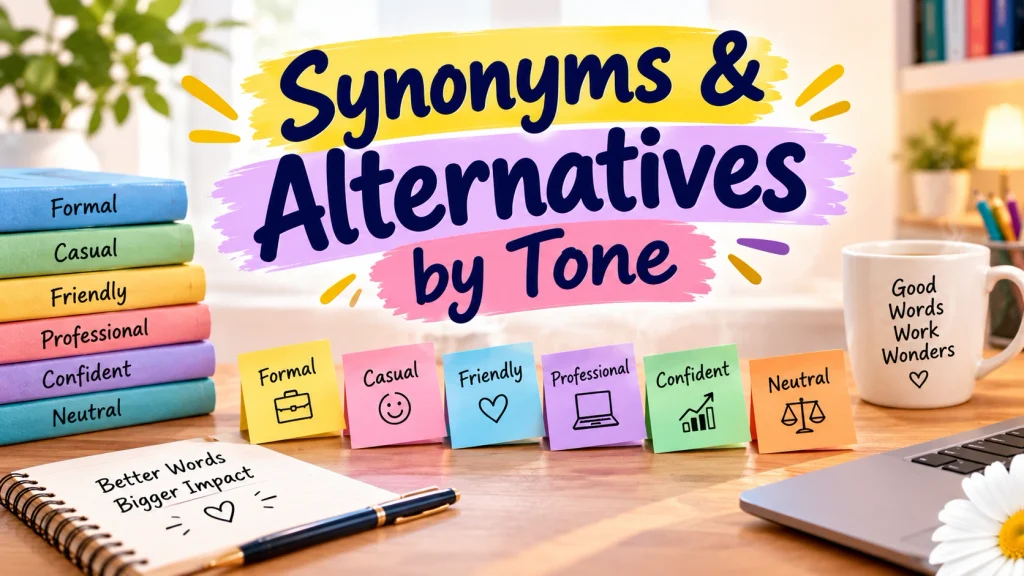
Synonyms & Alternatives by Tone
Professional & Neutral Alternatives
- Lacks follow-through
- Makes empty threats
- Fails to act on promises
- More talk than action
- Does not follow through
- Makes strong claims without action
- Has limited follow-through
Polite & Supportive Alternatives
- May be stronger in words than in actions
- Has not followed through yet
- Has made commitments without acting on them
- The actions have not matched the statements
- There is a gap between words and actions
Encouraging & Reassuring Alternatives
- Needs to turn plans into action
- Could benefit from stronger follow-through
- Has room to improve execution
- Needs more consistent action
- Could match its commitments with results
Casual, Playful & Idiomatic Alternatives
- All talk, no action
- Talks a big game
- Full of hot air
- Big talk
- Empty threats
- More noise than action
- All show, no substance
- Talks tough
- Blows off steam without acting
When Should You Use “All Bark, No Bite”?
“All bark, no bite” is most effective when you want to describe a noticeable difference between someone’s threatening language and their actual behavior.
Professional Settings
The idiom can appear in informal workplace conversations, especially when discussing negotiations, leadership behavior, or repeated warnings. It is generally better to use a neutral alternative in formal reports or official feedback.
Casual Conversations
This is one of the phrase’s strongest settings. Friends and family members may use it to describe someone who talks aggressively but rarely follows through.
Writing, Presentations, and Digital Communication
The expression works well in blogs, opinion writing, social media, informal presentations, and conversational content. Its vivid imagery makes writing more engaging.
When It Is Especially Effective
Use it when:
- Someone repeatedly makes threats without acting.
- A person talks confidently but does not deliver.
- Warnings are not supported by behavior.
- You want a concise, memorable description.
- The audience understands informal idiomatic English.
When Should You Avoid “All Bark, No Bite”?
Avoid the idiom when precision and neutrality are more important than colorful language.
In legal, academic, medical, or official settings, it may sound subjective or judgmental. Instead of saying that a person is “all bark, no bite,” describe the observable behavior.
For example:
“The organization has repeatedly announced enforcement measures but has not implemented them.”
This is more precise than:
“The organization is all bark, no bite.”
The idiom can also be inappropriate when the person may have legitimate reasons for not acting. A lack of action does not automatically mean that someone is pretending, weak, or dishonest.
Is “All Bark, No Bite” Professional, Polite, or Casual?
“All bark, no bite” is primarily informal and conversational. It is generally understandable and not inherently offensive, but it can sound critical because it questions someone’s credibility, courage, or ability to follow through.
In professional communication, the phrase may be acceptable among colleagues who have an informal relationship. However, formal feedback should focus on behavior rather than character.
For example, “There has been limited follow-through on the announced changes” sounds more professional than “He is all bark, no bite.”
The phrase can also carry a slightly humorous quality, which makes it effective in casual conversations but less suitable for serious official documents.
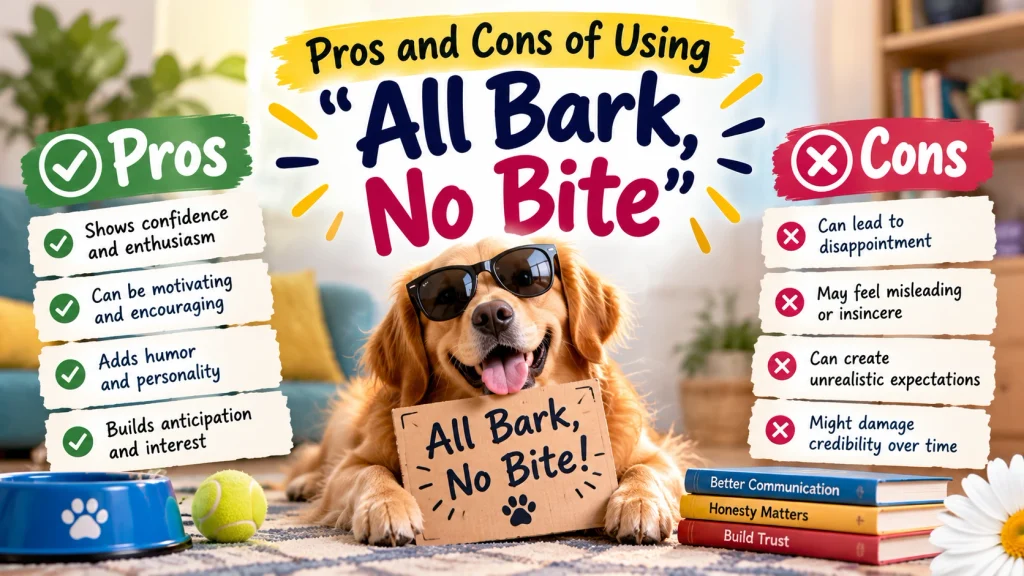
Pros and Cons of Using “All Bark, No Bite”
Advantages
- Clarity: It quickly communicates a gap between words and actions.
- Efficiency: The idiom expresses a complex behavior in only four words.
- Accessibility: The underlying image is easy for many English speakers to understand.
- Memorability: Its contrast makes it vivid and easy to remember.
Potential Drawbacks
- Oversimplification: It may ignore legitimate reasons for someone’s lack of action.
- Tone mismatch: It can sound judgmental in formal situations.
- Repetition: Frequent use can make writing feel predictable.
- Subjectivity: It describes an interpretation rather than objectively proving why someone did not act.
Real-Life Examples of “All Bark, No Bite” by Context
Emails
“We have heard several warnings about changing the supplier, but nothing has happened yet. At this point, it feels like all bark, no bite.”
Meetings
“The committee has threatened to change the policy several times, but they haven’t taken any steps. Some members think it’s all bark, no bite.”
Presentations
“The company has announced strict consequences for repeated violations, but critics argue that the policy is all bark, no bite because enforcement has been limited.”
Conversations
“Don’t worry about him. He sounds angry, but he’s all bark, no bite.”
Social Media
“Another big announcement, another deadline with no follow-through. At this point, it’s starting to look like all bark, no bite.”
“All Bark, No Bite” vs Similar Expressions (Key Differences)
| Phrase | Meaning Difference | Tone Difference | Best Use Scenario |
| All talk, no action | Someone talks about doing things but does not act | Direct, neutral-casual | Everyday criticism |
| Empty threats | Warnings or threats are not intended or expected to be carried out | More serious and negative | Warnings and disputes |
| Talks a big game | Someone talks confidently about abilities or plans | Casual, sometimes playful | Sports, work, personal conversations |
| More talk than action | Words significantly outweigh actual results | Neutral and professional | Workplace discussions |
| Lacks follow-through | Someone does not complete promised actions | Professional and objective | Performance feedback |
| Full of hot air | Someone makes a lot of meaningless or exaggerated claims | Informal, dismissive | Casual conversations |
Meaning Differences
“All bark, no bite” specifically emphasizes intimidating language without meaningful action. “All talk, no action” is broader and can describe ordinary promises or plans that are never completed.
“Empty threats” focuses specifically on warnings. “Lacks follow-through” is more neutral and describes behavior without implying that the person is intentionally pretending.
“Talks a big game” often focuses on confidence or claims about ability, while “full of hot air” suggests that someone’s statements are exaggerated or lacking substance.
Tone Differences
The original idiom is informal, vivid, and mildly mocking. Professional alternatives such as “lacks follow-through” remove most of the emotional judgment.
Best-Use Scenarios
Use the expression according to the behavior you are describing. If the issue is threats, use “empty threats.” If it is missed commitments, “lacks follow-through” is more precise. If someone simply talks confidently about their abilities, “talks a big game” may fit better.
Common Mistakes & Misuse of “All Bark, No Bite”
Overuse
Using the idiom repeatedly can weaken its impact. In professional writing, repeated idiomatic language may also make the tone sound overly conversational.
Incorrect Context
Do not use it simply because someone has not acted yet. A delay does not necessarily mean that the person never intends to act.
Contradictory Usage
The phrase describes a pattern in which words are not matched by action. If someone makes a warning and then immediately follows through, calling them “all bark, no bite” would be contradictory.
Cultural Misunderstandings
ESL learners may initially interpret the phrase literally. Because idioms are culturally shaped, it is useful to understand that “bark” and “bite” are symbolic here rather than references to actual animals.
Psychological Reason People Prefer “All Bark, No Bite”
Cognitive Load Reduction
The phrase summarizes a complicated behavioral pattern in a short expression. Instead of explaining that someone repeatedly makes strong statements without following through, speakers can use four familiar words.
Trust and Authority Signals
People often evaluate credibility by comparing what someone says with what they do. The idiom captures this relationship between claims and behavior.
Attention Economy
Short, vivid language attracts attention. The contrast between “bark” and “bite” makes the phrase particularly memorable in conversations, headlines, blogs, and social media.
Modern Communication Habits
Digital communication favors concise expressions. Idioms such as “all bark, no bite” allow people to express criticism quickly without providing a lengthy explanation.
US vs UK Usage of “All Bark, No Bite”
“All bark, no bite” is understood in both American and British English. The basic meaning remains the same: someone appears threatening or forceful but does not follow through with action.
In both varieties, it is generally considered informal. American speakers may use it frequently in casual workplace conversations, sports discussions, politics, entertainment, and everyday speech. British speakers also use it naturally, although alternatives such as “all talk and no action” or “more talk than action” may sometimes be preferred depending on context.
There is no major difference in grammar or meaning between US and UK usage.
“All Bark, No Bite” in Digital & Modern Communication
Emails
The idiom can work in informal emails between colleagues, but formal correspondence usually benefits from objective wording such as “limited follow-through.”
Slack / WhatsApp
Short digital messages are a natural environment for the expression. For example:
“Three warnings and no changes yet. All bark, no bite?”
Social Media
The phrase is especially effective on social platforms because it is short, memorable, and easy to understand. However, when discussing real people or organizations, avoid presenting an opinion as a fact.
AI-Generated Summaries
When reviewing an AI-generated summary, the idiom can describe a situation where a document contains many promises but little evidence of implementation. For professional analysis, however, measurable language is usually better.
Linguistic & Communication Insight
Emotional Weight & Subtext
Native speakers usually hear “all bark, no bite” as more than an action statement. It can imply that the person is intimidating, boastful, unreliable, or less powerful than they appear. Because of this subtext, the phrase can carry a mildly mocking or dismissive quality.
Direct vs Indirect Phrasing
The idiom is indirect in form because it does not literally say, “This person makes threats without acting.” Yet its figurative meaning can be quite direct.
Compare:
“He is all bark, no bite.”
with:
“He has made several commitments but has not followed through.”
The first is vivid and conversational. The second is more neutral and evidence-focused.
Professional Communication Perspective
At work, experienced communicators often distinguish between describing behavior and judging character. “All bark, no bite” can sound like a judgment of the person. “There has been limited follow-through” focuses on what can actually be observed.
Pragmatic Reasons for Alternatives
Professionals may choose alternatives to avoid defensiveness. Saying “The actions have not matched the statements” leaves room for explanation and problem-solving, whereas calling someone “all bark, no bite” can make them feel personally attacked.
Social Signaling
Idioms signal familiarity and informality. Using this expression can make a conversation sound relaxed and conversational, but it can also signal skepticism toward someone’s credibility.
Tone & Context Guidance
The phrase is strongest when used informally to describe a clear pattern of empty warnings or promises. It becomes risky when used as a formal judgment about someone’s character without enough evidence.
Meaning, Usage & Examples for Each Alternative
Lacks Follow-Through
Meaning: This means that someone does not consistently complete or act on what they have promised, planned, or started.
Why This Phrase Works: It describes observable behavior without attacking someone’s personality.
Real-World Usage Insight: This is one of the best professional alternatives because it sounds objective and measured.
Best Use: Performance discussions, workplace communication, project reviews, and professional writing.
Avoid When: You specifically need to describe threats rather than incomplete commitments.
Tone: Professional, neutral, constructive.
US vs UK Usage: Natural in both US and UK English.
Example (Email): “We’ve agreed on these changes several times, but there has been limited follow-through. Could we assign owners and deadlines so the next steps are clear?”
All Talk, No Action
Meaning: This describes someone who talks extensively about plans or intentions but does not take meaningful action.
Why This Phrase Works: It is a simple and widely understood alternative to the original idiom.
Real-World Usage Insight: It works well when the problem involves promises or plans rather than direct threats.
Best Use: Casual conversations, commentary, and informal workplace discussions.
Avoid When: Writing formal evaluations or sensitive professional feedback.
Tone: Direct, informal, mildly critical.
US vs UK Usage: Common in both varieties.
Example (Meeting): “We’ve discussed improving the onboarding process for months. I don’t want this to become all talk, no action, so let’s agree on two changes we can implement this week.”
More Talk Than Action
Meaning: This means that someone produces more discussion, promises, or claims than actual results.
Why This Phrase Works: It communicates the gap between communication and performance without using a strong personal judgment.
Real-World Usage Insight: This expression can fit professional conversations better than many informal idioms.
Best Use: Meetings, workplace discussions, articles, and presentations.
Avoid When: You need to make a very specific factual statement about a missed commitment.
Tone: Neutral, analytical, moderately critical.
US vs UK Usage: Widely understood in both.
Example (Presentation): “The strategy has received considerable attention, but so far there has been more talk than action. The next phase needs measurable deadlines.”
Empty Threats
Meaning: This refers to threats or warnings that are not expected to result in actual consequences.
Why This Phrase Works: It directly addresses the threatening aspect of the original idiom.
Real-World Usage Insight: The phrase is stronger than “lacks follow-through” because it suggests a deliberate warning that has little practical force.
Best Use: Disputes, negotiations, warnings, and commentary.
Avoid When: You cannot reasonably establish that a threat is empty.
Tone: Serious, direct, critical.
US vs UK Usage: Common in both US and UK English.
Example (Conversation): “I wouldn’t worry about those messages. He’s made the same threats before, and they turned out to be empty threats.”
Talks a Big Game
Meaning: This means someone talks confidently or impressively about their abilities, plans, or expected success.
Why This Phrase Works: It captures confident claims without necessarily saying the person has made an actual threat.
Real-World Usage Insight: The expression is particularly common in sports, competition, and informal discussions about performance.
Best Use: Casual conversations, sports, social situations, and informal work discussions.
Avoid When: Giving formal feedback or discussing sensitive performance issues.
Tone: Casual, playful, sometimes skeptical.
US vs UK Usage: Common in both, with especially strong familiarity in American English.
Example (Meeting): “He talks a big game about improving sales, but we haven’t seen a plan yet. I’d like to see what he proposes before we make any changes.”
Full of Hot Air
Meaning: This describes someone who talks a lot without providing useful, truthful, or meaningful information.
Why This Phrase Works: It strongly communicates skepticism about the substance of someone’s words.
Real-World Usage Insight: It is more dismissive than “all bark, no bite” and should therefore be used carefully.
Best Use: Informal conversations, opinion writing, and casual commentary.
Avoid When: Speaking to clients, giving workplace feedback, or writing formal documents.
Tone: Informal, dismissive, critical.
US vs UK Usage: Familiar in both varieties.
Example (Social Media): “The announcement sounded impressive, but without a timeline or budget, it feels like a lot of hot air.”
The Actions Don’t Match the Words
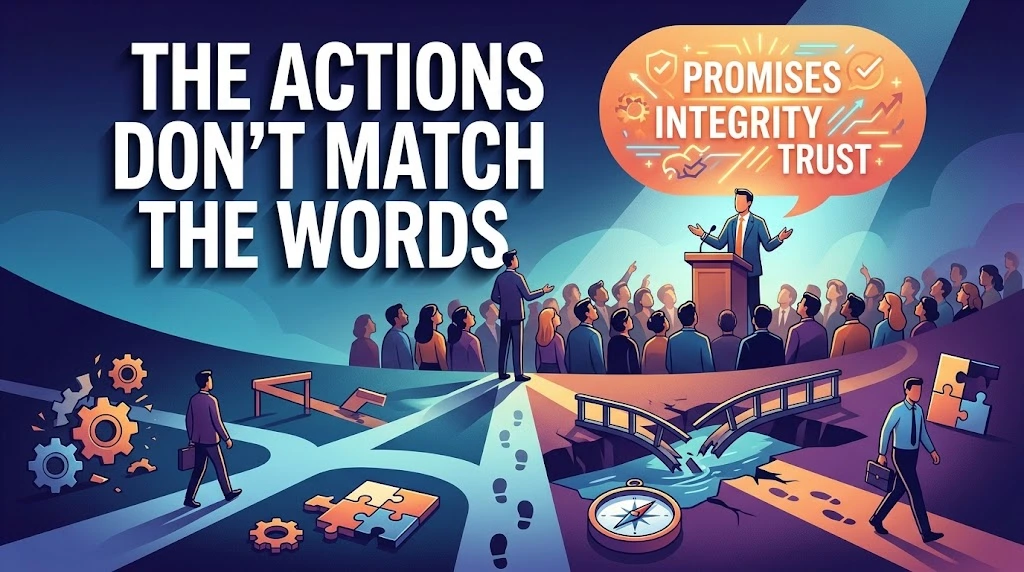
Meaning: This means that someone’s behavior does not support or correspond with what they have said.
Why This Phrase Works: It identifies the central problem without relying on an idiom.
Real-World Usage Insight: This is useful when you want to be clear while avoiding an unnecessarily harsh judgment.
Best Use: Workplace conversations, articles, presentations, and professional feedback.
Avoid When: You need a very short casual expression.
Tone: Neutral, clear, professional.
US vs UK Usage: Natural in both.
Example (Email): “I appreciate the commitment outlined in the proposal, but the actions so far don’t match the words.
Conclusion
Understanding “all bark, no bite” helps you describe the difference between strong words and limited action in a concise, memorable way. The idiom is especially useful in casual conversations, opinion writing, social media, and informal workplace discussions where a vivid expression can make an observation more engaging. However, it can sound judgmental or dismissive when used in formal or sensitive situations. In professional communication, alternatives such as “lacks follow-through,” “more talk than action,” and “the actions don’t match the words” provide greater neutrality and precision. Choosing the right expression depends on whether you are describing empty threats, unfulfilled promises, exaggerated claims, or inconsistent behavior. For students, professionals, ESL learners, and writers, understanding these differences makes communication more accurate and audience-aware. Ultimately, effective language is not only about expressing an idea clearly; it is also about selecting wording that matches the context, relationship, purpose, and level of formality.
FAQs
What does “all bark, no bite” mean?
“All bark, no bite” describes someone who sounds threatening, aggressive, or confident but does not follow through with meaningful action. The phrase is commonly used when a person repeatedly makes warnings, promises, or strong statements without acting on them. It is an informal idiom and can describe behavior in personal, workplace, or public situations.
What is another way to say “all bark, no bite”?
Common alternatives include “all talk, no action,” “more talk than action,” “lacks follow-through,” “empty threats,” and “the actions don’t match the words.” The best synonym depends on the situation. For professional communication, “lacks follow-through” is usually more neutral, while “all talk, no action” works naturally in casual conversations.
Is “all bark, no bite” a negative phrase?
Yes, “all bark, no bite” usually has a negative or critical meaning. It suggests that someone’s words sound stronger than their actual behavior. However, it can sometimes be used humorously among friends or colleagues. Because it questions someone’s credibility or effectiveness, it should be used carefully in sensitive professional situations.
Is “all bark, no bite” professional?
“All bark, no bite” is mainly informal rather than highly professional. It can appear in casual workplace conversations, but formal reports, performance reviews, and official communication usually benefit from more objective wording. Alternatives such as “limited follow-through,” “more talk than action,” or “the actions have not matched the commitments” sound more professional.
What is a polite alternative to “all bark, no bite”?
A polite alternative is “There seems to be a gap between the commitments and the actions.” Other options include “There has been limited follow-through” and “The actions have not yet matched the stated plans.” These expressions focus on observable behavior rather than criticizing someone’s personality or intentions.
What is the difference between “all bark, no bite” and “all talk, no action”?
Both expressions describe a gap between words and behavior, but “all bark, no bite” emphasizes threats, intimidation, or aggressive language. “All talk, no action” is broader and can describe anyone who discusses plans or promises without acting. Therefore, the second expression applies to a wider range of situations.
Can “all bark, no bite” describe a person?
Yes. The phrase commonly describes a person who makes strong warnings, boasts, or threats but rarely follows through. For example, someone might repeatedly threaten to leave a project but never actually do so. However, it is better to describe specific behavior in formal settings rather than label someone’s character.
What is a formal synonym for “all bark, no bite”?
Formal alternatives include “lacks follow-through,” “fails to act on stated commitments,” “limited implementation,” and “the actions do not correspond with the stated intentions.” These expressions are suitable for professional reports, workplace feedback, presentations, and analytical writing because they focus on behavior rather than using an informal idiom.
Is “all bark, no bite” used in American and British English?
Yes, “all bark, no bite” is understood in both American and British English. Its meaning is essentially the same in both varieties: someone appears threatening or forceful but does not act accordingly. It remains an informal expression, although the preferred wording can vary according to individual and workplace communication styles.
When should you avoid saying “all bark, no bite”?
Avoid it when writing legal, academic, medical, or highly formal documents, or when discussing sensitive personal matters. The phrase can sound subjective and judgmental. In these situations, use precise descriptions such as “has not followed through on the stated commitments” or “the announced actions have not been implemented.”