
Imagine a colleague explains your idea incorrectly during a meeting, or a friend makes an assumption that misses the point completely. You might naturally respond, “That is not it at all.” The phrase is useful when you want to make it clear that someone’s interpretation, explanation, or assumption is completely different from what you actually mean.
In modern communication, choosing the right alternative matters because the same message can sound helpful, professional, defensive, or dismissive depending on the wording. “That is not it at all” is direct and understandable, but alternatives such as “That’s not quite what I mean,” “That’s not the case,” or “That’s not what I intended” can communicate the correction more gently.
This guide explores the meaning, synonyms, tone, usage, regional differences, common mistakes, and practical examples of “that is not it at all.” It is designed for students, professionals, ESL learners, writers, and anyone who wants to communicate corrections naturally and clearly.
What Does “That Is Not It At All” Mean?
“That is not it at all” means that a statement, explanation, interpretation, assumption, or suggestion is completely incorrect or fails to represent the intended meaning. The phrase is commonly used when correcting a misunderstanding, rejecting an inaccurate interpretation, clarifying an idea, or explaining that someone has misunderstood what was said or intended.
Origin & History of “That Is Not It At All”

The expression “that is not it at all” comes from ordinary English patterns used to identify whether something is correct, relevant, or accurate. The word “it” can refer to an idea, answer, explanation, situation, or intended point, while “at all” strengthens the negative statement.
The construction developed naturally from English expressions such as “that is it” or “that’s it,” which can mean that something is correct, complete, or has reached the intended point. Adding “not” reverses the meaning, while “at all” emphasizes the complete absence of agreement.
Over time, similar constructions became common in everyday spoken English. Today, “that is not it at all” is widely understandable in both American and British English. Its exact force depends on context. In friendly conversation, it can simply correct a misunderstanding, while in a workplace discussion it may sound somewhat blunt if the listener feels personally corrected.
Synonyms & Alternatives by Tone
Professional & Neutral Alternatives
- That’s not quite what I mean.
- That’s not the case.
- That’s not what I intended.
- That’s not accurate.
- That’s not what I was referring to.
- That’s not the point.
- That interpretation isn’t correct.
- That’s different from what I meant.
Polite & Supportive Alternatives
- That’s not quite what I meant.
- I think there may be a misunderstanding.
- Let me clarify what I mean.
- I may not have explained that clearly.
- That’s slightly different from what I intended.
- Let me put it another way.
Encouraging & Reassuring Alternatives
- You’re close, but that’s not quite what I mean.
- I see where you’re coming from, but that’s not the idea.
- I understand your point, but I meant something different.
- We’re looking at it from slightly different angles.
- That’s a reasonable interpretation, but it isn’t what I intended.
Casual, Playful & Idiomatic Alternatives
- Nope, that’s not it.
- That’s not quite it.
- Not exactly.
- That’s not what I meant.
- You’ve got the wrong idea.
- That’s not the point.
- That’s way off.
- That’s not how I see it.
When Should You Use “That Is Not It At All”?
“That is not it at all” works best when you need to correct a misunderstanding clearly and quickly.
Professional Settings
You can use it when a colleague has misunderstood an idea and a direct correction is appropriate. However, a softer alternative may be better when discussing sensitive feedback or correcting someone senior to you.
Casual Conversations
The phrase is natural when talking with friends, classmates, or family members. It can communicate strong disagreement without necessarily being rude.
Writing, Presentations, and Digital Communication
In writing, the phrase can work when the context is conversational. For formal reports, academic writing, or professional documents, alternatives such as “This is not accurate” or “This does not reflect the intended meaning” may be more appropriate.
When It Is Especially Effective
Use it when:
- Someone has completely misunderstood your point.
- You need to reject an incorrect interpretation.
- A quick clarification is more useful than a long explanation.
- The relationship allows direct communication.
- You want your disagreement to be unmistakable.
When Should You Avoid “That Is Not It At All”?
Avoid the phrase when a softer correction would produce better cooperation.
In formal academic, legal, medical, or highly sensitive communication, saying that something is “not it at all” can sound too absolute. If the issue involves interpretation or incomplete information, a more precise statement is usually safer.
For example, instead of:
“That is not it at all.”
you could write:
“That interpretation does not fully reflect the available information.”
The phrase can also be risky when someone has made a reasonable mistake. If their interpretation is understandable, saying they are completely wrong may make them defensive.
Is “That Is Not It At All” Professional, Polite, or Casual?
“That is not it at all” is generally neutral-to-casual, but it is quite direct. It is not inherently rude, yet the listener may perceive it as dismissive when the speaker uses a sharp tone.
Its emotional effect depends heavily on delivery. In conversation, a warm voice can make it sound like a simple correction. A firm or irritated delivery can make it sound like rejection.
In professional settings, “That’s not quite what I mean” is often safer because it corrects the misunderstanding without directly labeling the other person’s interpretation as completely wrong.
The phrase is most suitable when clarity is more important than softness, and the relationship supports direct communication.
Pros and Cons of Using “That Is Not It At All”
Advantages
- Clarity: It immediately signals that the interpretation is incorrect.
- Efficiency: It corrects a misunderstanding without requiring a long explanation.
- Accessibility: The wording is simple and easy for ESL learners to understand.
- Strong correction: It is useful when the difference between the intended meaning and the interpretation is substantial.
Potential Drawbacks
- Oversimplification: It can make a nuanced disagreement sound completely binary.
- Tone mismatch: It may sound blunt in formal or sensitive situations.
- Repetition: Frequent use can make communication feel dismissive.
- Reduced collaboration: Someone who feels sharply corrected may become defensive.
Real-Life Examples of “That Is Not It At All” by Context
Emails
“Thanks for raising that. Just to clarify, that is not it at all—the proposal is about reducing processing time, not reducing the team’s responsibilities.”
Meetings
“That is not it at all. We’re not suggesting that the project should be canceled. We’re suggesting that we change the timeline.”
Presentations
“Some people assume the research is focused on cost reduction, but that is not it at all. The main goal is improving reliability.”
Conversations
“You think I’m upset with you? That is not it at all. I’m just tired after a long day.”
Social Media
“People are assuming the update means the service is shutting down, but that’s not it at all. The company is simply changing how the feature works.”
“That Is Not It At All” vs Similar Expressions (Key Differences)
| Phrase | Meaning Difference | Tone Difference | Best Use Scenario |
| That’s not quite what I mean | Signals that the interpretation is close but not correct | Softer and collaborative | Workplace discussions and explanations |
| That’s not the case | Says that a particular claim or situation is untrue | Neutral and factual | Professional writing and corrections |
| That’s not what I intended | Focuses on the speaker’s original intention | Polite and accountable | Misunderstandings involving communication |
| That’s not the point | Says the listener has focused on the wrong issue | Direct and moderately firm | Meetings, debates, and explanations |
| That’s not accurate | Directly challenges the factual correctness of something | Professional and objective | Reports, presentations, and workplace communication |
| Let me clarify what I mean | Moves attention from disagreement to explanation | Cooperative and diplomatic | Teaching, meetings, and sensitive discussions |
Meaning Differences
“That’s not quite what I mean” suggests the listener may be near the intended idea. “That’s not the case” challenges a factual claim. “That’s not what I intended” focuses on the speaker’s purpose rather than the listener’s error.
“That’s not the point” redirects attention toward the central issue, while “that’s not accurate” emphasizes factual correctness.
Tone Differences
The original phrase is relatively strong because “at all” emphasizes complete disagreement. Softer alternatives reduce the risk of sounding dismissive. Professional expressions such as “that’s not accurate” can sound more objective because they focus on information rather than the person.
Best-Use Scenarios
Choose the expression according to what you need to correct: meaning, facts, intention, focus, or interpretation. This small distinction can make professional communication substantially clearer.
Common Mistakes & Misuse of “That Is Not It At All”
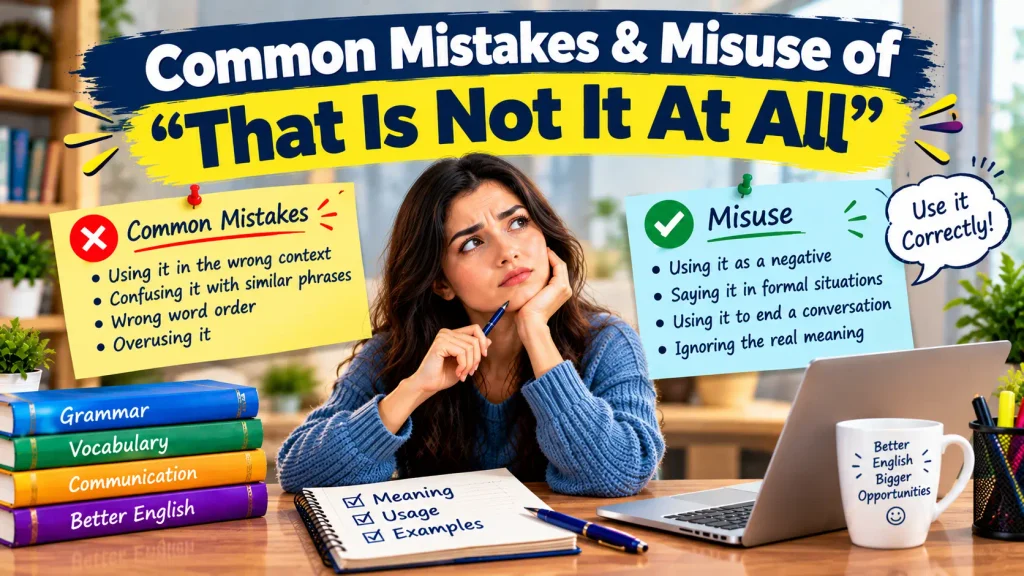
Overuse
Repeating the phrase every time someone misunderstands you can make your communication sound impatient. Varying your wording keeps conversations more constructive.
Incorrect Context
The phrase is not ideal when you only disagree partially. If someone is mostly correct but has missed one detail, “That’s not quite what I mean” is more accurate.
Contradictory Usage
Avoid using the phrase and then immediately agreeing with the same interpretation. For example, saying “That’s not it at all, but yes, that’s basically what I mean” creates confusion.
Cultural Misunderstandings
ESL speakers may interpret the phrase more harshly because the negative construction sounds absolute. Likewise, speakers from communication cultures that favor indirect disagreement may prefer a softer alternative.
Psychological Reason People Prefer “That Is Not It At All”
Cognitive Load Reduction
Short phrases make corrections easy to process. Rather than explaining immediately why an interpretation is wrong, the speaker can first establish that clarification is needed.
Trust and Authority Signals
Direct language can communicate confidence. When used appropriately, it signals that the speaker understands the subject and knows what they intended to communicate.
Attention Economy
Modern communication often rewards concise wording. In emails, chats, meetings, and social media, people frequently need to correct an idea in only a few words.
Modern Communication Habits
Digital communication has encouraged shorter, faster responses. Expressions such as “not quite,” “not exactly,” and “that’s not the point” are common because they allow people to redirect a conversation quickly.
US vs UK Usage of “That Is Not It At All”
The phrase is understandable and usable in both American English and British English. There is no major difference in its basic meaning.
American speakers may use direct constructions comfortably in informal workplace or everyday conversations, while British speakers may sometimes prefer softer forms such as “That’s not quite what I mean” or “That’s not really what I was getting at.”
These are broad tendencies rather than strict rules. Individual personality, workplace culture, age, and context have a greater effect on tone than nationality alone.
“That Is Not It At All” in Digital & Modern Communication
Emails
Email communication benefits from precision. If the misunderstanding is significant, the phrase can work, but a professional alternative often sounds more collaborative.
Slack / WhatsApp
Short forms such as “That’s not quite it” or “Not exactly” are especially natural in instant messaging because they fit the quick rhythm of digital conversation.
Social Media
The phrase can be useful when correcting a misconception publicly. However, public disagreement should be worded carefully because short written statements can appear harsher than intended.
AI-Generated Summaries
When reviewing an AI-generated summary, someone might say:
“That’s not it at all—the summary focuses on the background but misses the main recommendation.”
This is useful when the summary substantially misrepresents the source, although a more specific correction is usually better for professional editing.
Linguistic & Communication Insight
Emotional Weight & Subtext
The literal meaning is simple, but “at all” adds emphasis. Native speakers generally understand it as stronger than “that’s not quite right.” Depending on delivery, it can communicate certainty, frustration, surprise, or firm correction.
Direct vs Indirect Phrasing
The original expression is direct because it immediately rejects the interpretation. Softer alternatives create space for collaboration.
Compare:
“That is not it at all.”
with:
“I think we may be looking at this differently.”
The first prioritizes clarity and correction. The second prioritizes relationship management and cooperation.
Professional Communication Perspective
In the workplace, the best wording depends on the purpose of the correction. If a serious factual misunderstanding needs immediate attention, direct language can be useful. If the goal is coaching, teamwork, or feedback, softer phrasing usually creates a more productive exchange.
Pragmatic Reasons for Alternatives
Experienced communicators often avoid unnecessarily absolute language. They may choose “That’s not quite what I mean” because it leaves room for discussion rather than suggesting the other person has completely failed.
Social Signaling
Word choice communicates more than information. A direct correction can signal confidence and authority, while a collaborative correction can signal respect and openness.
Tone & Context Guidance
Use “that is not it at all” when the distinction is genuinely substantial. Choose a softer alternative when the listener has made a reasonable interpretation, when emotions are involved, or when maintaining cooperation is especially important.
Meaning, Usage & Examples for Each Alternative

That’s Not Quite What I Mean
Meaning: This phrase means that another person’s interpretation is close to the intended idea but does not fully capture it.
Why This Phrase Works: It corrects the misunderstanding without suggesting that the other person’s thinking is completely unreasonable.
Real-World Usage Insight: This is one of the safest choices for professional conversations because it leaves room for clarification.
Best Use: Meetings, emails, teamwork, teaching, and feedback.
Avoid When: You need to state clearly that a factual claim is completely false.
Tone: Polite, collaborative, professional.
US vs UK Usage: Common and natural in both varieties of English.
Example (Meeting): “That’s not quite what I mean. I’m suggesting that we test the new process with one team first before rolling it out company-wide.”
That’s Not the Case
Meaning: This means that a particular statement, assumption, or description is not true.
Why This Phrase Works: It focuses on the situation or claim rather than the person who made the statement.
Real-World Usage Insight: It is particularly effective when correcting factual misunderstandings.
Best Use: Professional emails, reports, meetings, and formal explanations.
Avoid When: You are correcting someone’s personal intention rather than a factual claim.
Tone: Neutral, factual, professional.
US vs UK Usage: Widely used in both US and UK English.
Example (Email): “The current figures may look unusual, but that’s not the case. The difference comes from the way the new reporting period has been calculated.”
Conclusion
“That Is Not It At All” is a useful phrase for expressing disagreement, correcting a misunderstanding, or explaining that something is completely different from what someone thinks. It can be used in everyday conversations when you want to make your meaning clear and show that an assumption or interpretation is incorrect.
Understanding phrases like “That Is Not It At All” can make your communication more natural, expressive, and confident. Whether you use it in casual conversations, writing, or humorous situations, it helps you clearly explain your point and avoid confusion. We hope this article gave you a simple and helpful understanding of the phrase and how it can be used.
FAQs
What is another way to say “that is not it at all”?
Common alternatives include “That’s not quite what I mean,” “That’s not the case,” “That’s not what I intended,” “That’s not accurate,” and “I think there may be a misunderstanding.” The best choice depends on whether you are correcting an interpretation, fact, intention, or point of discussion.
Is “that is not it at all” rude?
It is not automatically rude, but it can sound blunt or dismissive because “at all” strongly emphasizes the disagreement. In professional or sensitive situations, “That’s not quite what I mean” is usually softer and more collaborative while still correcting the misunderstanding.
Is “that is not it at all” professional?
The phrase can be used professionally in conversation, particularly when a significant misunderstanding needs immediate correction. However, it is relatively direct. In formal emails, reports, or sensitive workplace discussions, phrases such as “That’s not accurate” or “That’s not what I intended” may sound more polished.
What is a polite way to say “that is not it at all”?
A polite alternative is “That’s not quite what I mean.” Other options include “Let me clarify what I mean,” “I think there may be a misunderstanding,” and “That’s slightly different from what I intended.” These expressions correct the issue without making the listener feel directly criticized.
What is the difference between “that’s not it” and “that’s not it at all”?
“That’s not it” is a straightforward rejection, while “that’s not it at all” is stronger because “at all” emphasizes that the interpretation is completely wrong or unrelated. The second expression therefore carries greater emphasis and may sound more forceful.
Can I use “that is not it at all” in an email?
Yes, but consider the relationship and purpose of the email. For casual or familiar communication, it can work naturally. In professional emails, “That’s not quite what I mean” or “That’s not what I intended” may be preferable because they reduce the risk of sounding abrupt.
What is a formal synonym for “that is not it at all”?
Formal alternatives include “That is not accurate,” “That is not the case,” “That does not reflect the intended meaning,” and “That interpretation is incorrect.” These expressions are useful in reports, professional correspondence, presentations, and other situations where precise language matters.
What is a casual synonym for “that is not it at all”?
Casual alternatives include “Not exactly,” “That’s not quite it,” “Nope, that’s not it,” “You’ve got the wrong idea,” and “That’s way off.” The last two are stronger and should be used with people and situations where direct informal language is appropriate.
Is “that’s not quite what I mean” better than “that is not it at all”?
Neither phrase is universally better. “That’s not quite what I mean” is usually more diplomatic because it suggests the interpretation may be partly correct. “That is not it at all” is better when you need to emphasize that the interpretation is substantially or completely different from your intended meaning.
Do Americans and British speakers use “that is not it at all” differently?
Both American and British speakers understand and use the expression. The main difference is often stylistic rather than grammatical. British workplace communication may sometimes favor softer expressions such as “That’s not quite what I mean,” while American speakers may use direct corrections more freely, although individual and workplace preferences vary.