
Imagine your team is having an unusually smooth day, a job interview seems to have gone perfectly, or your exam results look promising. Someone says, “Everything is finally going our way,” and another person quickly replies, “Don’t jinx it.” This familiar expression is often used when people want to stay hopeful without becoming too confident about an uncertain outcome.
It is a casual English phrase connected with the idea of tempting fate or accidentally bringing bad luck to something that is currently going well. Although the expression has roots in superstition, modern speakers frequently use it humorously rather than literally.
Knowing alternatives to “don’t jinx it” is useful because the phrase is informal and can sound playful or superstitious. In professional emails, academic writing, presentations, or sensitive conversations, a more neutral expression may communicate the same basic idea with greater precision. The best choice depends on whether you want to sound cautious, supportive, professional, humorous, or optimistic.
What Does “Don’t Jinx It” Mean?
Its means not to say or do something that is believed to bring bad luck to a situation that is currently going well or has not been decided yet. It is commonly used when discussing expected success, good news, competitions, plans, interviews, exams, relationships, or other uncertain outcomes.
In everyday English, the expression usually communicates cautious optimism. The speaker may genuinely expect something positive to happen but does not want another person to speak too confidently before the result is certain.
For example:
“I think we’re going to finish the project ahead of schedule.”
A friend might respond:
“Don’t jinx it “we still have two days to go.”
The speaker is not necessarily claiming that words have supernatural power. In many modern conversations, the phrase simply means “Let’s not assume success before it happens.”
Origin & History of “Don’t Jinx It”

The history of jinx is older than the modern expression itself. Merriam-Webster records jinx as a noun meaning a person or thing that brings bad luck and gives its first known use as 1902. Its etymology is described as possibly deriving from jynx, the name for the wryneck bird, which was historically associated with witchcraft. (Merriam-Webster)
The jynx connection is also discussed by the Online Etymology Dictionary. It traces the older word to Latin iynx and Greek iynx, referring to the wryneck. In English, jynx was used in the sense of a charm or spell by the late seventeenth century. The modern spelling jinx became established in American English in the early twentieth century and was especially associated with baseball slang. (Etymology Online)
Sports culture helped popularize the idea of a jinx as something that could supposedly interfere with success. The concept became particularly familiar when people avoided talking too confidently about an ongoing winning streak or good performance. The verb jinx developed from the noun and came to mean bringing bad luck to someone or something. (Etymology Online)
Over time, the expression became less dependent on literal superstition. Today, people often say “Don’t jinx it” jokingly when they simply want to avoid premature confidence. Modern dictionary examples show the phrase being used around subjects such as sports, work, markets, and successful situations. (Dictionary.com)
So, while the historical background involves ideas about charms and bad luck, contemporary usage is usually much lighter. The phrase can now function as a conversational way of saying “Let’s wait until we know for sure.”
Synonyms & Alternatives by Tone
There is no single perfect replacement for “don’t jinx it.” The right alternative depends on the intended meaning. Some expressions preserve the idea of avoiding bad luck, while others remove superstition completely and focus on patience or uncertainty.
Professional & Neutral Alternatives
- Let’s not get ahead of ourselves.
- Let’s wait and see.
- Let’s not assume anything yet.
- Better to wait for confirmation.
- Let’s see how it goes.
- Stay cautiously optimistic.
Polite & Supportive Alternatives
- Hopefully, it stays that way.
- Let’s give it some time.
- We’ll know soon enough.
- Let’s take it one step at a time.
- Let’s wait for the final result.
Encouraging & Reassuring Alternatives
- Keep your fingers crossed.
- I’m hopeful it works out.
- Let’s stay positive.
- Hopefully, everything goes according to plan.
- We have good reason to be optimistic.
Casual, Playful & Idiomatic Alternatives
- Don’t tempt fate.
- Don’t speak too soon.
- Let’s not celebrate yet.
- Don’t count on it just yet.
- Knock on wood.
When Should You Use “Don’t Jinx It”?
“Don’t jinx it” works best when the conversation is informal, friendly, and focused on an uncertain but potentially positive outcome.
Professional Settings
It can work in a relaxed workplace where colleagues already communicate casually. For example:
“The client seems ready to sign.”
“Don’t jinx it” we still need the final approval.”
However, a formal report or client-facing email would usually benefit from a more neutral alternative such as “Let’s wait for confirmation.”
Casual Conversations
This is where the expression feels most natural. Friends and family members commonly use it when discussing:
- upcoming events
- exams
- sports
- travel plans
- job opportunities
- good weather
- personal plans
- unexpected good luck
Writing, Presentations, and Digital Communication
The phrase can work well in social media posts, informal blogs, group chats, Slack conversations, and conversational content.
For formal writing, however, “don’t jinx it” may introduce unnecessary informality or superstition. A phrase such as “Let’s not assume the outcome yet” can be clearer.
When It Is Especially Effective
The expression is particularly effective when you want to:
- acknowledge that something is going well
- avoid sounding overly confident
- add a little humor
- keep expectations realistic
- maintain a friendly conversational tone
When Should You Avoid “Don’t Jinx It”?
There are situations where the phrase can sound too casual or unclear.
Overly Formal Situations
In legal documents, official reports, formal business proposals, and highly professional correspondence, “don’t jinx it” may sound out of place.
Instead of:
“Don’t jinx it; I think the contract will be approved.”
Use:
“The contract appears promising, but we should wait for final approval.”
Legal, Academic, or Sensitive Contexts
Formal communication generally benefits from language that clearly identifies uncertainty rather than implying that speech can influence events.
For academic writing, phrases such as “the outcome remains uncertain” or “further evidence is required” are more precise.
Situations Where Nuance May Be Lost
Someone unfamiliar with the expression may interpret it literally. If the purpose is to communicate a serious warning, use direct language rather than relying on an idiom.
Is “Don’t Jinx It” Professional, Polite, or Casual?
it is primarily casual and conversational. It is generally not rude, but its suitability depends heavily on the audience and setting.
Its tone can be:
- Casual: Very common among friends.
- Playful: Often used jokingly.
- Cautious: Signals that the speaker does not want to assume success.
- Superstitious: May carry a light reference to luck or fate.
- Friendly: Usually does not sound aggressive.
In a workplace, the phrase may be perfectly acceptable among familiar colleagues. With a new client, senior executive, professor, or formal audience, a neutral alternative is usually safer.
The emotional subtext is often:
“I’m hopeful too, but let’s not celebrate before we know the result.”
That makes the phrase warmer than a blunt statement such as “You cannot know that yet.”
Pros and Cons of Using “Don’t Jinx It”
Advantages
- Clarity: Most fluent English speakers understand the basic intention.
- Efficiency: Three words can communicate caution, uncertainty, and optimism.
- Accessibility: It is easy to understand in everyday conversation.
- Friendly tone: It can make a response feel natural rather than overly formal.
- Humor: It often adds a playful element to uncertain situations.
Potential Drawbacks
- Oversimplification: It may not clearly explain why an outcome remains uncertain.
- Tone mismatch: It can sound too informal in professional communication.
- Superstitious undertone: Some audiences may interpret it literally.
- Repetition: Frequent use can make writing or conversation feel predictable.
- Ambiguity: It does not always distinguish between genuine caution and playful superstition.
Real-Life Examples of “Don’t Jinx It” by Context
“The client sounded very positive about the proposal during today’s call. Hopefully, we’re close to getting approval but don’t jinx it.”
This works in an informal internal email but would be less appropriate in a formal client communication.
Meeting
“It looks like we can finish the rollout this week.”
“Don’t jinx it. We still have the final testing phase.”
The phrase adds friendly caution without creating unnecessary tension.
Presentation
A presenter discussing a successful project might say:
“Everything has gone smoothly so far. I don’t want to jinx it, but we’re currently ahead of schedule.”
This is conversational rather than formal.
Conversation
“I think I finally passed the interview.”
“Don’t jinx it! Wait until they send the official email.”
Here, the expression communicates shared excitement while encouraging patience.
Social Media
“Three weeks without a single flight delay. Don’t jinx it.”
The playful tone is particularly natural on social media.
“Don’t Jinx It” vs Similar Expressions
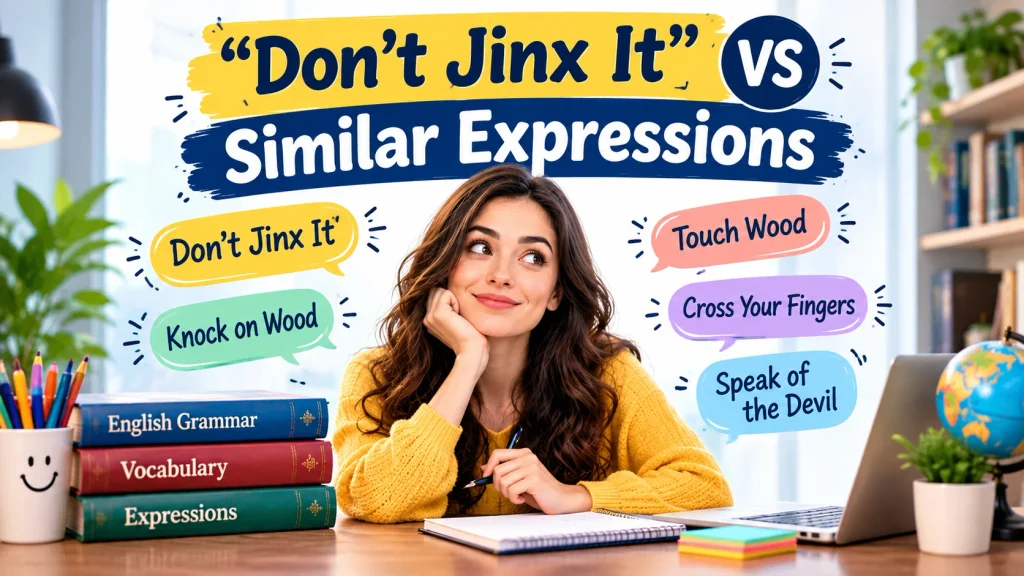
The closest alternatives are not exact synonyms. Some focus on luck, others on premature celebration, and others on uncertainty.
| Phrase | Meaning Difference | Tone Difference | Best Use Scenario |
| Don’t tempt fate | Avoid doing something that could invite an unwanted outcome | Casual, slightly dramatic | Talking about risk or luck |
| Let’s not get ahead of ourselves | Do not assume success before it is confirmed | Professional, measured | Workplace conversations |
| Don’t speak too soon | Do not make a confident prediction before the result | Neutral to casual | Competitions, plans, results |
| Let’s wait and see | Allow events to develop before reaching a conclusion | Calm and neutral | Uncertain situations |
| Don’t count on it yet | Do not rely on an expected result | Direct and practical | Plans that are not confirmed |
| Let’s not celebrate yet | Avoid celebrating before success is certain | Direct, neutral | Projects, exams, competitions |
Meaning Differences
“Don’t tempt fate” retains the strongest connection to luck or supernatural thinking. “Let’s wait and see” removes that idea and simply emphasizes uncertainty.
“Let’s not get ahead of ourselves” focuses on expectations, while “don’t speak too soon” focuses specifically on making predictions before an outcome is known.
Tone Differences
it is generally more playful. “Let’s not get ahead of ourselves” sounds more mature and workplace-friendly. “Let’s wait and see” is particularly neutral and useful when you want to avoid emotional or superstitious language.
Best-Use Scenarios
Choose “don’t jinx it” with friends or relaxed colleagues. Choose “let’s not get ahead of ourselves” in professional discussions. it“let’s wait and see” when you want a calm, neutral response.
Common Mistakes & Misuse of “Don’t Jinx It”
Overuse
Using the phrase after every positive statement can make conversations sound repetitive. It is most effective when there is genuine uncertainty about an outcome.
Incorrect Context
It does not always mean “be quiet.” Although someone may say it after another person makes a prediction, the main idea is avoiding the supposed risk of bringing bad luck or assuming success too early.
Contradictory Usage
A speaker may create confusion by saying “don’t jinx it” and then immediately making an extremely confident prediction.
For example:
“Don’t jinx it, but we are definitely going to win.”
The second part weakens the cautious meaning of the first.
Cultural Misunderstandings
Not everyone treats luck and superstition in the same way. Some people use “jinx” purely as humor, while others may take expressions about bad luck more seriously.
When communicating with an international audience, a neutral alternative can avoid unnecessary ambiguity.
Psychological Reason People Prefer “Don’t Jinx It”
People often use phrases like “don’t jinx it” because short expressions can efficiently communicate complicated social intentions.
Cognitive Load Reduction
Instead of explaining:
“We are optimistic, but the outcome has not been confirmed, so we should avoid assuming that everything will work out.”
a speaker can simply say:
“Don’t jinx it.”
The idiom compresses a longer idea into a familiar phrase.
Trust and Authority Signals
In a friendly conversation, recognizing uncertainty can make a person sound grounded rather than excessively confident. The phrase can signal that the speaker understands that circumstances may still change.
Attention Economy
Modern communication often rewards short, recognizable expressions. Phrases such as “don’t jinx it” work well in texts, chats, captions, and quick workplace messages because they require little explanation.
Modern Communication Habits
Digital communication encourages concise language. A three-word expression can carry emotional meaning that would otherwise require a longer sentence.
Importantly, this does not mean people necessarily believe that words cause bad luck. In contemporary usage, the phrase is often simply a socially familiar way of managing expectations.
US vs UK Usage of “Don’t Jinx It”
it is understood in both American and British English. There is no major difference in its core meaning.
The word jinx has a documented history in American English, particularly in early twentieth-century baseball culture, which helped establish its association with sports and bad luck. (Etymology Online)
In both the US and UK, speakers can use the phrase informally when discussing:
- sports
- work
- exams
- plans
- weather
- relationships
- expected good news
The difference is more about individual style than grammar. British speakers may also use expressions such as “don’t tempt fate” or “touch wood,” while American speakers commonly use “knock on wood.” These preferences vary by person and situation, so they should not be treated as absolute regional rules.
“Don’t Jinx It” in Digital & Modern Communication
Emails
In an informal internal email, it can make a message feel relaxed:
“The numbers are looking good this month. Don’t jinx it!”
For formal external correspondence, replace it with:
“The results are encouraging, although we should wait for the final figures.”
Slack / WhatsApp
The phrase is highly natural in quick messages:
“Looks like everyone is finally online for the meeting Don’t jinx it.”
Social Media
It works especially well in short posts because readers already understand its playful meaning.
“No traffic on my morning commute today. Don’t jinx it.”
AI-Generated Summaries
When writing summaries for professional audiences, an AI system should usually replace “don’t jinx it” with a more precise phrase if the source is formal.
For example:
Conversational:
“Things are going well don’t jinx it.”
Professional summary:
“Current results are positive, although the outcome remains uncertain.”
This distinction matters because effective communication is not only about synonyms; it is about matching the wording to the intended audience.
Linguistic & Communication Insight
Emotional Weight & Subtext
The literal wording of “don’t jinx it” refers to preventing bad luck, but native speakers often hear an additional message: “I’m hopeful, but I don’t want us to become overconfident.”
That emotional layer makes the phrase more socially useful than a simple statement such as “the result is uncertain.”
Direct vs Indirect Phrasing
It is relatively indirect. It does not explicitly say:
“You are being too confident.”
Instead, it uses an idiom to soften the correction.
By contrast:
“We should not assume the result yet.”
is direct and factual.
This difference matters in workplace communication. Indirect phrasing can preserve friendliness, while direct phrasing may be better when precision is essential.
Professional Communication Perspective
In a workplace, the phrase can help colleagues maintain a relaxed relationship. However, it should not replace factual information.
For example:
“Don’t jinx it we still need final approval.”
is conversational.
A formal version would be:
“The proposal is progressing well, but final approval is still pending.”
The second sentence is better when documentation, accountability, or precise reporting matters.
Pragmatic Reasons for Alternatives
Experienced communicators often choose alternatives to reduce defensiveness or create a more collaborative tone.
“Let’s not get ahead of ourselves” uses we, which makes the caution collaborative.
“Let’s wait and see” sounds less corrective.
“Stay cautiously optimistic” communicates hope while acknowledging uncertainty.
The choice of wording can therefore change how the same basic message is received.
Social Signaling
Word choice tells listeners something about the speaker’s attitude. “Don’t jinx it” can signal familiarity, humor, and shared cultural understanding.
A phrase such as “better to wait for confirmation” signals professionalism and evidence-based thinking.
Neither is inherently better. The important question is what social signal the situation requires.
Tone & Context Guidance
Use “don’t jinx it” when the relationship is informal, and the subject is relatively low-stakes.
Use a neutral alternative when:
- the information is official
- the audience is unfamiliar
- the subject is sensitive
- accuracy matters more than humor
- the communication may be archived or quoted
The safest professional replacement is often “Let’s wait for confirmation.”
Meaning, Usage & Examples for Each Alternative
Let’s Not Get Ahead of Ourselves
Meaning: This phrase means that a person should avoid becoming too confident or making assumptions before an outcome is confirmed. Why This Phrase Works: It preserves the cautious intention of “don’t jinx it” without the supernatural or superstitious suggestion. Real-World Usage Insight: It is especially natural when discussing business opportunities, project results, promotions, or plans that still require approval. Best Use: Professional conversations, meetings, and internal emails. Avoid When: You deliberately want a playful or humorous expression. Tone: Professional, calm, and measured. US vs UK Usage: Common and natural in both American and British English. Example (Meeting): “The client sounded ready to move forward, but let’s not get ahead of ourselves until we receive the signed agreement.”
Let’s Wait and See

Meaning: This phrase means that the situation should be allowed to develop before making a judgment. Why This Phrase Works: It removes the superstition from “don’t jinx it” and focuses entirely on uncertainty. Real-World Usage Insight: Native speakers frequently use it when there is not enough information to predict what will happen. Best Use: Everyday conversations, workplace discussions, and uncertain plans. Avoid When: A decision has already been made, and immediate action is required. Tone: Neutral, calm, and patient. US vs UK Usage: Very common in both varieties of English. Example (Email): “The early response to the campaign has been encouraging, but let’s wait and see how the numbers look at the end of the week.”
Don’t Speak Too Soon
Meaning: This expression advises someone not to make a prediction or confident statement before an outcome is known. Why This Phrase Works: It closely matches the idea of avoiding premature confidence. Real-World Usage Insight: It is especially effective when results are imminent, such as sports, examinations, elections, competitions, or negotiations. Best Use: Casual and semi-formal communication. Avoid When: You need a highly precise statement for formal documentation. Tone: Friendly and cautionary. US vs UK Usage: Understood and used in both regions. Example (Conversation): “We might finish the project today, but don’t speak too soon we still have the final review.”
Don’t Tempt Fate
Meaning: This phrase warns against doing something that might supposedly invite bad luck or an unwanted result. Why This Phrase Works: It is one of the closest idiomatic alternatives because it retains the traditional idea of fate. Real-World Usage Insight: It is often used humorously when someone points out an unusually lucky situation. Best Use: Casual conversation and playful workplace exchanges. Avoid When: Speaking to an audience that may interpret superstition literally or when formal precision is needed. Tone: Idiomatic, playful, and slightly dramatic. US vs UK Usage: Familiar in both American and British English. Example (Social Media): “I’ve had three weeks of perfect weather for my commute. I’m not saying anything else I don’t want to tempt fate.”
Let’s Not Assume Anything Yet
Meaning: This phrase means that an expected result should not be treated as certain before there is enough evidence. Why This Phrase Works: It is clear, factual, and free from superstition. Real-World Usage Insight: It works especially well when discussing decisions, applications, contracts, grades, or business results. Best Use: Professional and academic-adjacent communication. Avoid When: A playful tone is the main goal. Tone: Neutral and responsible. US vs UK Usage: Natural in both varieties. Example (Meeting): “The interview went well, but let’s not assume anything yet until the hiring team responds.”
Let’s Not Celebrate Yet
Meaning: This phrase advises people to delay celebration because success has not been confirmed. Why This Phrase Works: It directly addresses premature celebration rather than suggesting that someone can cause bad luck. Real-World Usage Insight: It is useful when a positive result seems likely, but a final step remains. Best Use: Projects, competitions, exams, and personal achievements. Avoid When: The result is already officially confirmed. Tone: Direct, friendly, and practical. US vs UK Usage: Common in both the US and UK. Example (Meeting): “The team has completed almost everything, but let’s not celebrate yet the final inspection is tomorrow.”
Better to Wait for Confirmation
Meaning: This phrase means that it is sensible to wait until information or an outcome has been officially verified. Why This Phrase Works: It provides a professional alternative without emotional or superstitious language. Real-World Usage Insight: It is particularly useful when information may change or when official approval matters. Best Use: Emails, reports, customer communication, and workplace discussions. Avoid When: Talking casually with close friends where a warmer expression would sound more natural. Tone: Professional and cautious. US vs UK Usage: Widely understood in both. Example (Email): “The supplier expects the shipment to arrive Friday, but it’s better to wait for confirmation before updating the customer.”
Conclusion
Understanding “don’t jinx it” is useful for anyone who wants to communicate naturally and choose the right words for different situations. The phrase is informal, friendly, and often playful, making it especially common in conversations about uncertain outcomes, good luck, sports, exams, work, plans, and expected success. While its historical background is connected with ideas about bad luck and superstition, modern speakers often use it simply to express cautious optimism. If you need a more professional alternative, phrases such as “let’s wait and see,” “let’s not get ahead of ourselves,” “don’t speak too soon,” or “better to wait for confirmation” can communicate a similar idea with greater precision. For ESL learners, students, professionals, and content writers, the most important point is that synonyms are not always interchangeable.
FAQs
What does “don’t jinx it” mean?
“Don’t jinx it” means not to say or do something that might supposedly bring bad luck to a situation that is going well. In modern English, it is usually used casually or humorously to express cautious optimism. It can also mean “don’t assume success before the final result is known.”
Is “don’t jinx it” a synonym for “don’t tempt fate”?
Yes, “don’t jinx it” and “don’t tempt fate” are closely related expressions. Both can refer to avoiding actions or statements that might supposedly cause bad luck. However, “don’t tempt fate” often sounds slightly more dramatic, while “don’t jinx it” is generally more casual and conversational.
Is “don’t jinx it” professional?
“Don’t jinx it” is generally considered casual rather than formal. It can be acceptable in relaxed workplace conversations between familiar colleagues, but it may sound too informal in official emails, reports, academic writing, or client-facing communication. In professional contexts, alternatives such as “let’s wait for confirmation” are usually clearer and more appropriate.
What is a professional alternative to “don’t jinx it”?
A strong professional alternative is “let’s not get ahead of ourselves.” Other options include “let’s wait and see,” “let’s not assume anything yet,” “better to wait for confirmation,” and “stay cautiously optimistic.” These phrases communicate uncertainty without relying on the informal or superstitious suggestion associated with “jinx.”
What is a polite way to say “don’t jinx it”?
A polite alternative is “let’s wait and see.” It sounds calm and does not directly correct or criticize another person. “Hopefully, it stays that way” and “let’s take it one step at a time” can also work when you want to maintain a supportive and positive tone.
What is the opposite of “don’t jinx it”?
The opposite depends on the intended meaning. If “don’t jinx it” expresses caution, an opposite idea might be “celebrate the success,” “be confident,” or “go ahead and expect a positive result.” However, there is no single exact opposite because the original phrase can express both humor and caution.
Can “don’t jinx it” be used in an email?
Yes, but it depends on the email’s audience and purpose. It can work naturally in an informal internal email, especially among colleagues who communicate casually. For clients, managers, academic institutions, or formal correspondence, a phrase such as “the outcome is not confirmed yet” will usually sound more professional.
Is “don’t jinx it” used in American and British English?
Yes. “Don’t jinx it” is understood and used in both American and British English. The core meaning is the same. Related expressions can vary by region; for example, Americans commonly say “knock on wood,” while British speakers may use “touch wood.” Individual preferences vary, so these are not strict regional rules.
What are the best alternatives to “don’t jinx it”?
The best alternative depends on context. “Let’s wait and see” is neutral, “let’s not get ahead of ourselves” is professional, “don’t speak too soon” is conversational, “don’t tempt fate” is idiomatic, and “stay cautiously optimistic” is balanced and professional. Choosing based on tone makes the message sound more natural.
Is “don’t jinx it” rude?
No, “don’t jinx it” is not normally considered rude. It is usually a friendly or playful expression used to discourage premature confidence. However, tone and context matter. If said sharply, it could sound dismissive. In formal or sensitive situations, a neutral phrase such as “let’s wait for the final result” may be more suitable.