Imagine you are in a meeting and want to introduce an idea that could change how a project is handled. You could simply say, “I have a proposition,” but the best wording depends on your audience, purpose, and relationship with the listener. In some situations, the phrase sounds professional and direct; in others, it may feel formal, dramatic, or slightly old-fashioned.
“I have a proposition” generally means that you have an idea, suggestion, offer, or plan that you want another person to consider. Choosing an alternative can make the same basic message sound more collaborative, friendly, persuasive, cautious, or businesslike.
This guide explores 20 other terms for “I have a proposition,” including practical synonyms, tone-based alternatives, examples, regional usage, common mistakes, and communication insights. These alternatives can help professionals, students, ESL learners, writers, and everyday speakers choose language that fits the situation naturally.
What Does “I Have a Proposition” Mean?
“I have a proposition” means that the speaker has an idea, proposal, offer, or plan that they want another person or group to consider. The phrase is commonly used when introducing a possible agreement, business arrangement, solution, change, or course of action. It signals that more details are about to follow.
Origin & History of “I Have a Proposition”
The word proposition comes from Latin propositio, meaning a statement, presentation, or something put forward for consideration. It entered English through French and developed several related meanings, including a statement, an idea presented for discussion, and an offer or proposal.
The modern sense of proposition is closely connected to the idea of putting something before another person for consideration. That is why a proposition can refer to a business offer, a suggested plan, or an argument that someone wants others to evaluate.
The phrase “I have a proposition” became particularly associated with formal negotiation, business conversations, sales situations, and fictional dialogue. In modern everyday English, proposal, suggestion, idea, and offer are often more natural choices.
The word also has a special cultural association in expressions such as “business proposition” and “a proposition for consideration.” Depending on context, “proposition” can therefore sound more serious or deliberate than a simple “idea.”
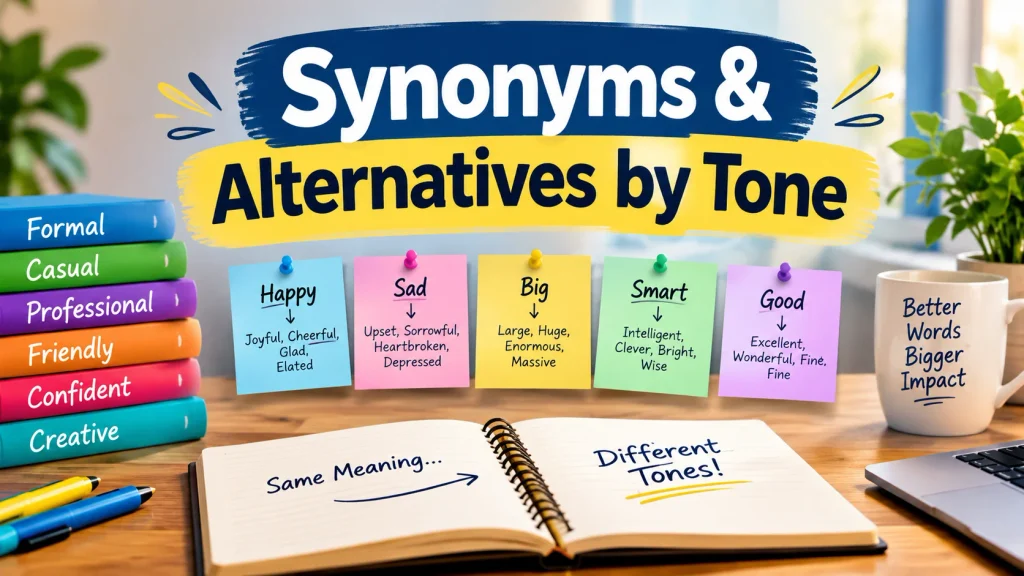
Synonyms & Alternatives by Tone
Professional & Neutral Alternatives
- I have a proposal.
- I have a suggestion.
- I have an idea.
- I’d like to propose something.
- I’d like to propose.
- I’d like to suggest an approach.
- I have an offer.
- I’d like to put forward an idea.
Polite & Supportive Alternatives
- Could I suggest something?
- I’d like to run an idea by you.
- Would you be open to an idea?
- I’d like to discuss an option.
- May I make a suggestion?
Encouraging & Reassuring Alternatives
- I think we have an opportunity here.
- I have an idea that might help.
- There may be another approach we could consider.
- I think there’s a way we can make this work.
Casual, Playful & Idiomatic Alternatives
- I’ve got an idea.
- Hear me out.
- What if we tried something different?
- I’ve got a thought.
- Let me pitch something.
- How about this?
When Should You Use “I Have a Proposition”?
“I have a proposition” works best when you want to introduce something for another person to consider and the subject has some degree of importance.
Professional settings
In business, negotiation, sales, partnerships, and formal discussions, the phrase can introduce an offer or proposed arrangement.
For example:
“I have a proposition that could reduce the project’s delivery time.”
However, “I have a proposal” will usually sound more conventional in modern workplace communication.
Casual conversations
The phrase can be used casually, but it may sound more formal than necessary. Among friends, “I have an idea” or “What if we…” usually sounds more natural.
Writing, presentations, and digital communication
In presentations, articles, business documents, and persuasive writing, “proposition” can be useful when discussing a specific idea or offer. In emails and messaging apps, a simpler alternative may improve readability.
When it is especially effective
Use it when:
- You are introducing a serious idea.
- The listener needs to consider an offer.
- You are beginning a negotiation.
- You want to create a clear transition into a proposed plan.
- The situation is formal enough to support slightly elevated wording.
When Should You Avoid “I Have a Proposition”?
There are situations where a different expression is clearer.
Overly formal situations
The phrase can sound unnecessarily formal in a quick text, casual conversation, or friendly workplace chat.
Instead of:
“I have a proposition.”
You might say:
“I have an idea.”
Legal, academic, or sensitive contexts
In legal or academic writing, proposal, claim, argument, recommendation, or another precise term may be better depending on the intended meaning. “Proposition” can be too broad if accuracy matters.
Situations where nuance may be lost
A proposition can mean an idea, offer, or proposed arrangement, so the listener may not immediately know what type of proposition you mean.
If you are making a concrete business offer, “I’d like to make an offer” may be clearer.
If you are suggesting a solution, “I have a suggestion” may be better.
Is “I Have a Proposition” Professional, Polite, or Casual?
“I have a proposition” is generally professional or formal rather than casual. Its exact tone depends heavily on context.
The phrase is direct because it announces that the speaker has something specific to present. It can also carry an undertone of negotiation because a “proposition” often requires another person’s consideration or response.
In a workplace, it may sound confident:
“I have a proposition for the next phase of the project.”
In a friendly conversation, however, it can sound unusually serious:
“I have a proposition for you.”
That wording may make the listener expect a generous offer or negotiation.
For everyday communication, “I have an idea” is softer and more accessible. For structured professional communication, “I have a proposal” is usually more precise.
Pros and Cons of Using “I Have a Proposition”
Advantages
- Clarity: It signals that the speaker has something specific to present.
- Efficiency: It introduces an idea without requiring a long explanation.
- Accessibility: Most fluent English speakers understand the basic meaning.
- Professional tone: It can sound appropriate during negotiations or formal discussions.
- Flexibility: The proposition can be an idea, offer, plan, or arrangement.
Potential Drawbacks
- Oversimplification: The listener may not know whether you mean an idea, offer, or formal proposal.
- Tone mismatch: It can sound too formal for casual communication.
- Repetition: Frequent use can make writing feel formulaic.
- Possible ambiguity: “Proposition” has several related meanings.
- Context sensitivity: Some listeners may interpret it as a negotiation or serious offer.
Real-Life Examples of “I Have a Proposition” by Context
Emails
“I have a proposition regarding the project timeline. If we move the testing phase forward by one week, we may be able to meet the client’s preferred launch date.”
Meetings
“I have a proposition for the team. Instead of assigning the entire report to one person, we could divide the sections according to each person’s area of expertise.”
Presentations
“I have a proposition for improving customer communication: we could introduce a single weekly update rather than sending several separate messages.”
Conversations
“I have a proposition. What if we finish the assignment today and use tomorrow to review everything?”
Social media
“I have a proposition for our study group: one short revision session each evening instead of trying to cover everything on the weekend.”
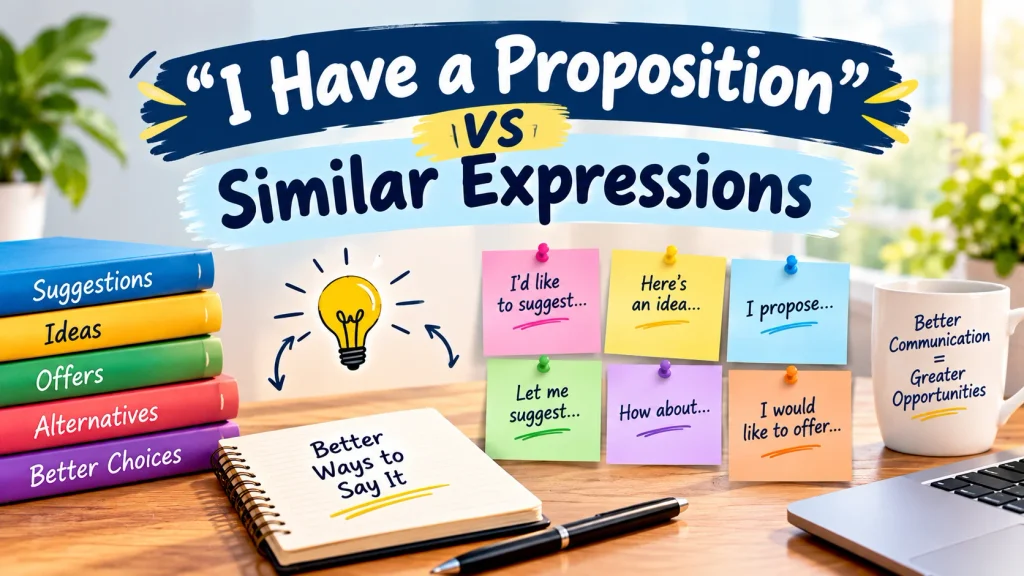
“I Have a Proposition” vs Similar Expressions
| Phrase | Meaning Difference | Tone Difference | Best Use Scenario |
| I have a proposal | Introduces a structured plan or recommendation | Professional and formal | Business, projects, organizations |
| I have an idea | Introduces a thought or possible solution | Neutral and friendly | Everyday and workplace communication |
| I have a suggestion | Offers an idea for consideration without strongly demanding acceptance | Polite and collaborative | Feedback, teamwork, discussions |
| I have an offer | Usually presents something being offered to another person | Direct and transactional | Business, negotiations, arrangements |
| I’d like to propose something | Signals an intentional recommendation or plan | Professional and measured | Meetings, presentations, negotiations |
| I’d like to run an idea by you | Asks someone to consider an idea informally | Friendly and collaborative | Workplace chats, conversations |
The main difference is what the speaker is presenting. A proposition is broad, while a proposal usually refers to a more developed plan, an offer describes something being given or provided, and an idea can be much less formal.
Common Mistakes & Misuse of “I Have a Proposition”
Overuse
Using “proposition” every time you have an idea can make ordinary communication sound unnecessarily formal. If you are simply suggesting lunch plans, a study method, or a small change, “I have an idea” is usually more natural.
Incorrect context
A proposition often suggests something substantial enough to consider. Using it for trivial matters can create an unintended sense of importance.
Contradictory usage
Avoid introducing something as a proposition when you are not actually asking the listener to consider an idea, offer, or arrangement.
Cultural misunderstandings
In some contexts, proposition may carry stronger associations with business negotiation or a serious offer. In informal situations, listeners may wonder whether something significant or unusual is being proposed.
Psychological Reason People Prefer “I Have a Proposition”
Language choices often reflect how people manage attention, uncertainty, and social interaction.
Cognitive load reduction
A short introductory phrase tells the listener what to expect. “I have a proposition” signals that a specific idea or offer is coming, helping the listener prepare to evaluate it.
Trust and authority signals
Formal vocabulary can sometimes create an impression of seriousness or preparation. In professional settings, that can make a speaker sound deliberate.
However, overly formal wording does not automatically create trust. Clear, appropriate language is usually more effective than impressive-sounding vocabulary.
Attention economy
Modern communication rewards concise messages. A phrase such as “I have an idea” quickly establishes purpose without requiring a lengthy introduction.
Modern communication habits
Digital communication has generally encouraged shorter and more conversational wording. This is one reason expressions such as “I have an idea,” “What if we…,” and “Could we try…” are often preferred in everyday online communication.
US vs UK Usage of “I Have a Proposition”
The phrase is understood in both American and British English, and there is no major difference in its basic meaning.
In both varieties, “proposition” can refer to an idea, offer, or suggested arrangement. However, everyday speakers in both the US and UK frequently choose simpler alternatives such as proposal, suggestion, or idea.
In American business communication, “proposal” is especially common for structured plans, while “proposition” may sound more formal or negotiation-oriented.
In British English, “proposition” is also natural in formal contexts, although everyday speakers may similarly prefer more direct alternatives.
The main difference is therefore context and register rather than meaning. Neither version of English requires a substantially different interpretation.
“I Have a Proposition” in Digital & Modern Communication
Emails
In formal business emails, “proposition” can work when introducing a serious offer or proposed arrangement. For routine workplace communication, “I have a proposal” or “I have an idea” is often smoother.
Slack / WhatsApp
Short-form messaging favors conversational expressions:
“I’ve got an idea.”
or:
“What if we tried this?”
Social media
Social posts generally benefit from direct, accessible wording. “Here’s an idea” is often more engaging than “I have a proposition.”
AI-generated summaries
AI-generated summaries typically favor standardized language such as proposal, recommendation, or suggestion because these terms clearly identify the function of the statement.
Linguistic & Communication Insight
Emotional weight & subtext
The literal meaning of “I have a proposition” is neutral, but the phrase can carry additional social meaning. Because “proposition” is associated with offers and negotiations, listeners may expect the speaker to present something important or potentially consequential.
That expectation gives the phrase more weight than “I have an idea.”
Direct vs indirect phrasing
“I have a proposition” is relatively direct. It tells the listener that the speaker has something to present.
Compare:
“I have a proposition.”
with:
“Would you be open to considering another approach?”
The second version is more indirect and gives the listener more conversational space. It may therefore reduce defensiveness when the subject is sensitive.
Professional communication perspective
In professional settings, the strongest wording is not necessarily the most formal wording. Effective communicators select language according to the relationship, stakes, and purpose.
A manager presenting a structured plan may use “I have a proposal.” A colleague suggesting a small change may use “I have an idea.” A negotiator making a concrete arrangement may use “I have an offer.”
Pragmatic reasons for alternatives
Professionals often choose alternatives to manage interpersonal reactions.
“I have a suggestion” can make feedback feel less forceful.
“I’d like to propose something” can sound deliberate without being overly rigid.
“Would you be open to an idea?” gives the listener a sense of choice.
“Let me run something by you” creates a more conversational atmosphere.
Social signaling
Word choice signals how the speaker views the interaction. Formal vocabulary can communicate seriousness and authority, while conversational vocabulary can signal openness and equality.
This is why the “best synonym” is not always the dictionary synonym. The right alternative is the one that matches the social purpose of the conversation.
Tone & context guidance
Use “I have a proposition” when the subject genuinely deserves a formal or serious introduction. Choose a softer alternative when you want collaboration, and choose a precise alternative when the nature of the proposal matters.
I have a proposal
Meaning: “I have a proposal” means that the speaker has a specific plan, recommendation, or suggested course of action for others to consider.
Why This Phrase Works: It is clearer than “I have a proposition” when the speaker has developed a structured plan. It is widely accepted in professional communication.
Real-World Usage Insight: This is one of the most useful replacements in workplaces because “proposal” naturally fits projects, policies, partnerships, schedules, and business decisions.
Best Use: Meetings, business emails, project planning, presentations, and formal discussions.
Avoid When: You are only mentioning a very small or undeveloped thought.
Tone: Professional, neutral, structured.
US vs UK Usage: Common in both American and British English with little difference in meaning.
Example (Meeting): “I have a proposal for the next project phase. We could complete the research first and move the design work into the following week.”
I have a suggestion
Meaning: “I have a suggestion” introduces an idea that the speaker wants others to consider, without strongly implying that it should be accepted.
Why This Phrase Works: It sounds cooperative and gives other people room to respond.
Real-World Usage Insight: It is especially effective when offering feedback because it avoids sounding like a command.
Best Use: Team discussions, feedback, classroom conversations, workplace collaboration, and problem-solving.
Avoid When: You are presenting a formal business document or a binding arrangement where “proposal” or “offer” is more precise.
Tone: Polite, collaborative, approachable.
US vs UK Usage: Very common in both varieties of English.
Example (Email): “I have a suggestion for the report layout. We could move the summary to the beginning so readers can see the main findings immediately.”
I have an idea
Meaning: “I have an idea” means the speaker has a thought, possibility, or potential solution that they want to share.
Why This Phrase Works: It is simple, natural, and highly flexible.
Real-World Usage Insight: Native speakers use it constantly in both professional and personal conversations because it does not make the idea sound more developed than it actually is.
Best Use: Everyday conversations, brainstorming, meetings, messages, and informal workplace discussions.
Avoid When: You need to communicate a formal offer or a fully developed business plan.
Tone: Friendly, neutral, conversational.
US vs UK Usage: Extremely common in both.
Example (Meeting): “I have an idea. What if we send the client a short progress update every Friday instead of waiting until the end of the month?”
I’d like to propose something.
Meaning: This phrase introduces an idea, recommendation, or plan that the speaker intends to present for consideration.
Why This Phrase Works: It sounds confident while remaining measured and professional.
Real-World Usage Insight: It works particularly well when you want to take the floor without sounding as though your idea is already decided.
Best Use: Meetings, presentations, negotiations, and professional discussions.
Avoid When: The conversation is extremely casual and a simpler expression would feel more natural.
Tone: Professional, confident, respectful.
US vs UK Usage: Natural in both American and British English.
Example (Meeting): “I’d like to propose something before we finalize the schedule: could we leave one afternoon open for unexpected revisions?”
I’d like to propose.
Meaning: This phrase means that the speaker wants to present a formal or structured plan for consideration.
Why This Phrase Works: It clearly communicates that the upcoming information is organized and deserves attention.
Real-World Usage Insight: It is particularly appropriate when the speaker has prepared specific details rather than simply having a spontaneous idea.
Best Use: Business meetings, presentations, formal negotiations, and organizational decisions.
Avoid When: You are making a quick, informal suggestion to a friend or colleague.
Tone: Formal, professional, deliberate.
US vs UK Usage: Common and natural in both varieties.
Example (Email): “I’d like to propose next quarter’s schedule. If the team agrees, I can circulate a revised timetable tomorrow.”
I’d like to suggest an approach.
Meaning: This phrase introduces a particular method or way of handling a problem or task.
Why This Phrase Works: It focuses attention on the practical solution rather than presenting the idea as an important personal proposition.
Real-World Usage Insight: The wording works well when several possible solutions exist, and you want to present one without dismissing the alternatives.
Best Use: Problem-solving, consulting, teamwork, academic discussions, and project planning.
Avoid When: You are actually making a financial or commercial offer.
Tone: Professional, thoughtful, collaborative.
US vs UK Usage: Natural in both.
Example (Meeting): “I’d like to suggest an approach that keeps the existing process but automates the repetitive part.”
Conclusion

Understanding “I have a proposition” helps you choose language that matches your audience, purpose, and communication style. The phrase generally introduces an idea, offer, plan, or arrangement for someone else to consider. While it can sound professional and deliberate, it may feel overly formal in casual conversations. For everyday communication, alternatives such as “I have an idea,” “I have a suggestion,” or “I’d like to propose something” can sound more natural. In business settings, “I have a proposal” is often a clearer choice when presenting a structured plan. The most effective alternative depends on whether you want to sound formal, collaborative, friendly, persuasive, or direct. By understanding these subtle differences, students, professionals, ESL learners, and content writers can communicate more naturally and precisely. Choosing the right synonym is not simply about replacing words; it is about matching meaning, tone, context, and audience expectations to make every message clearer and more effective.
FAQs
What does “I have a proposition” mean?
“I have a proposition” means that someone has an idea, offer, plan, or arrangement they want another person to consider. The phrase is generally formal or professional and may suggest that the subject is important or involves negotiation. Depending on context, it can refer to a business proposal, suggested solution, agreement, or specific offer.
Is “I have a proposition” professional?
Yes, “I have a proposition” can be professional, especially in negotiations, business discussions, and formal conversations. However, it may sound more formal than necessary in everyday workplace communication. “I have a proposal” is often a more natural professional alternative, while “I have an idea” works better for informal brainstorming and routine discussions.
What is a better synonym for “I have a proposition”?
The best synonym depends on context. “I have a proposal” is ideal for a formal or structured plan, while “I have a suggestion” sounds collaborative. “I have an idea” is natural and flexible, and “I have an offer” is appropriate when something specific is being offered in a negotiation or arrangement.
Is “I have a proposition” polite?
The phrase is generally neutral and can sound polite when used appropriately, but it is not specifically a soft or indirect expression. If you want to sound more considerate, alternatives such as “Could I suggest something?” or “Would you be open to an idea?” give the listener more conversational space and can reduce the impression of pressure.
Can I use “I have a proposition” in an email?
Yes, you can use it in an email when introducing a serious idea, offer, or proposed arrangement. However, the phrase may sound formal. In most professional emails, “I have a proposal” is clearer for a structured plan, while “I have an idea” is more suitable for informal workplace communication or brainstorming.
What is the difference between “proposition” and “proposal”?
A proposition is a broad term for something presented for consideration and can mean an idea, offer, or arrangement. A proposal usually refers to a specific plan or recommendation. Therefore, “proposal” is often more precise in professional communication, while “proposition” can have a broader or more formal meaning.
What is a casual way to say “I have a proposition”?
Casual alternatives include “I’ve got an idea,” “I’ve got a thought,” “What if we…,” and “Hear me out.” These expressions sound more conversational and natural in messages, conversations, brainstorming sessions, and informal workplace chats. They are usually better choices when speaking with friends, classmates, or colleagues in relaxed situations.
Is “I have an idea” better than “I have a proposition”?
Neither is always better. “I have an idea” is more conversational, accessible, and flexible, while “I have a proposition” sounds more formal and may imply a generous offer or arrangement. For everyday communication, “idea” is usually more natural. For negotiations or serious proposals, “proposition” can be appropriate.
What does “I have a proposition for you” imply?
“I have a proposition for you” usually suggests that the speaker has a specific offer, plan, or arrangement they want the listener to consider. Because the wording sounds relatively formal, it may create an expectation of negotiation or an important decision. The exact implication depends on the relationship, subject, and surrounding conversation.
What should I say instead of “I have a proposition” at work?
At work, strong alternatives include “I have a proposal,” “I have an idea,” “I have a suggestion,” “I’d like to propose something,” and “I’d like to discuss an option.” Use “proposal” for a developed plan, “suggestion” for collaborative feedback, and “idea” for brainstorming. The right choice depends on the formality and purpose of the discussion.