
Imagine someone spilling a little coffee during a busy meeting and immediately apologizing several times. A colleague might smile and say, “Don’t make a fuss.” The speaker is not necessarily dismissing the problem; they may simply be saying that the situation does not require a lot of worry, attention, or unnecessary activity.
“Don’t make a fuss” is a familiar English expression used to tell someone not to react with excessive concern, excitement, complaint, or attention to a situation. Its meaning depends strongly on context and tone. A warm delivery can sound reassuring, while a sharp delivery can feel dismissive.
Knowing alternatives is valuable because different situations call for different levels of sensitivity. A manager might say, “There’s no need to worry about it,” while a friend could say, “Don’t worry about it.” In a sensitive conversation, “It’s okay; we can handle this” may be more supportive.
This guide explores the meaning, origin, tone, usage, alternatives, and practical examples of “don’t make a fuss” so that students, professionals, ESL learners, and content writers can choose natural English with greater confidence.
What Does “Don’t Make a Fuss” Mean?
“Don’t make a fuss” means do not react with unnecessary concern, excitement, complaint, or attention to a situation. The phrase is commonly used when someone is making more of an issue than the speaker considers necessary. It can appear in conversations about minor problems, apologies, celebrations, requests, or inconveniences, depending on tone and context.
Origin & History of “Don’t Make a Fuss”

The expression “make a fuss” developed from the noun fuss, a word associated with unnecessary agitation, excitement, complaint, or disturbance. The exact origin of fuss is uncertain, although it has been used in English for several centuries.
By the eighteenth and nineteenth centuries, fuss was established in English as a word describing unnecessary activity, worry, complaint, or attention. The construction “make a fuss” naturally developed to describe creating or expressing that kind of disturbance.
The negative imperative “don’t make a fuss” therefore means not to create unnecessary concern, excitement, or disturbance.
Historically, the expression became especially useful in everyday speech because it could cover several related behaviors. Someone might make a fuss about a small inconvenience, a child might make a fuss when upset, or a person might make a fuss over a guest by providing excessive attention.
Modern English retains these meanings. However, context determines whether the phrase sounds comforting, humorous, dismissive, or controlling.
The expression is also strongly associated with British English, although it is fully understandable and used in American English as well.
Synonyms & Alternatives by Tone
Professional & Neutral Alternatives
- There’s no need to worry about it.
- There’s no need to make an issue of it.
- It’s not a major concern.
- No further action is necessary.
- Please don’t be concerned.
Polite & Supportive Alternatives
- Don’t worry about it.
- It’s perfectly fine.
- There’s nothing to worry about.
- Please don’t feel bad about it.
- It’s okay; we can handle it.
Encouraging & Reassuring Alternatives
- It’s not a big deal.
- Everything is under control.
- We’ll take care of it.
- There’s no need to stress.
- You don’t need to worry.
Casual, Playful & Idiomatic Alternatives
- Don’t make a big deal out of it.
- No need to make a song and dance about it.
- Let it go.
- Don’t sweat it.
- Take it easy.
When Should You Use “Don’t Make a Fuss”?
“Don’t make a fuss” is most appropriate when the speaker wants to discourage an excessive reaction to something relatively minor. The phrase works particularly well in informal spoken English, family conversations, and friendly interactions.
Professional Settings
Use it selectively. In a relaxed workplace, a familiar colleague may understand it as reassurance. However, it can sound dismissive if someone is raising a legitimate concern.
For professional communication, phrases such as “There’s no need to worry about it” or “It’s not a major concern” are generally safer.
Casual Conversations
This is where the expression feels most natural. Friends and family members may use it when someone apologizes repeatedly, worries about a minor inconvenience, or becomes overly concerned about a small issue.
Writing, Presentations, and Digital Communication
The phrase can appear in informal blogs, dialogue, social media, and personal messages. In formal reports or academic writing, a more precise expression is normally preferable.
When It Is Especially Effective
It works particularly well when the speaker genuinely wants to reduce unnecessary worry or attention and has enough familiarity with the listener to make the intention clear.
When Should You Avoid “Don’t Make a Fuss”?
Overly Formal Situations
Formal correspondence, official documents, academic papers, and professional complaints generally require more precise wording.
Legal, Academic, or Sensitive Contexts
Avoid the phrase when someone is discussing a serious concern. Saying “don’t make a fuss” can unintentionally minimize a legitimate issue.
Situations Where Nuance May Be Lost
Written communication can make the phrase sound harsher than intended. A friendly spoken “Don’t make a fuss” may become dismissive when sent as a short text message without context.
It is especially important to avoid it when someone is expressing genuine distress, reporting a problem, or asking for reasonable assistance.
Is “Don’t Make a Fuss” Professional, Polite, or Casual?
“Don’t make a fuss” is generally casual and conversational. It can be polite when used warmly, but it is not automatically reassuring.
Its tone depends on:
- Relationship: Close friends and family are more likely to accept it comfortably.
- Situation: A minor inconvenience makes the phrase more appropriate.
- Delivery: A warm voice can make it reassuring; an irritated voice can make it dismissive.
- Power relationship: A manager telling an employee not to make a fuss may sound more authoritative than a friend saying it.
- Subject matter: Serious concerns should not be minimized.
The expression is therefore best understood as context-sensitive rather than simply polite or rude.
Pros and Cons of Using “Don’t Make a Fuss”
Advantages
- Clarity: It clearly signals that the speaker does not think a strong reaction is necessary.
- Efficiency: It communicates reassurance or discouragement in a few words.
- Accessibility: The expression is familiar to many English speakers.
- Natural conversation: It sounds authentic in informal speech.
- Emotional de-escalation: When used appropriately, it can help someone relax about a minor matter.
Potential Drawbacks
- Tone mismatch: It may sound dismissive when the listener has a genuine concern.
- Oversimplification: It does not explain why the situation is considered minor.
- Cultural differences: Some listeners may interpret the expression more negatively than intended.
- Power imbalance: It can sound controlling when used by someone in authority.
- Repetition: Frequent use may make genuine concerns feel routinely minimized.
Real-Life Examples of “Don’t Make a Fuss” by Context
Emails
In professional email, a softer alternative is usually preferable:
“There’s no need to worry about the formatting issue. I’ll correct it before the final version.”
Meetings
A team leader might say:
“Don’t make a fuss about the small formatting error. We can fix it before the client sees the document.”
This works best when the issue really is minor.
Presentations
A speaker might reassure a colleague:
“The slide order got mixed up, but don’t make a fuss. We can switch them before we start.”
Conversations
A friend might say:
“Don’t make a fuss about dinner. A sandwich is completely fine.”
Here, the expression communicates reassurance rather than criticism.
Social Media
An informal post could say:
“The package arrived a day late. Don’t make a fuss—we’re still getting it today.”
The conversational tone fits casual online communication.
“Don’t Make a Fuss” vs Similar Expressions (Key Differences)
These expressions overlap, but they do not always communicate the same idea.
| Phrase | Meaning Difference | Tone Difference | Best Use Scenario |
| Don’t worry about it | Reassures someone that a problem is not important | Warm, reassuring | Apologies and minor mistakes |
| It’s not a big deal | Says the situation is insignificant | Casual, relaxed | Friends and informal conversations |
| Don’t make a big deal out of it | Directly discourages excessive attention | Direct, casual | Minor issues or reactions |
| There’s no need to worry | Reassures someone without directly criticizing their reaction | Polite, neutral | Workplace and everyday situations |
| Don’t sweat it | Tells someone not to worry or stress | Very casual, friendly | Informal conversations |
| Let it go | Encourages someone to stop focusing on an issue | Direct, sometimes firm | Arguments or repeated concerns |
The main distinction is that “don’t make a fuss” focuses on excessive reaction or attention, while “don’t worry about it” focuses more specifically on reducing concern.
Common Mistakes & Misuse of “Don’t Make a Fuss”
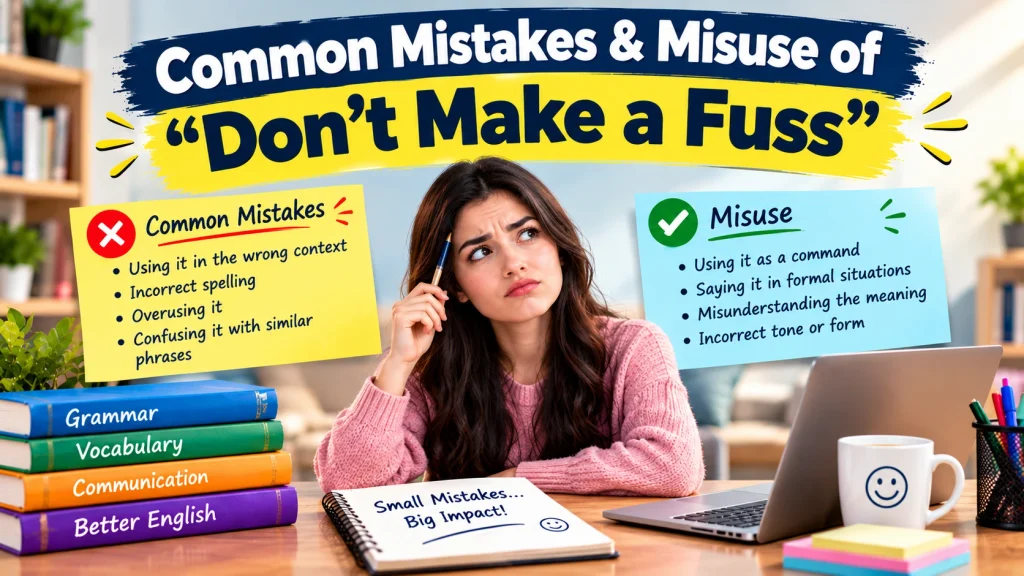
Overuse
Using the expression for every disagreement or complaint can make a speaker appear dismissive. It should not become a substitute for actually listening.
Incorrect Context
Do not use it automatically when someone raises a serious problem. A concern about safety, unfair treatment, health, or an important deadline deserves careful attention.
Contradictory Usage
Avoid pairing it with language that creates unnecessary urgency. For example, “Don’t make a fuss, but this is extremely serious” sends conflicting signals unless the distinction is clearly explained.
Cultural Misunderstandings
Some listeners interpret “fuss” as a mild, everyday expression, while others may hear it as criticism of their emotional reaction. ESL learners should therefore consider the relationship and situation before using it.
Psychological Reason People Prefer “Don’t Make a Fuss”
People often use short familiar expressions to manage social situations quickly. “Don’t make a fuss” gives the listener an immediate signal that the speaker considers the situation manageable.
Cognitive Load Reduction
The phrase is short and familiar. Instead of explaining at length that a minor problem does not require attention, speakers can communicate the general idea immediately.
Trust and Authority Signals
When used warmly, the phrase can communicate confidence that the situation is under control. When used by someone with authority, however, it may sound like an instruction to suppress concern.
Attention Economy
Modern communication favors concise expressions. Short phrases such as “don’t worry about it” or “don’t sweat it” work well in fast-moving conversations and digital messages.
Modern Communication Habits
Texting, workplace chat, and social media have increased the use of conversational expressions in written communication. This makes understanding tone increasingly important because readers cannot hear the speaker’s voice.
US vs UK Usage of “Don’t Make a Fuss”
“Don’t make a fuss” is understood in both American and British English, but it has a particularly familiar British conversational flavor.
In British English, fuss is commonly used to describe unnecessary concern, complaint, attention, or elaborate treatment. Expressions such as “make a fuss over someone” and “make a fuss about something” are well established.
American English speakers also understand and use the phrase, although alternatives such as “don’t worry about it,” “it’s not a big deal,” and “don’t make a big deal out of it” may feel more conversational in many settings.
The difference is mainly one of frequency and stylistic preference, not meaning.
“Don’t Make a Fuss” in Digital & Modern Communication
Emails
For professional emails, consider replacing it with “There’s no need to worry about it” or “It’s not a major concern.”
Slack / WhatsApp
The expression can work well among familiar colleagues or friends:
“Don’t make a fuss about the typo. I’ve already fixed it.”
Social Media
Its conversational quality can make a post feel informal and approachable. However, avoid it when responding to someone discussing a serious issue.
AI-Generated Summaries
AI-generated writing should preserve the original intention rather than mechanically replacing the phrase. Depending on context, the appropriate alternative may be “no action is required,” “there is no need for concern,” or “the issue is minor.”
Linguistic & Communication Insight
Emotional Weight & Subtext
Beyond its literal meaning, “don’t make a fuss” can communicate the speaker’s judgment that a reaction is disproportionate. That judgment is what gives the expression its emotional weight.
When used affectionately, it can mean, “You really don’t need to worry about this.” When delivered sharply, it can suggest, “Your reaction is unnecessary.”
Direct vs Indirect Phrasing
“Don’t make a fuss” is a direct negative command. It tells the listener what not to do.
By contrast, “There’s no need to worry” is more indirect. It focuses on the situation rather than directly criticizing the listener’s behavior.
This distinction matters because direct language can be efficient, while indirect language may be better for preserving cooperation and reducing defensiveness.
Professional Communication Perspective
In workplace communication, the phrase should be used carefully. If an employee raises a legitimate concern and receives “don’t make a fuss,” they may feel that their concern is being dismissed.
A professional communicator might instead say:
“I understand the concern. It looks manageable, and we can address it today.”
This acknowledges the person’s perspective while keeping the situation in proportion.
Pragmatic Reasons for Alternatives
Professionals often select alternatives because they want to reassure without judging the listener’s reaction. “Don’t worry about it” centers reassurance. “It’s not a major concern” centers the issue. “We’ll take care of it” centers action.
These differences allow speakers to maintain authority without sounding dismissive.
Social Signaling
Language choices communicate attitudes toward both the situation and the listener. Saying “don’t make a fuss” can signal familiarity, confidence, impatience, or authority.
More collaborative alternatives can signal respect and shared responsibility.
Tone & Context Guidance
A useful test is to ask: “Am I reassuring this person, or am I telling them that their reaction is unreasonable?”
If the goal is reassurance, “Don’t worry about it” may work better. If the goal is to stop excessive attention to a trivial matter, “Don’t make a fuss” may be appropriate.
Meaning, Usage & Examples for Each Alternative

There’s No Need to Worry About It
Meaning: This phrase reassures someone that a situation does not require concern or anxiety.
Why This Phrase Works: It focuses on reducing worry rather than criticizing the person’s behavior.
Real-World Usage Insight: It is one of the safest alternatives when you want to reassure someone without sounding dismissive.
Best Use: Workplace conversations, customer communication, apologies, and everyday situations.
Avoid When: The concern is genuinely serious and needs detailed discussion.
Tone: Calm, reassuring, professional.
US vs UK Usage: Natural and common in both varieties.
Example (Email): “Thanks for flagging the missing attachment. There’s no need to worry about it; I’ve added the file to the shared folder.”
Don’t Worry About It
Meaning: This expression tells someone that they do not need to remain concerned about a problem or inconvenience.
Why This Phrase Works: It is familiar, concise, and usually warmer than “don’t make a fuss.”
Real-World Usage Insight: It is particularly effective after someone apologizes for a minor mistake.
Best Use: Friends, coworkers, family, and everyday professional interactions.
Avoid When: Someone is raising a legitimate concern that requires attention.
Tone: Friendly, reassuring, casual to neutral.
US vs UK Usage: Extremely common in both.
Example (Meeting): “Don’t worry about the late start. We’ll cover the final point before we finish.”
It’s Not a Big Deal
Meaning: This phrase says that a situation is relatively unimportant or manageable.
Why This Phrase Works: It quickly reduces the perceived seriousness of a minor problem.
Real-World Usage Insight: It sounds natural in casual speech and is often used after apologies or small mistakes.
Best Use: Informal conversations and relaxed workplaces.
Avoid When: Discussing serious professional, legal, academic, or personal concerns.
Tone: Casual, relaxed, reassuring.
US vs UK Usage: Very common in American English and well understood in British English.
Example (Conversation): “You forgot to bring the charger? It’s not a big deal. I have a spare one.”
Don’t Make a Big Deal Out of It
Meaning: This expression directly asks someone not to treat a situation as more important than it is.
Why This Phrase Works: It closely matches the meaning of “don’t make a fuss” while sounding very natural in everyday English.
Real-World Usage Insight: It can be reassuring, but it may also sound critical if the listener genuinely believes the issue matters.
Best Use: Informal conversations and minor disagreements.
Avoid When: Someone is expressing a serious concern.
Tone: Direct, casual, sometimes firm.
US vs UK Usage: Common in both varieties.
Example (Social Media): “The delivery arrived this afternoon instead of this morning. Don’t make a big deal out of it—we still got everything.”
There’s No Need to Worry
Meaning: This phrase reassures someone that concern is unnecessary.
Why This Phrase Works: It removes the judgment found in some more direct alternatives.
Real-World Usage Insight: It is useful when you want to sound calm and respectful.
Best Use: Professional communication, customer service, and personal conversations.
Avoid When: The situation genuinely requires immediate attention.
Tone: Polite, calm, reassuring.
US vs UK Usage: Common in both.
Example (Meeting): “There’s no need to worry about the revised figures. I’ve checked them twice, and everything is consistent.”
Don’t Sweat It
Meaning: “Don’t sweat it” means do not worry or stress about something.
Why This Phrase Works: It is short, friendly, and strongly conversational.
Real-World Usage Insight: It works especially well between people who have an informal relationship.
Best Use: Friends, teammates, casual coworkers, and informal messages.
Avoid When: Writing formal business communication or addressing someone unfamiliar.
Tone: Very casual, friendly, relaxed.
US vs UK Usage: Especially common in American English; British speakers understand it readily.
Example (Message): “Don’t sweat it about the late reply. I know you’ve been busy.”
It’s Perfectly Fine
Meaning: This phrase tells someone that a situation is acceptable and does not require concern.
Why This Phrase Works: It directly reassures the listener without suggesting that they have overreacted.
Real-World Usage Insight: It is useful after small mistakes, delays, or apologies.
Best Use: Customer service, workplace communication, friends, and family.
Avoid When: The problem genuinely needs correction or acknowledgment.
Tone: Reassuring, polite, neutral.
US vs UK Usage: Common in both varieties.
Example (Email): “It’s perfectly fine that the form came through this morning. We can still process it today.”
Please Don’t Be Concerned
Meaning: This expression politely asks someone not to worry about a particular matter.
Why This Phrase Works: It sounds more formal and measured than casual alternatives.
Real-World Usage Insight: It can be useful when reassurance needs to sound professional rather than conversational.
Best Use: Formal workplace communication and customer-facing messages.
Avoid When: Speaking casually with close friends, where it may sound overly formal.
Tone: Formal, courteous, reassuring.
US vs UK Usage: Understood in both, though exact frequency varies by context.
Example (Email): “Please don’t be concerned about the scheduling change. Your appointment remains confirmed.”
Conclusion
Understanding “don’t make a fuss” is about more than knowing its dictionary definition. The expression usually tells someone not to give a minor problem, inconvenience, or situation more attention than the speaker believes it deserves. However, its effect depends strongly on tone, relationship, and context. Among friends or family, it can sound reassuring, familiar, or even playful. In professional communication, it may sometimes sound dismissive, particularly when someone is raising a legitimate concern.
Alternatives such as “don’t worry about it,” “there’s no need to worry,” “it’s perfectly fine,” and “we’ll take care of it” allow speakers to communicate reassurance with different levels of warmth and professionalism. For ESL learners and professionals, understanding these distinctions is especially valuable because literal meaning does not always communicate the complete social message. The best expression is the one that matches the seriousness of the situation, the relationship between speakers, and the desired tone. Choosing carefully makes communication clearer, more respectful, and more natural.
FAQs
What does “don’t make a fuss” mean?
“Don’t make a fuss” means do not react with unnecessary concern, excitement, complaint, or attention. It is usually said when the speaker considers a situation relatively minor. The expression can be reassuring when used warmly, but it may sound dismissive if someone is discussing a genuine or serious concern. Context and tone strongly influence its meaning.
Is “don’t make a fuss” rude?
“Don’t make a fuss” is not inherently rude, but it can sound dismissive or commanding in certain situations. Among friends and family, it may be friendly or reassuring. In professional or sensitive conversations, alternatives such as “There’s no need to worry” or “Let’s see how we can resolve this” are usually more considerate.
Is “don’t make a fuss” professional?
“Don’t make a fuss” is generally considered casual rather than professional. It can occasionally work in relaxed workplace conversations between familiar colleagues, but it is not ideal for formal emails, customer service, official communication, or sensitive discussions. More professional alternatives include “There’s no need for concern” and “It’s not a major issue.”
What is a polite alternative to “don’t make a fuss”?
Polite alternatives include “There’s no need to worry,” “Please don’t be concerned,” “It’s perfectly fine,” and “There’s no need to worry about it.” These phrases reassure the listener without directly suggesting that their reaction is excessive. For workplace communication, “There’s no need to worry about it” is usually a natural and respectful choice.
What is the difference between “don’t make a fuss” and “don’t worry about it”?
“Don’t make a fuss” focuses on discouraging an excessive reaction, complaint, or amount of attention. “Don’t worry about it” focuses more directly on reducing someone’s concern. As a result, “don’t worry about it” is often softer and more reassuring, while “don’t make a fuss” can sound more direct or dismissive.
What does “make a fuss” mean?
“Make a fuss” means to react to something with a lot of concern, complaint, excitement, attention, or unnecessary activity. The exact meaning depends on context. For example, someone can make a fuss about a small mistake, while “make a fuss over someone” can mean giving that person a great deal of attention or care.
Can “don’t make a fuss” be used in an email?
It can be used in an informal email, but it is usually better to choose a softer expression in professional correspondence. Written messages do not communicate facial expressions or vocal tone, so “don’t make a fuss” may appear harsher than intended. “There’s no need to worry about it” is generally a safer professional alternative.
What is a casual synonym for “don’t make a fuss”?
Common casual alternatives include “Don’t worry about it,” “It’s not a big deal,” “Don’t sweat it,” “Take it easy,” and “Don’t make a big deal out of it.” “Don’t sweat it” is particularly informal, while “it’s not a big deal” is widely used in everyday American English and understood in British English.
Is “don’t make a fuss” more British or American?
“Don’t make a fuss” is understood in both British and American English, but it has a particularly familiar British conversational feel. American speakers may more frequently use alternatives such as “don’t worry about it,” “it’s not a big deal,” or “don’t make a big deal out of it.” The meaning remains clear in both varieties.
When should you avoid saying “don’t make a fuss”?
Avoid “don’t make a fuss” when someone is reporting a serious problem, expressing genuine distress, making a legitimate complaint, or discussing a sensitive subject. The phrase may unintentionally minimize their concern. In such situations, acknowledge the issue first and use supportive wording such as “I understand your concern” or “Let’s work through this.”