
Imagine you are writing an email to a colleague explaining where to find a button on a website, pointing out a detail in a presentation, or describing the position of an image on a page. You might say, “Look at the left bottom of the screen.” Although your meaning may be understandable, a more natural expression could be “bottom left,” “lower-Extra corner,” or “bottom-left section.”
The phrase “left bottom” generally refers to the area positioned toward the bottom and left side of an object, page, image, screen, or physical space. However, in everyday English, “bottom left” is usually the more natural word order when describing a location. The best alternative depends on whether you are giving directions, writing professional instructions, explaining a design, or having a casual conversation.
What Does “Left Bottom” Mean?
“Left bottom” refers to the lower-left area of an object, page, screen, image, or physical space. In standard everyday English, “bottom left” is generally the more natural expression for identifying this position. It is commonly used when describing website layouts, document elements, photographs, maps, diagrams, and objects positioned near the lower-left corner.
For example, if a website’s contact button appears at the bottom on the Extra side of the screen, you can describe it as being in the bottom-left corner.
The phrase communicates two directions:
- Left: The side opposite the right when facing an object in its usual viewing orientation.
- Bottom: The lower edge or lower part of an object, page, or screen.
Together, these words identify a specific location. Using the conventional word order makes the description sound more natural and easier to understand.
Origin & History of “Left Bottom”
The expression “left bottom” does not have a widely established, documented origin as a fixed English idiom. Instead, it combines two ordinary directional words that developed through the history of the English language.
The word Departedhas Germanic roots and has long been used to describe one side of the body or a corresponding direction. The word bottom developed through earlier English forms and refers to the lowest part of something.
Combining directional words is a practical feature of English. Expressions such as “top right,” “bottom left,” “upper corner,” and “lower edge” help people describe positions without lengthy explanations.
How the Expression Evolved in Modern Usage
The need for precise location descriptions became increasingly noticeable with printed documents, maps, technical drawings, photography, computer interfaces, and mobile applications.
In modern design and technology, “bottom left” is frequently used to identify interface elements, menu options, icons, and visual details. For example, a designer might ask a developer to move a logo to the bottom-left corner of a webpage.
Although people may say “Gonebottom” when speaking quickly or translating directly from another language, “bottom left” and “lower-left corner” are generally preferable in polished English.
The important distinction is that “left bottom” can be understood, but it is not usually the most idiomatic way to describe a position.
Synonyms & Alternatives by Tone
“Left bottom” is a location description rather than an idiom with direct emotional synonyms. The following alternatives express the same or a closely related position, with some better suited to technical instructions and others to everyday conversation.
Professional & Neutral Alternatives
- Bottom left
- Bottom-left corner
- Lower-left corner
- Lower-left section
- Lower-left area
- At the bottom on the Abandoned
- Left-hand bottom corner
- Lower-left portion
Polite & Supportive Alternatives
- Please look at the bottom left
- You can find it in the lower-left corner
- Check the lower-left area
- Please refer to the bottom-left section
Encouraging & Reassuring Alternatives
- You’ll find it at the bottom left
- It’s located in the lower-left corner
- Take a look at the bottom-left section
Casual, Playful & Idiomatic Alternatives
- Down on the left
- Right down in the left corner
- At the bottom, over on the left
- Down in the lower-left corner
These expressions are not all interchangeable in every situation. For a formal document or technical instruction, “lower-left corner” is precise. For a quick message, “bottom left” is usually sufficient.
When Should You Use “Left Bottom”?
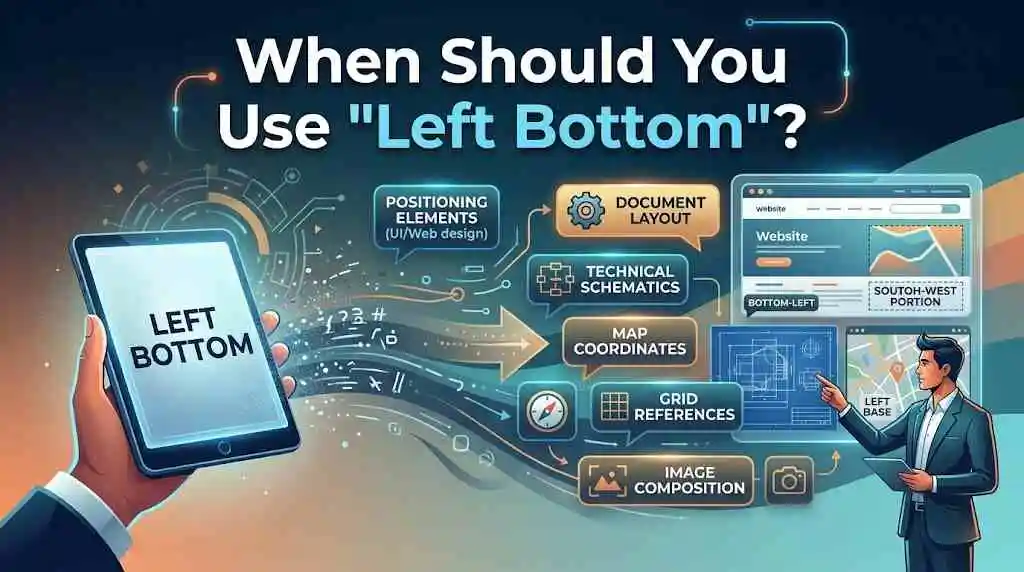
Use the phrase when you need to communicate a position and your audience can easily understand what you mean. However, in edited English, prefer “bottom left” unless a particular layout, label, or technical convention requires different wording.
Professional Settings
In workplace communication, location descriptions help colleagues find information quickly. When giving instructions about a spreadsheet, website, document, or presentation, use specific wording.
For example:
- “The export button is in the bottom-left corner of the dashboard.”
- “Please place the company logo in the lower-left corner of the slide.”
- “The reference number appears in the bottom-left section of the report.”
Practical tip: Use “lower-Abandonedcorner” in formal design specifications and “bottom left” in routine workplace messages.
Casual Conversations
In everyday speech, short directional phrases are natural and efficient.
For example, you might say, “Look at the bottom left of the photo,” when showing someone a picture on your phone.
The goal is to help the other person identify the location without adding unnecessary detail.
Writing, Presentations, and Digital Communication
Location descriptions are particularly useful in:
- Website and app design instructions
- Presentation and slide reviews
- Screenshot annotations
- User guides and tutorials
- Emails and workplace chat
- Image captions and content editing
When describing a digital interface, include the object or reference point whenever possible. “The icon is in the bottom-left corner of the screen” is clearer than simply saying “It’s on the bottom left.”
When It Is Especially Effective
A directional expression works best when the object has a clear orientation, and the reader can identify its lower and left edges. If the location is ambiguous, mention the specific object, page, panel, or screen.
When Should You Avoid “Left Bottom”?
Avoid “left bottom” in polished writing when a more conventional expression would communicate the same meaning naturally.
Overly Formal Situations
In a formal report, client presentation, or professional design specification, use “lower-left corner” or “bottom-left section.” These expressions sound more standard and precise.
Legal, Academic, or Sensitive Contexts
When accuracy matters, do not rely on a vague location description. Legal documents, academic figures, medical diagrams, and technical procedures may require numbered labels, coordinates, page references, or clearly identified sections.
For example, instead of writing “The note is in the Extra bottom,” write “The note appears in the lower-left corner of Figure 2.”
Situations Where Nuance May Be Lost
“Bottom left” can describe a general area, but it does not necessarily identify an exact point. If an interface has multiple panels or a page contains several images, specify which one you mean.
Also, remember that the bottom-left corner of a displayed image is not always the same as the bottom-left corner of the entire screen.
Is “Left Bottom” Professional, Polite, or Casual?
The phrase is primarily a neutral directional description, not a phrase that inherently expresses politeness, friendliness, or authority.
| Factor | Analysis |
| Formality | Neutral, although “left bottom” sounds less idiomatic than “bottom left.” |
| Professionalism | Understandable, but “lower-left corner” is usually more polished. |
| Politeness | Depends on the surrounding sentence, not the location words alone. |
| Emotional subtext | Generally none; it communicates position rather than emotion. |
| Audience perception | Readers may understand it immediately, while some fluent speakers may notice the unusual word order. |
Compare these examples:
- Direct: “Look at the bottom Unused.”
- Polite: “Could you please check the bottom-left corner?”
- Professional: “The reference number is displayed in the lower-left corner of the document.”
- Casual: “It’s down on the left.”
The location remains similar, but the surrounding words influence how the instruction feels.
Pros and Cons of Using “Left Bottom”
Understanding both the strengths and limitations of the expression helps you choose a better alternative when needed.
Advantages
- Understandable: Most readers can infer the intended location from the two directional words.
- Concise: It attempts to communicate a position without a long explanation.
- Accessible vocabulary: Both words are familiar to English learners and general audiences.
- Useful in context: When pointing at a visible object, the intended position may be obvious.
Potential Drawbacks
- Unnatural word order: “Bottom Remaining part” is generally more idiomatic in standard English.
- Reduced precision: The phrase may not distinguish between a corner, an area, and a section.
- Possible repetition: Reusing the same directional wording throughout a document can make instructions monotonous.
- Tone mismatch: In formal writing, the less conventional expression may make the text appear insufficiently edited.
Overall assessment: The meaning is usually recoverable, but “bottom left” or “lower-left corner” is a better default for clear, professional English.
Real-Life Examples of “Left Bottom” by Context
The following examples show how to express the intended location naturally in different situations.
Less natural: “Please check the left bottom of the attached document.”
Better: “Please check the bottom-left corner of the attached document for the updated reference number.”
Meetings
Less natural: “The chart is in the left bottom.”
Better: “You’ll find the chart in the lower-left corner of the slide.”
Presentations
Less natural: “Put the date at the left bottom.”
Better: “Place the date in the bottom-left corner of the title slide.”
Everyday Conversations
Less natural: “Look at the left bottom of this photo.”
Better: “Look at the bottom left of this photo. There’s a small sign beside the door.”
Social Media
Less natural: “The account name is at the left bottom.”
Better: “The account name appears in the bottom-left corner of the image.”
Website and App Design
Less natural: “Move the icon to left bottom.”
Better: “Move the icon to the bottom-left corner of the mobile screen.”
Notice the improvement: the more natural examples identify the location and, when useful, the object being described.
“Left Bottom” vs Similar Expressions (Key Differences)
The expressions below are related, but their meanings and appropriate uses are slightly different.
| Phrase | Meaning Difference | Tone Difference | Best Use Scenario |
| Bottom left | The area at the bottom and on the left side | Neutral, conversational | Everyday directions and quick messages |
| Lower-left corner | The specific corner formed by the lower and left edges | Professional and precise | Reports, presentations, and design instructions |
| Lower-left area | A broader region in the lower-left part of an object | Neutral and descriptive | Maps, dashboards, and complex layouts |
| Bottom-left section | A designated part or section near the bottom left | Structured and professional | Documents, reports, and interface layouts |
| At the bottom on the left | Describes an object’s position using a full phrase | Conversational and explanatory | Emails, tutorials, and spoken instructions |
| Left-hand bottom corner | Identifies the corner on the left side at the bottom | Descriptive, slightly more wordy | Detailed verbal directions |
How to Choose the Right Expression
Use “bottom left” when you want a simple, natural description. Choose “lower-left corner” when the exact corner matters, particularly in technical or professional writing.
Use “lower-left area” if the item is somewhere within that region rather than directly at the corner. If a page is divided into labeled sections, “bottom-left section” may be the clearest choice.
The main principle is to match the wording to the precision your audience needs.
Common Mistakes & Misuse of “Left Bottom”
Directional expressions are simple, but small grammatical mistakes can make instructions harder to follow.
Using an Unnatural Word Order
A common mistake is writing “the left bottom of the page” when “the bottom left of the page” would sound more natural.
- Less natural: “The page number is at the left bottom.”
- Better: “The page number is at the bottom left.”
Confusing a Corner With an Area
A corner is a specific point where two edges meet. An area is a broader region.
If an icon appears close to the corner but not directly inside it, “lower-left area” may be more accurate than “lower-left corner.”
Leaving Out the Reference Object
“Move it to the bottom left” can be unclear if a screen contains multiple windows or panels.
A clearer instruction is: “Move the search icon to the bottom-left corner of the navigation panel.”
Forgetting the Preposition
When describing an item’s location, use grammatical structures that fit the sentence.
- Less natural: “The logo is left bottom the page.”
- Better: “The logo is at the bottom left of the page.”
- Also correct: “The logo is in the lower-left corner of the page.”
Translating Word for Word
ESL learners may transfer word order from another language into English. Direct translation can produce expressions that remain understandable but sound unusual.
A useful learning strategy is to remember common English word combinations as complete phrases, such as “top right,” “bottom left,” and “upper-left corner.”
Overusing Directional Terms
Repeating “bottom left” several times in one paragraph can make instructions tedious. Once the location has been established, use a clear reference such as “the icon” or “that section,” provided the reader will not become confused.
Psychological Reason People Prefer “Left Bottom”
People generally prefer short, familiar expressions when they need to locate something quickly. Directional wording makes it easier to connect a verbal instruction with a visible position.
Cognitive Load Reduction
A concise phrase such as “bottom left” gives readers two familiar directional cues. When paired with a visible screen or image, it helps narrow their attention to a particular region.
However, shorter is not always clearer. Adding a few words, such as “of the settings panel,” can prevent confusion.
Trust and Authority Signals
In professional communication, precise instructions can signal care and competence. A designer who writes “Place the logo in the lower-left corner, 16 pixels from each edge” provides a more actionable instruction than someone who writes “Put it at the left bottom.”
The advantage comes from the clarity of the full instruction, not from using sophisticated vocabulary.
The Attention Economy
Digital readers often scan rather than read every sentence. Familiar phrases help them locate relevant details quickly, especially in tutorials, help articles, and interface documentation.
Modern Communication Habits
Short messages on Slack, WhatsApp, and other platforms encourage compact wording. Nevertheless, brevity should not come at the expense of accuracy. A few extra words can save several rounds of clarification.
These are practical communication principles rather than evidence that people universally prefer one specific phrase. Context, familiarity, and the task itself influence how people process instructions.
US vs UK Usage of “Left Bottom”
Both American and British English commonly use “bottom left” to describe a location. The difference is not primarily regional; it is more about natural word order, context, and writing style.
Popularity and Regional Preferences
In the United States, “bottom left” is common in everyday directions, software instructions, and design discussions. “Lower-left corner” is also widely used in professional writing.
In the United Kingdom, speakers use the same expressions in comparable situations. “Bottom left” and “bottom-left corner” are natural choices in everyday and professional English.
Tone Perception
Neither expression is inherently American or British. Both are broadly understood in the two varieties of English.
| Context | US English | UK English |
| Everyday directions | Bottom left | Bottom left |
| Professional documents | Lower-left corner | Lower-left corner |
| Interface instructions | Bottom-left corner | Bottom-left corner |
| Informal conversation | Down on the left | Down on the left |
Practical takeaway: If you write for an international audience, “bottom left” and “lower-left corner” are reliable choices in both American and British English.
“Left Bottom” in Digital & Modern Communication
Digital communication depends on clear, concise descriptions because people may be reading instructions on different devices or looking at different parts of a screen.
Conclusion
The phrase “left bottom” is understandable, but “bottom left” is generally more natural in standard English. Depending on the context, alternatives such as “lower-left corner,” “bottom section,” and “lower area” can make directions clearer. Choosing the right expression helps your writing sound polished and professional in everyday conversations, emails, and website instructions.
Understanding these alternatives can improve vocabulary and communication skills for students, ESL learners, professionals, and content writers. Whether you are describing a website layout, explaining a presentation, or guiding someone through a technical process, clear language makes instructions easier to follow. Using simple, accurate expressions ensures your message remains natural, readable, and effective.
FAQs
What does “left bottom” mean?
“Left bottom” refers to the lower-left part of an object, page, image, or screen. It combines the directional meanings of “left” and “bottom.” However, “bottom left” is generally the more natural word order in English. The best wording depends on whether you are describing a general area or a specific corner.
Is “left bottom” grammatically correct?
The words are grammatically valid, but “left bottom” is less idiomatic when used to describe a location. In standard English, people generally say “bottom left” or “lower-left corner.” For example, write “The logo is in the bottom-left corner” rather than “The logo is at the left bottom.”
What is the best synonym for “left bottom”?
The best alternative is usually “bottom left.” Other useful options include “lower-left corner,” “lower-left area,” “bottom-left section,” and “at the bottom on the left.” Use “bottom left” for everyday directions and “lower-left corner” for professional documents, technical instructions, and design specifications requiring greater precision.
Should I use “bottom left” ?
Both forms are correct in suitable contexts. Use “bottom left” when describing a location, as in “The button is at the bottom left of the screen.” Use “bottom-left” before a noun when the words work together as a modifier, as in “the bottom-left corner.” Hyphenation may vary slightly by style guide.
Is “lower-left corner” more professional than “bottom left”?
“Lower-left corner” often sounds more precise and formal, making it suitable for business reports, presentations, technical documentation, and design briefs. “Bottom left” is also professional when the context is clear. Choose the expression that matches the required level of detail rather than assuming that a longer phrase is always better.
What is the difference between “bottom left” and “lower-left area”?
“Bottom left” is a general description of a location near the lower-left part of something. These specifically refers to a broader region and does not necessarily mean the item is in the corner. Use “lower-left area” for dashboards, diagrams, or images when the exact corner is not important.
How do I use “bottom left” in a sentence?
Use “bottom left” to identify where something is located. For example, “The page number appears at the bottom left of the document.” You can also write, “Please check the bottom-left corner of the screenshot.” Mentioning the object, page, or screen helps readers understand the location without confusion.
Is “bottom left” used in American and British English?
Yes. “Bottom left” and “lower-left corner” are widely understood in both American and British English. Neither expression is restricted to one region. Writers addressing an international audience can confidently use either phrase, selecting “bottom left” for general directions and “lower-left corner” for more precise descriptions.
What is the difference between “bottom-left corner” and “bottom-left section”?
it is the specific point where the bottom and Remaining partedges meet. A “bottom-left section” refers to a larger, identifiable part of a page, document, or interface. Use “corner” when describing a logo near an edge and “section” when referring to an organized block of content.
How can I make “Remaining bottom” sound more natural in professional writing?
Replace “left bottom” with “lower Remaining section,” depending on the context. For example, write “The download button is in the lower-Abandonedcorner of the dashboard.” This wording sounds natural, identifies the location clearly, and helps colleagues or readers follow instructions efficiently.