Imagine a teacher introducing a new concept, allowing students time to understand the basics, and gradually adding more challenging material as their skills improve. This step-by-step approach helps learners build confidence, strengthen their understanding, and progress at a suitable pace rather than trying to master everything at once.
The term progressive learning describes a process in which knowledge and skills develop gradually, with new concepts building on previous understanding. Depending on the context, alternatives such as “continuous learning,” “incremental learning,” and “scaffolded learning” highlight different aspects of this approach. Understanding these distinctions helps students, educators, and professionals choose more precise vocabulary for educational discussions, training materials, and workplace communication.
What Does “Progressive Learning” Mean?
Its means a gradual approach to gaining knowledge or skills in which learning develops from simpler concepts toward more advanced understanding. It is commonly used in education, training, professional development, and skill-building contexts where learners improve over time through practice, feedback, increasingly difficult tasks, and the addition of new knowledge.
Origin & History of “Progressive Learning”
The word progressive comes from the Latin progressus, meaning advancement or movement forward. It entered English through French and Latin forms and gradually developed the broader meaning of moving from one stage to another.
The educational use of “progressive” became especially influential during the late nineteenth and early twentieth centuries, when educators began questioning highly rigid, teacher-centered models of instruction. Educational reformers emphasized experience, active participation, practical activities, and development according to learners’ needs.
One particularly influential figure was John Dewey, whose educational philosophy emphasized experience, inquiry, problem-solving, and learning through meaningful activity. While “progressive learning” does not have one universally accepted definition derived from a single theory, its modern use often reflects the broader idea that learning can develop progressively rather than occur as a single event.
Today, the phrase is used more broadly. It may describe structured educational progression, gradual skill development, continuing professional education, adaptive instruction, or learning systems that become more challenging as the learner advances.
Synonyms & Alternatives by Tone
Professional & Neutral Alternatives
- Continuous Learning
- Incremental Learning
- Sequential Learning
- Structured Learning
- Developmental Learning
- Skill Development
- Gradual Learning
Polite & Supportive Alternatives
- Supported Learning
- Guided Learning
- Scaffolded Learning
- Learner-Centered Learning
Encouraging & Reassuring Alternatives
- Continuous Development
- Ongoing Development
- Step-by-Step Learning
- Growth-Oriented Learning
Casual, Playful & Idiomatic Alternatives
- Learning as You Go
- Learning Step by Step
- Building Skills Over Time
- Learning at Your Own Pace
When Should You Use “Progressive Learning”?
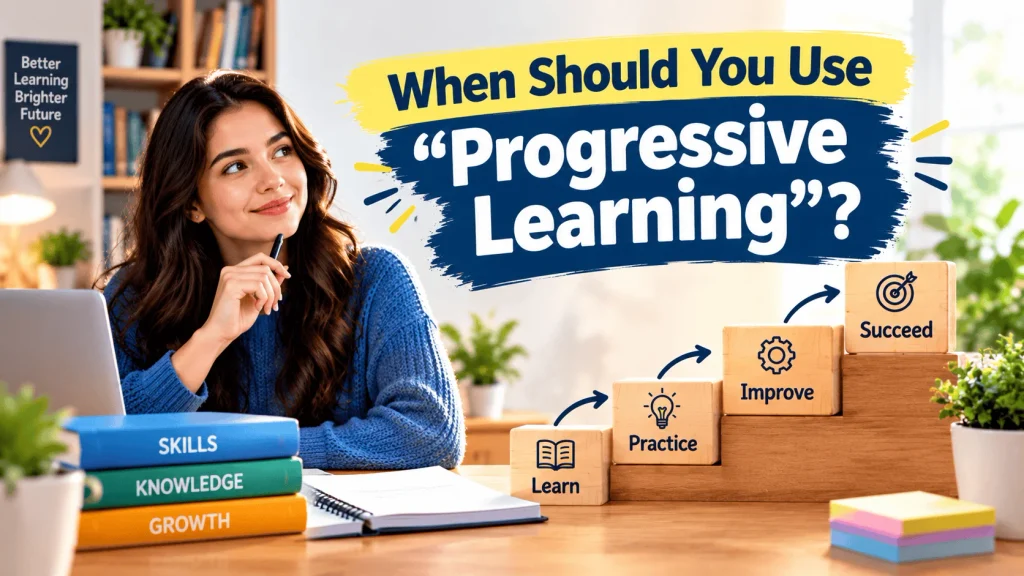
Progressive learning is useful when you want to emphasize development, advancement, and increasing understanding rather than a single learning event.
Professional settings
The phrase can work well in employee training, professional development, coaching, education policy, and organizational learning.
For example:
“Our training program uses progressive learning to help new employees develop technical skills gradually.”
Casual conversations
In everyday conversation, the phrase can describe gradual improvement:
“I’m taking a progressive learning approach instead of trying to master everything at once.”
However, simpler expressions such as learning step by step may sound more natural in casual speech.
Writing and presentations
“Progressive learning” can be useful in educational articles, teaching plans, presentations, training documents, and discussions about curriculum design.
Digital communication
The term can also describe online courses and educational platforms that introduce concepts progressively.
When it is especially effective
Use it when the key idea is advancement from one stage to another. If your intended meaning is simply that learning continues throughout life, continuous learning may be more precise.
When Should You Avoid “Progressive Learning”?
There are situations where a more specific expression improves clarity.
Overly formal situations
If your audience is unfamiliar with educational terminology, “progressive learning” may sound broader than necessary. Plain language such as learning step by step can be easier to understand.
Legal, academic, or sensitive contexts
Academic writing should define the term if it is central to an argument because “progressive learning” can refer to different educational ideas depending on context.
Situations where nuance may be lost
Avoid using it as a universal synonym for every type of learning. For example, continuous learning means ongoing learning, while incremental learning specifically emphasizes small additions or changes.
Is “Progressive Learning” Professional, Polite, or Casual?
“Progressive learning” is generally professional and neutral. It is more common in education, training, organizational development, and academic discussions than in everyday conversation.
Its emotional tone is usually positive because “progressive” suggests advancement and improvement. However, the phrase does not necessarily guarantee that learning is effective. It simply emphasizes a developing or advancing process.
For a professional audience, it can sound appropriate when the meaning is clearly established. For a general audience, step-by-step learning, ongoing learning, or continuous development may be easier to understand.
Pros and Cons of Using “Progressive Learning”
Advantages
- Clarity: It communicates the general idea of development over time.
- Efficiency: It summarizes a gradual learning process in two words.
- Accessibility: The basic meaning is understandable to many English speakers.
- Positive emphasis: “Progressive” naturally suggests advancement.
- Flexibility: It can apply to education, training, and professional development.
Potential Drawbacks
- Broad meaning: It can describe several different learning approaches.
- Tone mismatch: It may sound too academic in casual conversation.
- Repetition: Frequent use can make educational writing monotonous.
- Oversimplification: Not all learning happens in a predictable sequence.
- Possible ambiguity: Readers may interpret “progressive” differently depending on context.
Real Life Examples of “Progressive Learning” by Context
Emails
“The new onboarding course follows a progressive learning structure, beginning with basic procedures before introducing more complex tasks.”
Meetings
“We should use progressive learning so new team members aren’t expected to master the entire system during their first week.”
Presentations
“This program uses progressive learning to move participants from foundational concepts to practical application.”
Conversations
“I’m using progressive learning for coding because I understand new topics better when I build on what I already know.”
Social media
“Progressive learning doesn’t mean rushing through every topic. It means building understanding one stage at a time.”
“Progressive Learning” vs Similar Expressions: Key Differences
These expressions overlap, but each highlights a slightly different aspect of learning.
| Phrase | Meaning Difference | Tone Difference | Best Use Scenario |
| Continuous Learning | Learning that continues over time | Professional and broad | Career development and lifelong learning |
| Incremental Learning | Learning through small additions or steps | Technical and precise | Skill development and structured training |
| Sequential Learning | Learning in a particular order | Formal and structured | Courses, curricula, and technical instruction |
| Scaffolded Learning | Learning supported through temporary guidance | Educational and professional | Teaching difficult concepts |
| Learner-Centered Learning | Instruction designed around learners’ needs | Modern and educational | Teaching strategies and curriculum design |
| Step-by-Step Learning | Learning through clearly defined stages | Simple and accessible | General explanations and beginner instruction |
The important distinction is that progressive learning focuses broadly on advancement, whereas alternatives can identify the specific mechanism behind that advancement.
Common Mistakes & Misuse of “Progressive Learning”
Overuse
Using “progressive learning” in every paragraph can make educational content repetitive. Alternate it with precise terms when the context allows.
Incorrect context
Do not automatically use the phrase when you simply mean “education.” Progressive learning specifically suggests development or advancement.
Contradictory usage
A learning system cannot be described as strictly progressive if the explanation says learners move randomly between unrelated concepts without development or sequence.
Cultural misunderstandings
The word “progressive” can have broader cultural or political associations in some contexts. When writing for an international audience, explaining the educational meaning can prevent confusion.
Psychological Reasons People Prefer “Progressive Learning”
Cognitive load reduction
Breaking complex material into manageable stages can make information easier to process. Learners can connect new ideas with concepts they already understand.
Trust and authority signals
A clearly organized learning progression can reassure learners that there is a logical path from basic knowledge to more advanced skills.
Attention economy
Modern learners often have limited time. Structured progression allows them to focus on one stage or skill before moving forward.
Modern communication habits
Online courses, workplace training, educational apps, and tutorials commonly divide information into smaller lessons. This makes progressive approaches particularly relevant to digital education.
US vs UK Usage of “Progressive Learning”
“Progressive learning” is understandable in both American and British English, although it is not necessarily the most common everyday expression in either variety.
In the US, educational discussions may more frequently use terms such as progressive education, differentiated learning, personalized learning, continuous learning, or skill development, depending on the subject.
In the UK, expressions such as progressive education, learner-centered learning, staged learning, and continuous professional development may appear more often in specific educational contexts.
The basic meaning remains understandable across both varieties. The main difference is usually institutional terminology rather than grammar or meaning.
“Progressive Learning” in Digital & Modern Communication
Emails
Organizations can use the phrase when explaining structured training programs:
“The course follows a progressive learning model, with each module building on the previous one.”
Slack / WhatsApp
In workplace messages, simpler wording may be more natural:
“Let’s introduce the new software step by step.”
Social media
Educational creators often describe progressive learning as a way to develop skills gradually without overwhelming beginners.
AI-generated summaries
AI-generated educational content frequently organizes information from basic concepts to more advanced ones. Describing this structure as progressive learning can help readers understand how the material is organized.
Linguistic & Communication Insight
Emotional weight & subtext
The word progressive generally carries a positive association with movement, improvement, and development. As a result, “progressive learning” can sound optimistic without explicitly promising a particular outcome.
Native speakers may interpret the phrase as suggesting that learning moves forward in stages. However, the exact process is not automatically clear.
Direct vs indirect phrasing
“Progressive learning” is relatively abstract:
“The course uses progressive learning.”
A more direct alternative is:
“The course teaches basic skills first and introduces advanced skills later.”
The second version explains the process rather than naming it.
Professional communication perspective
In professional settings, the phrase can communicate a deliberate training strategy. However, experienced communicators often explain what “progressive” actually means for learners.
Instead of:
“We provide progressive learning.”
a clearer statement might be:
“Employees begin with essential procedures and gradually move to advanced responsibilities.”
Pragmatic reasons for alternatives
Professionals may choose step-by-step learning when speaking to beginners, incremental learning when discussing gradual skill acquisition, or continuous learning when emphasizing ongoing development.
The alternative is often chosen not because “progressive learning” is wrong, but because a more specific phrase reduces ambiguity.
Social signaling
Language can influence whether an educational program sounds accessible or complicated. “Progressive learning” sounds professional, while “learning step by step” feels more conversational and immediately understandable.
Tone & context guidance
Use “progressive learning” when discussing a planned process of advancement. If the audience needs immediate clarity, explain the progression or select a more specific alternative.
Meaning, Usage & Examples for Each Alternative
Continuous Learning
Meaning: Continuous learning refers to the ongoing process of acquiring knowledge or improving skills over time.
Why This Phrase Works: It emphasizes that learning does not stop after completing a course, degree, or training program.
Real-World Usage Insight: It is particularly common in professional development and workplace discussions.
Best Use: Careers, lifelong education, employee development, and professional skills.
Avoid When: You specifically need to emphasize a fixed sequence of learning stages.
Tone: Professional, positive, and broad.
US vs UK Usage: Common in both varieties.
Example (Email / Message / Meeting): “Our team encourages continuous learning by giving employees time each month to develop a new skill.”
Incremental Learning
Meaning: Incremental learning involves gaining knowledge or improving abilities through relatively small additions or stages.
Why This Phrase Works: It clearly emphasizes gradual change rather than sudden mastery.
Real-World Usage Insight: The term works particularly well when discussing technical skills, training, or complex subjects.
Best Use: Technical training, education, skill development, and structured improvement.
Avoid When: You simply mean lifelong learning.
Tone: Professional and precise.
US vs UK Usage: Used in both, particularly in technical and educational contexts.
Example (Meeting): “We introduced the software through incremental learning, adding one major feature to the training each week.”
Sequential Learning
Meaning: Sequential learning involves learning information or skills in a particular order.
Why This Phrase Works: It makes the importance of sequence explicit.
Real-World Usage Insight: It is useful when later concepts depend directly on earlier ones.
Best Use: Curriculum design, mathematics, science, technical training, and procedures.
Avoid When: Learners can freely explore topics without a required order.
Tone: Formal and structured.
US vs UK Usage: Understandable and used in both varieties.
Example (Blog): “The tutorial uses sequential learning, introducing basic commands before asking readers to build a complete program.”
Structured Learning
Meaning: Structured learning follows an organized plan, curriculum, schedule, or set of objectives.
Why This Phrase Works: It emphasizes organization rather than simply gradual progress.
Real-World Usage Insight: Schools, universities, training providers, and workplaces commonly use structured learning programs.
Best Use: Courses, employee training, certification programs, and study plans.
Avoid When: Describing completely spontaneous or informal learning.
Tone: Professional and organized.
US vs UK Usage: Widely used in both.
Example (Email): “The new employees will complete a structured learning program during their first month.”
Developmental Learning
Meaning: Developmental learning focuses on the gradual development of knowledge, abilities, understanding, or personal capabilities.
Why This Phrase Works: It emphasizes the learner’s broader development rather than only individual lessons.
Real-World Usage Insight: The expression can be useful when discussing education, professional growth, and personal development.
Best Use: Education, training, personal growth, and developmental programs.
Avoid When: You need to describe a specific lesson sequence.
Tone: Professional and educational.
US vs UK Usage: Recognized in both varieties.
Example (Meeting): “The mentoring program takes a developmental learning approach, giving junior employees increasing responsibility as their skills grow.”
Skill Development
Meaning: Skill development is the process of improving a particular ability through learning, practice, feedback, or experience.
Why This Phrase Works: It tells the reader exactly what is developing: a skill.
Real-World Usage Insight: This is one of the clearest choices for workplace training and career-related content.
Best Use: Careers, vocational training, education, and professional development.
Avoid When: Discussing broad knowledge that is not connected to a particular skill.
Tone: Practical and professional.
US vs UK Usage: Very common in both.
Example (Social Media): “Consistent practice is one of the most effective ways to support long-term skill development.”
Gradual Learning
Meaning: Gradual learning describes learning that develops slowly or in stages rather than all at once.
Why This Phrase Works: It is immediately understandable and clearly communicates the pace of development.
Real-World Usage Insight: It works particularly well when explaining learning to general audiences or beginners.
Best Use: General education, advice, beginner guides, and skill-building.
Avoid When: You need highly technical terminology.
Tone: Simple, neutral, and accessible.
US vs UK Usage: Natural in both varieties.
Example (Blog): “Gradual learning can make a difficult subject easier to manage because each lesson introduces only a limited amount of new material.”
Supported Learning
Meaning: Supported learning describes a process in which learners receive assistance, resources, guidance, or feedback while developing skills.
Why This Phrase Works: It emphasizes the help available to the learner.
Real-World Usage Insight: The expression is particularly useful when discussing inclusive education and training.
Best Use: Education, mentoring, tutoring, workplace onboarding, and learner support.
Avoid When: The main feature of the program is progression rather than assistance.
Tone: Supportive and professional.
US vs UK Usage: Understood in both varieties.
Example (Meeting): “We’ll provide supported learning during the first few weeks so new staff can ask questions as they work.”
Guided Learning
Meaning: Guided learning is learning supported by an instructor, mentor, coach, tutor, or structured set of instructions.
Why This Phrase Works: It makes the role of guidance clear.
Real-World Usage Insight: It is useful when learners need direction while gradually becoming more independent.
Best Use: Classrooms, tutoring, workplace training, mentoring, and online courses.
Avoid When: Learning is intentionally independent with minimal external direction.
Tone: Helpful, professional, and reassuring.
US vs UK Usage: Common in both varieties.
Example (Email): “The first three modules include guided learning sessions with an instructor before participants begin independent assignments.”
Scaffolded Learning
Meaning: Scaffolded learning provides temporary support that helps learners complete tasks they may not yet be able to handle independently.
Why This Phrase Works: It emphasizes support that can gradually be reduced as competence increases.
Real-World Usage Insight: Teachers often use examples, prompts, demonstrations, and guided practice before asking students to work independently.
Best Use: Education, teaching methodology, training, and complex skill development.
Avoid When: Writing for audiences unfamiliar with educational terminology without explaining.
Tone: Educational and professional.
US vs UK Usage: Common in educational discussions in both varieties.
Example (Blog): “The instructor uses scaffolded learning by demonstrating the first problem, solving the next one with the class, and then assigning independent practice.”
Learner Centered Learning
Meaning: Learner-centered learning places the learner’s needs, abilities, interests, participation, and development at the center of the educational process.
Why This Phrase Works: It emphasizes the learner rather than only the curriculum or instructor.
Real-World Usage Insight: The term is common in modern education and training discussions.
Best Use: Teaching strategies, curriculum planning, professional training, and educational policy.
Avoid When: The defining feature is simply progression through levels.
Tone: Modern, educational, and supportive.
US vs UK Usage: Used in both varieties.
Example (Meeting): “We redesigned the workshop around learner-centered learning so participants can choose activities that match their current skill levels.”
Continuous Development
Meaning: Continuous development describes ongoing improvement in knowledge, skills, abilities, or professional capabilities.
Why This Phrase Works: It emphasizes long-term growth rather than a single learning event.
Real-World Usage Insight: It is especially useful in professional development and organizational settings.
Best Use: Careers, leadership, workplace training, and personal development.
Avoid When: Discussing only one short learning activity.
Tone: Professional and growth-oriented.
US vs UK Usage: Common in both English varieties.
Example (Email): “The company supports continuous development through mentoring, workshops, and annual training opportunities.”
Conclusion
Learning becomes easier when new knowledge builds on existing skills. Progressive learning follows this gradual approach, helping learners move from basic concepts to advanced understanding. Related terms emphasize different aspects of this process depending on the context.. Continuous learning focuses on ongoing education, incremental learning emphasizes small steps, structured learning highlights organization, and scaffolded learning emphasizes temporary support. Choosing the right term can make educational, professional, and digital communication more precise.
Progressive learning can be useful in classrooms, workplace training, online courses, personal development, and skill-building programs, especially when learners need to build new abilities on an existing foundation. However, the phrase can be broad, so explaining what the learning process actually involves is often more effective than relying on the term alone. For general audiences, simple alternatives such as step by step learning may provide greater clarity. Ultimately, the best expression depends on the learner, context, purpose, and type of progression being described.
FAQs
What is progressive learning?
Progressive learning is an approach in which knowledge or skills develop gradually, usually by introducing foundational concepts before more advanced ones. It can involve practice, feedback, increasingly difficult tasks, and continued development. The term is commonly used in education, workplace training, professional development, online courses, and other settings where learners build abilities over time.
What is another word for progressive learning?
Common alternatives include continuous learning, incremental learning, sequential learning, structured learning, gradual learning, skill development, guided learning, scaffolded learning, and step-by-step learning. The best synonym depends on the intended meaning. For example, “continuous learning” emphasizes ongoing development, while “step-by-step learning” focuses on progressing through clearly defined stages.
Is progressive learning the same as continuous learning?
Not exactly. Progressive learning emphasizes advancement or development from one stage toward another, while continuous learning emphasizes learning that continues over time. A person can engage in continuous learning without following a particular progression. Therefore, use “progressive learning” when advancement matters and “continuous learning” when the main idea is ongoing development.
What are the benefits of progressive learning?
Progressive learning can make complex subjects easier to approach by introducing information in manageable stages. Learners can connect new concepts with previous knowledge, practice skills before moving forward, and receive feedback along the way. This approach can support better organization, gradual skill development, confidence, and deeper understanding, particularly in structured educational or training environments.
Is progressive learning good for students?
Progressive learning can be effective for students when lessons are appropriately sequenced and students receive enough practice and support. It allows foundational knowledge to develop before more difficult concepts are introduced. However, students do not all learn in the same way or at the same pace, so flexible teaching and appropriate support remain important.
What is the difference between progressive and incremental learning?
Progressive learning broadly describes advancement from one stage or level to another. Incremental learning specifically emphasizes small additions or changes made over time. The terms overlap, but incremental learning is more precise when the focus is on gradual steps, while progressive learning can describe a broader process of development.
What is step by step learning?
Step-by-step learning means developing knowledge or skills through clearly defined stages, with one part generally completed or understood before moving to the next. It is a simple, accessible alternative to “progressive learning” and works particularly well in beginner guides, tutorials, online courses, classroom instruction, and explanations intended for general audiences.
Is progressive learning formal or casual?
“Progressive learning” generally has a professional and educational tone. It is more common in teaching, training, professional development, and educational writing than in casual conversation. In everyday speech, alternatives such as “learning step by step,” “gradual learning,” or “learning as you go” may sound more natural and immediately understandable.
How is progressive learning used in the workplace?
In the workplace, progressive learning can describe training that develops employees’ knowledge and responsibilities gradually. For example, a new employee might first learn basic procedures, then handle routine tasks, and eventually take on more complex responsibilities. The approach can support onboarding, professional development, technical training, leadership development, and continuous improvement.
Can progressive learning be used for online education?
Yes. Progressive learning is well suited to online education because digital courses can divide complex subjects into modules, lessons, exercises, and increasingly advanced activities. A course might begin with foundational concepts, provide guided practice, and then introduce more challenging tasks. This structure can make online learning easier to navigate and understand.