
Imagine reading a report that describes a policy as deeply offensive, or hearing someone call an action morally objectionable. The word “odious” can communicate that strong negative judgment in a single, precise term. It is especially useful when ordinary words such as “bad” or “unpleasant” do not fully express the seriousness of a reaction.
In modern English, choosing the right synonym for odious depends heavily on context. A professional email may require a restrained alternative such as objectionable, while a personal conversation might naturally use disgusting or hateful. Understanding these distinctions helps students, professionals, ESL learners, and writers communicate criticism accurately without sounding unnecessarily harsh.
What Does “Odious” Mean?
Odious means extremely unpleasant, offensive, or deserving strong dislike. It commonly describes a person, behavior, idea, practice, or situation that causes intense moral, emotional, or personal disapproval. The word is often used in formal writing, criticism, discussions of unacceptable conduct, and situations where ordinary terms such as “bad” or “unpleasant” seem too weak.
Origin & History of “Odious”
The word odious comes from the Latin odiosus, meaning “hateful” or “full of hatred,” which developed from odium, meaning “hatred” or “dislike.” It entered English through Old French and became established in English during the Middle Ages.
Historically, odious was closely connected with the idea of being hated or strongly disliked. Over time, its meaning broadened to include things that are deeply offensive, objectionable, repellent, or morally unacceptable.
In modern English, the word remains relatively formal. It frequently appears in journalism, essays, legal commentary, political discussion, literature, and serious criticism. Its historical association with strong dislike explains why odious generally carries more emotional weight than simple alternatives such as “unpleasant” or “annoying.”
Synonyms & Alternatives by Tone
Professional & Neutral Alternatives
- Objectionable
- Offensive
- Unacceptable
- Unpleasant
- Reprehensible
Polite & Supportive Alternatives
- Concerning
- Problematic
- Unwelcome
- Distasteful
Encouraging & Reassuring Alternatives
- Difficult to accept
- Not appropriate
- Better avoided
Casual, Playful & Idiomatic Alternatives
- Disgusting
- Gross
- Nasty
- Awful
- Horrible
- Hateful
The best synonym depends on how strong your criticism needs to be. Some alternatives describe personal dislike, while others focus on ethical concerns, social acceptability, or emotional reaction.
When Should You Use “Odious”?
Odious is most effective when you need to express strong disapproval in a concise and relatively formal way.
Professional settings
In professional writing, odious can describe policies, practices, behavior, or ideas considered seriously objectionable. However, because it is strong, it should be supported by clear reasoning rather than used as an emotional label.
Casual conversations
The word is understandable in everyday English, but it can sound formal or literary. In casual speech, people often prefer words such as awful, disgusting, nasty, or horrible.
Writing, presentations, and digital communication
Odious can work well in essays, opinion writing, presentations, reviews, and formal commentary. In workplace chats or short messages, a softer alternative may communicate the same concern more constructively.
When it is especially effective
Use odious when the subject is not merely inconvenient or unpleasant but strongly offensive, objectionable, or deserving serious disapproval.
When Should You Avoid “Odious”?
Avoid odious when the situation requires neutral, measured, or highly specific language.
- Overly formal situations: A simple word such as “unpleasant” may sound more natural in everyday conversation.
- Legal contexts: Avoid replacing a precise legal description with an emotional judgment unless the wording is appropriate to the document.
- Academic contexts: Explain exactly why something is problematic rather than relying only on a strong adjective.
- Sensitive discussions: “Odious” may sound judgmental when the audience expects empathy or neutrality.
- Situations where nuance matters: If something is merely inconvenient, “odious” may exaggerate the problem.
Is “Odious” Professional, Polite, or Casual?
Odious is primarily formal and strongly negative. It is more common in serious writing than relaxed conversation.
Its emotional subtext suggests intense dislike, rejection, or moral disapproval. Because of this, readers may perceive the speaker as making a firm judgment rather than simply describing an inconvenience.
In professional communication, the word can sound authoritative when used carefully, but it can also appear unnecessarily severe. For example, calling a colleague’s proposal “odious” could create defensiveness. Describing the proposal as problematic or unacceptable may communicate the concern more productively.
The word is therefore best suited to contexts where strong criticism is intentional and justified.
Pros and Cons of Using “Odious”
Advantages
- Clarity: It communicates strong negative evaluation efficiently.
- Efficiency: One word can replace a longer description of intense dislike or objection.
- Accessibility: Most advanced English readers understand its general meaning.
- Precision: It can distinguish serious objection from ordinary inconvenience.
- Strong emphasis: It is useful when mild words do not adequately communicate the writer’s position.
Potential Drawbacks
- Oversimplification: Calling something “odious” may overlook important differences in context.
- Tone mismatch: It can sound too harsh in friendly or collaborative communication.
- Formality: It may feel unnatural in casual conversation.
- Emotional intensity: Readers may interpret it as a strong personal or moral judgment.
- Repetition: Using it repeatedly can make writing sound exaggerated.
Real-Life Examples of “Odious” by Context
“The committee agreed that the proposed practice was odious and inconsistent with the organization’s stated standards.”
Meeting
“Several members considered the policy odious because it treated different groups unfairly.”
Presentation
“The presentation examined why society came to regard the practice as odious.”
Conversation
“I find that kind of behavior completely odious.”
Social Media
“There is a serious difference between disagreeing with someone and supporting odious behavior.”
These examples show that odious is most natural when the speaker wants to express strong disapproval rather than simple dislike.
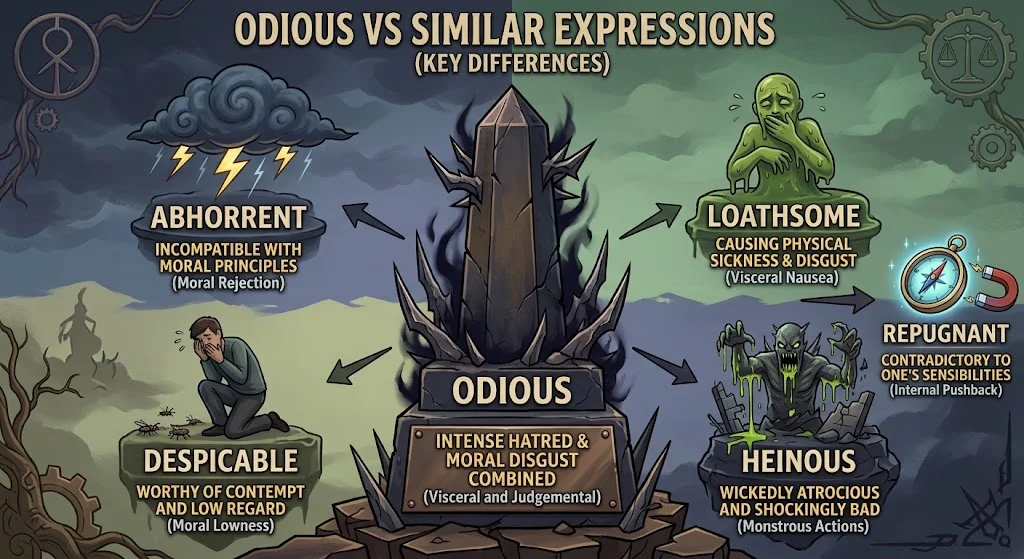
“Odious” vs Similar Expressions (Key Differences)
| Phrase | Meaning Difference | Tone Difference | Best Use Scenario |
| Objectionable | Something that causes disagreement or disapproval | Formal, measured | Professional criticism |
| Offensive | Something that causes insult, hurt, or outrage | Strong but common | Conduct, remarks, media |
| Unacceptable | Something that should not be tolerated or approved | Firm, professional | Workplace rules and standards |
| Reprehensible | Something deserving strong moral criticism | Formal, serious | Ethical or moral discussions |
| Distasteful | Something unpleasant or offensive to one’s sense of taste or judgment | Mild to moderate | Polite criticism |
| Disgusting | Something causing strong disgust or revulsion | Direct, emotional, casual | Everyday conversation |
The key difference is what kind of negative reaction each word emphasizes. “Odious” is broad but intense; “objectionable” is more restrained; “reprehensible” emphasizes moral blame; and “distasteful” usually sounds softer.
Common Mistakes & Misuse of “Odious”
Overuse
Using odious for every minor inconvenience weakens its impact. A delayed meeting or slightly boring presentation is usually not “odious.”
Incorrect context
The word should describe something that genuinely attracts strong dislike or disapproval. Using it simply to mean “different” or “unusual” is incorrect.
Contradictory usage
Avoid combinations that undermine the word’s meaning, such as describing something as “slightly odious” unless the context deliberately creates that contrast.
Cultural misunderstandings
The intensity of odious can vary according to audience. Some readers may interpret it as a serious moral accusation rather than casual criticism. In international communication, a softer synonym can prevent unintended offense.
Psychological Reasons People Prefer “Odious”
People sometimes choose strong words because they reduce the need for lengthy explanation. Saying something is “odious” immediately signals substantial disapproval.
Cognitive load reduction
A precise adjective can summarize a complicated emotional judgment without requiring several sentences.
Trust and authority signals
In formal writing, carefully selected vocabulary can make an argument appear more deliberate. However, sophisticated vocabulary does not automatically make an argument stronger; the reasoning behind the judgment still matters.
Attention economy
Modern readers often scan emails, articles, posts, and summaries. Strong, precise wording can make the writer’s evaluation immediately visible.
Modern communication habits
Digital communication encourages concise language. People increasingly select words that communicate a position quickly, although emotionally strong terms should still match the actual situation.
US vs UK Usage of “Odious”
Odious is used in both American and British English, with no major difference in its core definition.
In both varieties, it tends to sound formal, serious, and strongly negative. British English may sometimes use the word naturally in formal commentary, journalism, or literary writing, while American English also uses it in political, professional, and opinion-based contexts.
The more important difference is not geography but register. In both US and UK English, everyday speakers are more likely to choose “awful,” “disgusting,” “unacceptable,” or “offensive” in casual conversation.
“Odious” in Digital & Modern Communication
Emails
Use it sparingly when discussing serious misconduct, unacceptable practices, or strongly objectionable ideas.
Slack / WhatsApp
It can sound unusually formal. Problematic, unacceptable, or concerning may be more natural for workplace messaging.
Social media
The word can be effective when expressing strong criticism, but its intensity can also make a post sound confrontational.
AI-generated summaries
AI-generated writing may overuse formal words such as “odious” when summarizing criticism. Human editors should check whether the word accurately reflects the original speaker’s tone.
Linguistic & Communication Insight
Emotional weight & subtext
The literal meaning of odious concerns intense dislike or strong objection, but native speakers may also perceive a deliberate moral or emotional judgment. It does more than describe something as inconvenient. The word signals that the speaker believes the subject deserves substantial rejection.
Direct vs indirect phrasing
“Odious” is direct. It gives the audience little uncertainty about the speaker’s evaluation.
Compare:
“The practice is odious.”
with:
“The practice raises several serious concerns.”
The second sentence is less confrontational and leaves room for discussion. The first makes the speaker’s judgment unmistakable.
Professional communication perspective
In workplaces, direct language can be useful when standards have clearly been violated. However, interpersonal communication often benefits from explaining the specific problem instead of applying a powerful label.
Pragmatic reasons for alternatives
Experienced communicators often choose problematic, concerning, objectionable, or inappropriate because these words allow criticism without immediately closing the conversation. Softer wording can reduce defensiveness while preserving the central concern.
Social signaling
Word choice tells readers how strongly they should interpret a message. Odious signals high disapproval. Distasteful suggests a lower level of objection. Unacceptable signals that a boundary or standard has been crossed.
Tone & context guidance
Use odious when strong criticism is intentional, relevant, and defensible. Avoid it when your main goal is collaboration, negotiation, or gentle correction.
Meaning, Usage & Examples for Each Alternative
Objectionable
Meaning: Objectionable describes something that causes disapproval, disagreement, or concern. It is a useful alternative to “odious” when you want to criticize something without implying extreme emotional disgust.
Why This Phrase Works: It communicates a clear negative assessment while maintaining a professional and controlled tone.
Real-World Usage Insight: Professionals frequently use “objectionable” when discussing policies, procedures, statements, or decisions that do not meet accepted standards.
Best Use: Reports, workplace communication, formal feedback, academic writing, and policy discussions.
Avoid When: You need to communicate extreme emotional disgust or severe moral condemnation.
Tone: Formal, measured, professional.
US vs UK Usage: Common and natural in both American and British English.
Example (Email / Message / Meeting): “The revised clause is objectionable because it could create confusion about who is responsible for the final decision.”
Offensive
Meaning: Offensive describes something that causes insult, anger, hurt, or strong disapproval. It often focuses on the effect something has on people rather than simply describing something as unpleasant.
Why This Phrase Works: It is widely understood and communicates serious concern without sounding unusually literary.
Real-World Usage Insight: It is especially useful when discussing remarks, behavior, images, jokes, or content that crosses social boundaries.
Best Use: Workplace conduct, public statements, media, social situations, and content discussions.
Avoid When: You mean only “slightly unpleasant” or inconvenient.
Tone: Direct, serious, widely understood.
US vs UK Usage: Very common in both varieties of English.
Example (Email / Message / Meeting): “Several employees found the comment offensive, so we agreed to address the issue privately.”
Unacceptable
Meaning: Unacceptable means that something does not meet an expected standard and should not be permitted, approved, or tolerated.
Why This Phrase Works: It focuses on standards and boundaries rather than personal emotion.
Real-World Usage Insight: It is particularly effective when communicating decisions, expectations, workplace rules, or quality standards.
Best Use: Professional emails, policies, complaints, customer service, and management communication.
Avoid When: You only want to express a personal preference.
Tone: Firm, professional, authoritative.
US vs UK Usage: Equally natural in American and British English.
Example (Email / Message / Meeting): “The repeated delays are unacceptable because they are affecting the project’s agreed deadline.”
Unpleasant
Meaning: Unpleasant refers to something that causes discomfort, annoyance, or an unfavorable feeling. It is considerably milder than “odious.”
Why This Phrase Works: It allows criticism without sounding aggressive.
Real-World Usage Insight: It is a practical choice when the issue is uncomfortable but does not justify severe language.
Best Use: Everyday conversation, polite feedback, workplace communication, and general descriptions.
Avoid When: The issue involves serious misconduct or strong moral condemnation.
Tone: Mild, neutral, polite.
US vs UK Usage: Common in both American and British English.
Example (Email / Message / Meeting): “The discussion became unpleasant, so we decided to pause and continue after everyone had reviewed the information.”
Reprehensible
Meaning: Reprehensible means deserving strong criticism or blame, particularly because something is considered morally wrong or seriously unacceptable.
Why This Phrase Works: It emphasizes ethical judgment rather than simple personal dislike.
Real-World Usage Insight: Writers often use it when discussing serious misconduct, unethical behavior, or actions that violate important standards.
Best Use: Formal criticism, journalism, ethics discussions, serious essays, and public commentary.
Avoid When: Discussing ordinary annoyances or minor disagreements.
Tone: Formal, serious, strongly judgmental.
US vs UK Usage: Used in both varieties, particularly in formal writing.
Example (Email / Message / Meeting): “The committee described the misuse of customer information as reprehensible and recommended immediate corrective action.”
Concerning
Meaning: Concerning describes something that causes worry, uncertainty, or the need for further attention.
Why This Phrase Works: It communicates a problem without immediately assigning severe blame.
Real-World Usage Insight: It is one of the most useful alternatives when you want to start a constructive conversation.
Best Use: Workplace feedback, reports, customer communication, and sensitive discussions.
Avoid When: The audience needs a firm statement that a rule has already been violated.
Tone: Polite, cautious, professional.
US vs UK Usage: Common in both, although “concerning” can have different meanings depending on sentence structure.
Example (Email / Message / Meeting): “The latest figures are concerning, particularly because the same issue appeared in last month’s report.”
Problematic
Meaning: Problematic means involving a problem, difficulty, weakness, or potentially harmful issue.
Why This Phrase Works: It identifies concern while leaving room for analysis and improvement.
Real-World Usage Insight: It is particularly useful in professional and academic settings because it sounds analytical rather than purely emotional.
Best Use: Reports, feedback, discussions, workplace communication, and academic writing.
Avoid When: You need to state clearly that something violates a firm rule.
Tone: Neutral, analytical, measured.
US vs UK Usage: Widely used in both American and British English.
Example (Email / Message / Meeting): “The current approval process is problematic because it creates unnecessary delays for small requests.”
Unwelcome
Meaning: Unwelcome describes something that is not wanted, accepted, or appreciated by a person or group.
Why This Phrase Works: It communicates rejection without automatically implying moral wrongdoing.
Real-World Usage Insight: It works well when describing comments, changes, interruptions, behavior, or developments that people would rather not receive.
Best Use: Workplace communication, social situations, announcements, and polite criticism.
Avoid When: The matter involves serious ethical misconduct requiring stronger wording.
Tone: Polite, restrained, negative.
US vs UK Usage: Natural in both varieties of English.
Example (Email / Message / Meeting): “The unexpected change was unwelcome because the team had already planned the project around the original schedule.”
Distasteful
Meaning: Distasteful describes something that causes dislike or discomfort, especially because it seems offensive, inappropriate, or lacking good judgment.
Why This Phrase Works: It offers a softer way to criticize something that feels inappropriate.
Real-World Usage Insight: It can be useful when the speaker wants to express disapproval without making an extremely severe accusation.
Best Use: Social behavior, humor, advertising, writing, and sensitive criticism.
Avoid When: The conduct is clearly serious enough to require stronger and more precise language.
Tone: Polite, restrained, somewhat formal.
US vs UK Usage: Used naturally in both American and British English.
Example (Email / Message / Meeting): “Some readers considered the advertisement distasteful because it made light of a sensitive subject.”
Difficult to Accept
Meaning: “Difficult to accept” describes something that a person or group finds hard to approve, understand, tolerate, or emotionally process.
Why This Phrase Works: It expresses disagreement while acknowledging that people may have different reactions.
Real-World Usage Insight: This expression is valuable when communicating with empathy or discussing sensitive decisions.
Best Use: Personal conversations, workplace changes, difficult news, and supportive communication.
Avoid When: You need a concise formal adjective for a report or policy.
Tone: Empathetic, indirect, measured.
US vs UK Usage: Common and natural in both varieties.
Example (Email / Message / Meeting): “The decision is difficult to accept, especially after the team worked for months to meet the original requirements.”
Not Appropriate
Meaning: “Not appropriate” means unsuitable for a particular situation, audience, purpose, or standard.
Why This Phrase Works: It provides clear criticism without using highly emotional vocabulary.
Real-World Usage Insight: It is especially effective when correcting behavior or content while trying to preserve a respectful relationship.
Best Use: Schools, workplaces, customer communication, feedback, and professional conversations.
Avoid When: The issue requires an explicit statement of serious misconduct or harm.
Tone: Polite, corrective, professional.
US vs UK Usage: Very common in both American and British English.
Example (Email / Message / Meeting): “The wording in the draft is not appropriate for a customer-facing document, so I recommend revising it before publication.”
Better Avoided
Meaning: “Better avoided” indicates that something is best not used, attempted, or included because it may cause problems.
Why This Phrase Works: It advises without sounding aggressively judgmental.
Real-World Usage Insight: This expression is useful when advising someone about wording, behavior, or choices that could create unnecessary difficulty.
Best Use: Writing advice, professional recommendations, social situations, and informal guidance.
Avoid When: A direct prohibition or firm rule is necessary.
Tone: Mild, advisory, indirect.
US vs UK Usage: Understood in both varieties, though it may sound somewhat more natural or understated in British English.
Example (Email / Message / Meeting): “For this audience, that phrase is better avoided because it could be interpreted as dismissive.”
Disgusting
Meaning: Disgusting describes something that causes strong feelings of disgust or revulsion.
Why This Phrase Works: It is direct, familiar, and emotionally powerful.
Real-World Usage Insight: Unlike “odious,” it is very common in everyday speech and usually sounds much less formal.
Best Use: Casual conversations and strong personal reactions.
Avoid When: Writing formal workplace documents or making careful academic arguments.
Tone: Strong, emotional, casual.
US vs UK Usage: Very common in both American and British English.
Example (Email / Message / Meeting): “The smell coming from the spoiled food was disgusting, so we threw it away immediately.”
Gross
Meaning: Gross is an informal word meaning disgusting, unpleasant, or offensive.
Why This Phrase Works: It is short and natural in casual conversation.
Real-World Usage Insight: It is particularly common in spoken English and informal digital communication.
Best Use: Friends, family, casual messages, and social media.
Avoid When: Communicating formally with customers, managers, academic audiences, or unfamiliar professionals.
Tone: Very casual, direct.
US vs UK Usage: Common in both, although American English uses “gross” especially frequently in everyday speech.
Example (Email / Message / Meeting): “That old food in the back of the fridge is gross. We should clean it out today.”
Conclusion
Understanding odious and its synonyms helps you communicate strong dislike or disapproval with greater accuracy. Although the word generally describes something extremely unpleasant, offensive, or objectionable, its formal tone means it is not always the best choice for everyday communication. Depending on your audience and purpose, alternatives such as objectionable, unacceptable, offensive, problematic, reprehensible, or distasteful may express the same general idea with a more suitable level of intensity. For casual conversations, words such as awful, disgusting, gross, or nasty often sound more natural. The most effective choice depends on whether you want to emphasize moral criticism, personal dislike, social offense, or professional concern. By considering meaning, tone, context, and audience, writers can avoid exaggeration and communicate more naturally. Whether you are an ESL learner, student, professional, or content writer, knowing these distinctions can improve vocabulary, clarity, and confidence. Choose the synonym that matches both the message and the situation.
FAQs
What does “odious” mean?
Odious means extremely unpleasant, offensive, hateful, or deserving strong dislike. It is generally used for people, behavior, practices, ideas, or situations that cause intense disapproval. The word has a formal tone and commonly appears in serious writing, criticism, journalism, essays, and discussions involving unacceptable or morally objectionable conduct.
What are the best synonyms for “odious”?
Common synonyms for odious include objectionable, offensive, unacceptable, reprehensible, unpleasant, problematic, distasteful, disgusting, nasty, and awful. The best choice depends on context. “Reprehensible” emphasizes moral wrongdoing, “objectionable” sounds measured and professional, while “disgusting” is more emotional and natural in casual conversation.
Is “odious” a negative word?
Yes, odious is strongly negative. It describes something that causes intense dislike, offense, or disapproval. Unlike mild words such as “unpleasant,” it usually communicates a serious negative judgment. Because of its intensity, writers should use it when the situation genuinely deserves strong criticism rather than for ordinary inconveniences.
Is “odious” formal or informal?
Odious is primarily a formal word. It is more common in essays, journalism, professional commentary, literature, and serious discussions than in casual speech. Native speakers may understand it easily, but everyday conversations often use simpler alternatives such as “awful,” “disgusting,” “nasty,” or “unacceptable.”
Can “odious” describe a person?
Yes. Odious can describe a person whose behavior or character is considered extremely unpleasant, offensive, or hateful. However, calling someone “odious” is a very strong judgment. In professional or sensitive situations, describing the specific behavior as “inappropriate,” “problematic,” or “unacceptable” may communicate the concern more constructively.
What is a polite alternative to “odious”?
Polite alternatives include concerning, problematic, distasteful, unwelcome, inappropriate, and unpleasant. These words allow you to express criticism without sounding excessively harsh. For workplace communication, “concerning” or “problematic” can be particularly useful because they identify an issue while leaving room for discussion, clarification, and improvement.
What is the difference between “odious” and “offensive”?
Odious describes something extremely unpleasant or deserving strong dislike, while offensive usually emphasizes that something causes insult, hurt, anger, or outrage. For example, an unethical practice might be called odious, while a disrespectful remark is more naturally described as offensive.
What is the difference between “odious” and “reprehensible”?
Both words express strong disapproval, but reprehensible more specifically suggests that something deserves blame because it is morally wrong or seriously unacceptable. Odious is broader and can describe something intensely unpleasant, hateful, or objectionable. Therefore, “reprehensible” is especially suitable for ethical or moral criticism.
Is “odious” commonly used in American and British English?
Yes. Odious is used in both American and British English and has essentially the same meaning in each variety. In both forms of English, it tends to sound formal and serious. Everyday speakers in either region are more likely to choose familiar alternatives such as “awful,” “unacceptable,” “offensive,” or “disgusting.”
What is the best synonym for “odious” in professional writing?
Objectionable, unacceptable, problematic, or concerning are often better choices in professional writing, depending on the intended meaning. “Objectionable” expresses disapproval without excessive emotion, while “unacceptable” communicates a clear boundary. “Problematic” is analytical, and “concerning” is comparatively diplomatic. Choose the word that accurately reflects the seriousness of the issue.