
Imagine a colleague asks, “Would you prefer the morning meeting or the afternoon meeting?” You may genuinely have no preference and simply want to say that either option works. In that situation, “It does not matter to me” is a clear way to express that you have no particular preference.
The phrase is common in everyday English, workplace conversations, emails, messages, and informal discussions. However, the best wording depends on your relationship with the listener and the situation. Saying “I’m fine with either” can sound cooperative, while “I don’t care” may sound dismissive even when you intend to be neutral.
Understanding synonyms and alternatives for “it does not matter to me” helps you communicate flexibility without accidentally sounding uninterested, impatient, or rude. This guide explains the meaning, history, tone, practical alternatives, regional usage, and real-world examples so you can choose the most appropriate expression for every context.
What Does “It Does Not Matter to Me” Mean?
its means that a particular choice, outcome, detail, or option has no significant effect on the speaker’s preference or decision. It is commonly used when someone has no strong opinion between alternatives or considers the possible outcomes equally acceptable. The phrase can appear in conversations, workplace discussions, messages, and everyday communication.
Origin & History of “It Does Not Matter to Me”
The phrase “it does not matter to me” comes from the ordinary English verb “matter,” meaning to be important, significant, or consequential. The word matter has been used in English for centuries to describe something that has importance or influence. When English speakers say that something “does not matter,” they mean that it has little or no importance in the relevant situation.
The construction “matter to me” adds a personal element. It indicates that the speaker is explaining their own level of concern, preference, or emotional investment. Therefore, “it does not matter to me” literally communicates that the subject has no meaningful importance from the speaker’s perspective.
Over time, the phrase became a flexible part of everyday English. It can express genuine neutrality, willingness to accept another person’s choice, or emotional detachment depending on context and delivery.
The meaning has remained relatively stable, but digital communication has made tone more important. In a face-to-face conversation, facial expression and voice can show whether the speaker means “either option is fine” or “I am not interested.” In text messages and emails, those signals disappear, so alternatives such as “I’m happy with either option” can sometimes communicate the intended meaning more clearly.
Synonyms & Alternatives by Tone
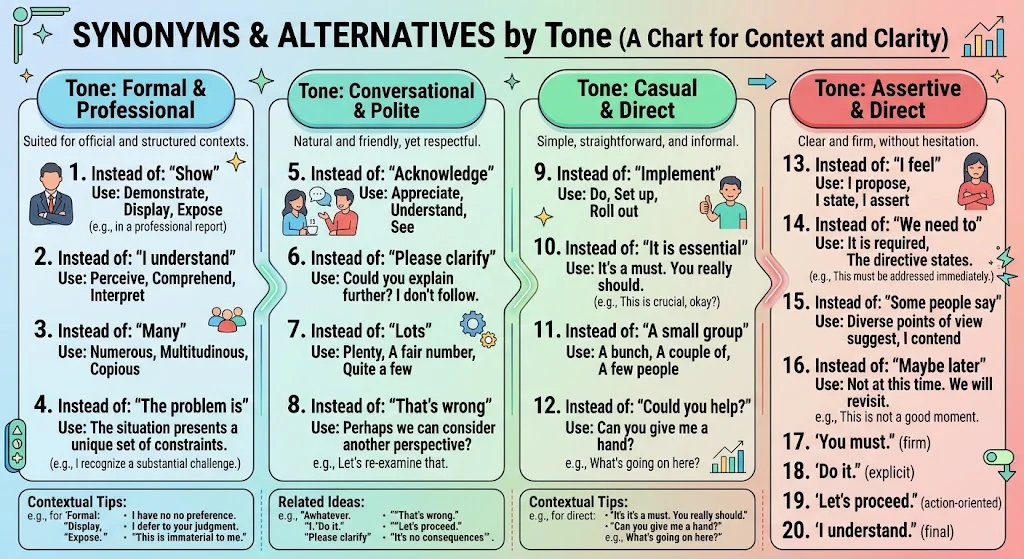
Professional & Neutral Alternatives
- I have no preference.
- Either option works for me.
- I’m fine with either.
- I’m flexible.
- I’m open to either option.
- I’m comfortable with either choice.
Polite & Supportive Alternatives
- I’m happy with either option.
- Whatever works best for you.
- I’m okay with either.
- I can go with your preference.
Encouraging & Reassuring Alternatives
- I’m happy to go along with your choice.
- Either way is fine with me.
- I’m comfortable with whatever you decide.
Casual, Playful & Idiomatic Alternatives
- I don’t mind.
- It’s all the same to me.
- I’m good either way.
- Either way works.
- I’m easy.
- Whatever works.
When Should You Use “It Does Not Matter to Me”?
it is most useful when you genuinely want to communicate that you have no strong preference or that the outcome will not affect your decision.
Professional settings
The phrase can work in workplace conversations when the intended meaning is clear. For example, if a coworker asks whether you want to meet at 2 p.m. or 3 p.m., saying “It does not matter to me” communicates flexibility.
However, a more polished alternative such as “Either time works for me” may sound more collaborative in professional communication.
Casual conversations
The expression is natural when talking with friends, classmates, family members, or acquaintances. If someone asks whether you want tea or coffee and you genuinely have no preference, the phrase is straightforward.
Writing, presentations, and digital communication
In formal writing, more specific alternatives can improve clarity. Instead of simply writing “It does not matter to me,” you might say “I have no preference” or “Either option is acceptable.”
In messages, the shorter “I’m good either way” may sound more natural among friends or familiar colleagues.
When it is especially effective
Use the phrase when:
- You genuinely have no preference.
- Either choice produces an acceptable result.
- You want another person to make the decision.
- The subject is relatively unimportant to you.
- You want to communicate flexibility without lengthy explanation.
When Should You Avoid “It Does Not Matter to Me”?
Although the phrase is grammatically correct, it is not always the best choice.
Overly formal situations
In highly formal business communication, “I have no preference” or “Either option would be suitable” can sound more polished.
Legal, academic, or sensitive contexts
Precision matters in legal and academic writing. “It does not matter to me” can be too broad because it may fail to specify exactly what is unimportant. A precise statement should identify the particular issue, choice, or condition.
Situations where nuance may be lost
Avoid the phrase when you actually have an opinion but want to appear flexible. It can also be risky when someone is asking for your emotional response to an important personal matter.
For example, telling someone “It does not matter to me” after they ask about an important decision may sound as though you are emotionally detached.
Is “It Does Not Matter to Me” Professional, Polite, or Casual?
“It does not matter to me” is generally neutral, but its tone depends heavily on context and delivery. It can be professional enough for ordinary workplace conversations, but it is not always the most polished choice for formal writing.
Its emotional subtext can vary:
- Neutral: “It does not matter to me which day we schedule the meeting.”
- Flexible: “It does not matter to me; choose whichever works for the team.”
- Detached: “It does not matter to me what they decide.”
- Dismissive: “It does not matter to me.”
The final example can sound blunt because it provides no explanation or indication of cooperation.
A useful communication principle is to show flexibility rather than merely show indifference. “Either option works for me” tells the listener not only that you have no preference but also that you are willing to cooperate.
Pros and Cons of Using “It Does Not Matter to Me”
Advantages
Clarity: The phrase directly communicates a lack of preference.
Efficiency: It is short and easy to understand.
Accessibility: ESL learners and native speakers can understand it without specialized vocabulary.
Flexibility: It can apply to choices, schedules, methods, outcomes, and personal preferences.
Potential Drawbacks
Oversimplification: It may not explain why you have no preference.
Tone mismatch: In sensitive situations, it can sound emotionally distant.
Repetition: Frequent use may make communication sound predictable.
Possible ambiguity: The listener may not know whether you mean “either choice is fine” or “I am not interested.”
Real-Life Examples of “It Does Not Matter to Me” by Context

Emails
“Thanks for checking. It does not matter to me whether we meet Tuesday or Wednesday, so please choose whichever day works better for the team.”
This works because the second part clarifies that the speaker is being flexible rather than dismissive.
Meetings
“It does not matter to me which version we present first. I’m comfortable starting with either one.”
Here, the phrase communicates flexibility during a decision-making process.
Presentations
“For the final section, it does not matter to me whether we use the chart or the table. Both communicate the information clearly.”
The speaker explains the reason for having no preference.
Conversations
“Do you want to watch a comedy or an adventure movie?”
“It does not matter to me. You can pick.”
The informal context makes the expression natural.
Social media
“People keep asking which design I prefer, but honestly, it does not matter to me as long as the information is easy to read.”
This use shows that the speaker prioritizes functionality over a particular choice.
“It Does Not Matter to Me” vs Similar Expressions (Key Differences)
| Phrase | Meaning Difference | Tone Difference | Best Use Scenario |
| I have no preference | Clearly states that neither option is preferred. | Professional and neutral. | Workplace decisions, surveys, formal communication. |
| Either option works for me | Emphasizes that both choices are acceptable. | Cooperative and practical. | Scheduling, planning, team discussions. |
| I’m fine with either | Shows acceptance of either choice. | Friendly and neutral. | Everyday conversation and informal work communication. |
| I don’t mind | Shows that the speaker does not object to something. | Casual and relaxed. | Informal conversations and routine choices. |
| Whatever works for you | Gives the other person freedom to choose. | Supportive but sometimes detached. | Scheduling and collaborative decisions. |
| I’m good either way | Says both possible outcomes are acceptable. | Casual and conversational. | Friends, classmates, chats, and informal workplace messages. |
The key difference is that “it does not matter to me” focuses on personal importance, while expressions such as **“either option works for me” focus more directly on acceptance and cooperation.
Common Mistakes & Misuse of “It Does Not Matter to Me”
Overuse
Using the phrase repeatedly can make you appear uninterested in decisions. If you truly have no preference, vary your language with alternatives such as “I’m flexible” or “Either option works for me.”
Incorrect context
Do not use it when the matter clearly requires your opinion. If a manager asks you to choose between two important project strategies, a vague “It does not matter to me” may appear careless.
Contradictory usage
Avoid saying “It does not matter to me” and then strongly arguing for one option. That creates a contradiction between your words and your behavior.
Cultural misunderstandings
Some listeners may interpret direct expressions of indifference more negatively than intended. In cultures or workplaces where indirect and relationship-focused communication is valued, “I’m happy with either option” may sound warmer.
Psychological Reason People Prefer “It Does Not Matter to Me”
People often prefer short expressions when they need to communicate a simple decision quickly.
Cognitive load reduction
A concise phrase reduces the amount of information both speakers need to process. If two options are equally acceptable, there may be little reason to explain a detailed preference.
Trust and authority signals
Clear communication can signal confidence. Someone who says “Either option works for me” communicates that they understand the decision but do not need to control it.
Attention economy
Modern communication often happens quickly through notifications, chats, short emails, and mobile devices. Short phrases are therefore practical when the issue itself is uncomplicated.
Modern communication habits
People increasingly use expressions such as “I’m good either way” because they are quick, natural, and conversational. The choice of wording depends on whether the speaker wants to emphasize neutrality, flexibility, cooperation, or lack of concern.
US vs UK Usage of “It Does Not Matter to Me”
The phrase is understood naturally in both American and British English. There is no major difference in its basic meaning.
American English frequently uses conversational alternatives such as “I’m good either way,” “I’m fine with either,” and “Whatever works.”
British English commonly uses “I don’t mind,” “Either is fine,” and “I’m happy with either.”
These are tendencies rather than strict rules. Speakers in both regions understand the full range of expressions.
Tone can matter more than geography. “I don’t mind” may sound perfectly polite in one conversation but slightly indifferent in another, depending on delivery and context.
“It Does Not Matter to Me” in Digital & Modern Communication
Emails
In professional emails, adding a cooperative phrase can prevent ambiguity:
“It does not matter to me which date you choose, so please go with what works best for everyone.”
Slack / WhatsApp
Shorter versions are usually more natural:
“I’m good either way.”
“Either works for me.”
Social media
The phrase can express personal neutrality:
“The format does not matter to me as long as the information is accurate.”
AI-generated summaries
AI-generated communication often favors concise alternatives such as “no preference,” “either option works,” or “flexible.” However, human writers should still consider tone. A technically correct phrase can sound cold if the surrounding context involves an important personal or professional issue.
Linguistic & Communication Insight
Emotional weight & subtext
The literal meaning of “it does not matter to me” is straightforward, but native speakers may hear additional meaning from context. The phrase can suggest neutrality, flexibility, emotional distance, or even irritation.
For example:
“It does not matter to me which restaurant we choose.”
usually communicates neutrality.
But:
“It does not matter to me what you do.”
can sound much more emotionally distant.
The difference comes from the subject, relationship, and conversational context.
Direct vs indirect phrasing
The expression is relatively direct. It tells the listener that the issue has no meaningful effect on the speaker.
A softer alternative might be:
“I’m happy with either option.”
This version communicates the same lack of preference while adding a positive signal.
An indirect version such as:
“Whatever works best for you.”
shifts attention toward the other person’s needs rather than emphasizing the speaker’s lack of concern.
Professional communication perspective
At work, experienced communicators often choose language that communicates both flexibility and cooperation.They may be completely appropriate, but “Either option works for me” can reduce the risk of sounding disengaged.
The best choice depends on the decision. If your opinion genuinely has no impact, neutrality is useful. If your input is expected, you should provide a reasoned preference rather than simply dismiss the choice.
Pragmatic reasons for alternatives
Professionals may use alternatives to manage interpersonal tone. “I have no preference” is precise. “I’m happy with either” is warmer. “Whatever works for you” gives control to another person. “I’m flexible” emphasizes adaptability.
Each expression carries a slightly different social signal even though they overlap in meaning.
Social signaling
Word choice affects how people perceive cooperation, interest, confidence, and respect. A short phrase can therefore communicate more than its dictionary definition.
Compare:
“I don’t care.”
with:
“Either option works for me.”
Both can indicate a lack of preference, but the second is much more likely to sound constructive in a professional setting.
Tone & context guidance
Before using the phrase, consider three questions:
- Do I genuinely have no preference?
- Does the listener need to know that I am willing to cooperate?
- Could my wording sound like indifference?
If the answer to the third question is yes, choose a warmer alternative.
I Have No Preference
Meaning: “I have no preference” means that you do not favor one option over another. It is especially useful when several choices are available, and you are comfortable with any of them.
Why This Phrase Works: It is precise and avoids the possible emotional interpretation of “It does not matter to me.” The listener immediately understands that you are neutral rather than uninterested.
Real-World Usage Insight: This phrase is particularly effective when someone directly asks you to choose between alternatives and you genuinely have no reason to select one.
Best Use: Workplace discussions, surveys, scheduling, academic communication, and formal emails.
Avoid When: You actually have a meaningful opinion that others need to consider.
Tone: Professional, neutral, direct.
US vs UK Usage: Common and natural in both American and British English.
Example (Email / Message / Meeting):
“Thanks for checking. I have no preference between the two meeting times, so please choose whichever works best for the group.”
Either Option Works for Me

Meaning: “Either option works for me” means that both choices are acceptable and you can proceed with either one.
Why This Phrase Works: It clearly communicates flexibility while sounding cooperative. Unlike a phrase centered on indifference, it focuses on the practical acceptability of both choices.
Real-World Usage Insight: Native speakers frequently use this construction when arranging meetings, choosing dates, selecting designs, or making everyday plans.
Best Use: Workplaces, group projects, scheduling, emails, and conversations.
Avoid When: Only one option is genuinely acceptable to you.
Tone: Friendly, professional, cooperative.
US vs UK Usage: Widely understood and natural in both regions.
Example (Email / Message / Meeting):
“Either option works for me. If Tuesday is easier for everyone else, I’m happy to go with Tuesday.”
I’m Fine with Either
Meaning: “I’m fine with either” means that you are comfortable with both available choices and do not need one option over the other.
Why This Phrase Works: It is concise while still sounding positive. The word “fine” communicates acceptance without suggesting that the decision is unimportant.
Real-World Usage Insight: This is a natural choice for everyday conversations and informal professional communication.
Best Use: Chats, quick workplace messages, conversations, and routine decisions.
Avoid When: Writing highly formal documents where more precise wording is expected.
Tone: Casual to neutral.
US vs UK Usage: Common in both American and British English.
Example (Email / Message / Meeting):
“I’m fine with either. Just let me know which version you want me to review first.”
I’m Flexible
Meaning: “I’m flexible” means that you are willing to adapt to different choices, arrangements, or schedules.
Why This Phrase Works: It emphasizes adaptability rather than indifference. That makes it particularly useful when you want to appear cooperative.
Real-World Usage Insight: This phrase is common when discussing availability, deadlines, meeting times, travel arrangements, or work assignments.
Best Use: Professional communication, scheduling, interviews, teamwork, and planning.
Avoid When: You actually have firm requirements or limitations.
Tone: Professional, positive, adaptable.
US vs UK Usage: Natural and widely used in both varieties of English.
Example (Email / Message / Meeting):
“I’m flexible about the interview time next week, so feel free to schedule it whenever the panel is available.”
I’m Open to Either Option
Meaning: “I’m open to either option” means that you are willing to consider and accept either choice.
Why This Phrase Works: It communicates openness without sounding passive. It can be particularly useful when you want to leave the final decision to the group.
Real-World Usage Insight: The phrase works well when choices have not yet been finalized, and you want to demonstrate a willingness to collaborate.
Best Use: Meetings, project planning, workplace emails, and group decisions.
Avoid When: You need to communicate a firm preference or requirement.
Tone: Professional, collaborative, neutral.
US vs UK Usage: Common in both US and UK English.
Example (Email / Message / Meeting):
“I’m open to either option for the presentation format. Let’s use whichever one the team thinks will be clearer.”
Conclusion
Understanding “it does not matter to me” helps you express neutrality, flexibility, and a lack of preference clearly in everyday and professional English. Although the phrase is grammatically correct and widely understood, its tone can change depending on context. In some situations, it simply means that either choice is acceptable; in others, it may sound detached or uninterested. Choosing the right synonym can make your communication more precise and considerate. Professional alternatives such as “I have no preference,” “either option works for me,” and “I’m flexible” are useful in workplace and formal settings. Casual expressions such as “I don’t mind” or “I’m good either way” work naturally in conversations and digital messages. Ultimately, the best alternative depends on your audience, purpose, and desired tone. By understanding these subtle differences, students, professionals, ESL learners, and content writers can communicate their intentions naturally while avoiding unnecessary misunderstandings.
FAQs
What does “it does not matter to me” mean?
Its means that something is not important to the speaker or that they have no particular preference. It is commonly used when two or more choices are equally acceptable. The phrase can express neutrality, flexibility, or indifference depending on the situation, tone of voice, and surrounding words.
Is “it does not matter to me” a polite phrase?
Yes, “it does not matter to me” can be polite when it genuinely communicates flexibility or a lack of preference. However, in some contexts it may sound slightly detached. If you want a warmer tone, alternatives such as “I’m happy with either option” or “Either option works for me” are often better choices.
Is “it does not matter to me” professional?
Yes, the phrase is grammatically correct and can be used professionally, especially in ordinary workplace conversations. However, formal emails may benefit from more precise alternatives such as “I have no preference” or “Either option works for me.” These expressions emphasize cooperation and reduce the possibility that your response will sound dismissive.
What is a professional alternative to “it does not matter to me”?
Some professional alternatives include “I have no preference,” “Either option works for me,” “I’m flexible,” and “I’m open to either option.” These phrases communicate that you do not strongly favor one choice while maintaining a constructive and professional tone. The best option depends on whether you want to emphasize neutrality, flexibility, or collaboration.
What is a polite way to say “it does not matter to me”?
A polite way to express the same idea is “I’m happy with either option” or “Whatever works best for you is fine with me.” These alternatives communicate flexibility while sounding more considerate. They are especially useful when another person is making a decision, and you want to reassure them that either choice is acceptable.
What is the difference between “it does not matter to me” and “I don’t mind”?
“It does not matter to me” generally emphasizes that something has little or no importance to the speaker, while “I don’t mind” usually means that the speaker does not object. Both can express a lack of preference. “I don’t mind” is generally more conversational and is particularly common in everyday speech.
What is the difference between “I have no preference” and “it does not matter to me”?
“I have no preference” specifically means that you do not favor one option over another. “It does not matter to me” can have a broader meaning, including emotional or practical indifference. Therefore, “I have no preference” is often clearer in professional situations where you want to communicate neutrality without sounding uninterested.
Can I use “it does not matter to me” in an email?
Yes, but context matters. In a professional email, “Either option works for me” or “I have no preference” may sound more collaborative. For example, instead of writing which date you choose,” you could write, “Either date works for me, so please choose whichever is most convenient for the team.”
What is a casual way to say “it does not matter to me”?
Common casual alternatives include “I don’t mind,” “I’m good either way,” “I’m fine with either,” and “Either way is fine with me.” These expressions are natural in conversations, text messages, and informal chats. “I’m good either way” is especially conversational and is widely used in informal American English.
What is the best synonym for “it does not matter to me”?
There is no single best synonym for every situation. “I have no preference” is excellent for formal or professional communication, while “Either option works for me” sounds cooperative and natural. For casual conversations, “I don’t mind” or “I’m good either way” may be more appropriate.