Imagine writing a report that says, “Technology has changed rapidly in recent years.” The sentence is correct, but depending on your audience, you may want a more precise or natural alternative such as “over the past few years,” “in recent times,” or “over the last decade.” Choosing the right expression can make your writing sound clearer, more professional, and better suited to its context.
The phrase “recent years” refers to a period of time that has occurred relatively close to the present. It is common in academic writing, business reports, news articles, presentations, conversations, and online content. However, its exact time span is flexible. For one writer, it may mean two or three years; for another, it may refer to the past decade.
This guide explains the meaning, history, tone, usage, alternatives, regional differences, and practical applications of “recent years.” It also provides 15 useful alternatives so you can choose wording that fits your intended meaning rather than simply replacing one phrase with another.
What Does “Recent Years” Mean?
“Recent years” means the years that have occurred relatively close to the present time. The phrase usually refers to a period covering the last few years, although its exact length depends on context. It is commonly used when discussing trends, developments, changes, events, research findings, business performance, technology, society, or personal experiences.
Origin & History of “Recent Years”
The phrase “recent years” is built from two ordinary English words: “recent” and “years.” The adjective recent comes from Latin recens, meaning fresh, new, or newly occurring. English adopted the word through French and developed its modern meaning of something that happened not long ago.
The word “year” has a much older Germanic origin and has been used in English for centuries to describe a complete cycle of approximately twelve months.
Together, “recent years” became a natural way of referring to a period close to the present without specifying exact dates. This flexibility explains why the phrase remains common in modern English.
Its meaning has not changed dramatically, but its practical range depends on the subject. In a fast-moving technology article, “recent years” might mean the last three or four years. In historical research, it may refer to the last decade or even the last several decades.
Modern communication increasingly favors precise alternatives when exact timing matters. For example, “between 2022 and 2026” is more precise than “in recent years.” Nevertheless, “recent years” remains useful when the exact period is less important than the general trend.
Synonyms & Alternatives by Tone
Professional & Neutral Alternatives
- In recent years
- Over the past few years
- In the past few years
- Over recent years
- Over the last few years
- In the last few years
- During recent years
- In the past several years
- Over the years
- In the past decade
Polite & Supportive Alternatives
- In recent times
- Over the past several years
- Over the recent period
- In the years leading up to the present
Encouraging & Reassuring Alternatives
- Over the past few years
- In recent times
- In the years since
- Over the last several years
Casual, Playful & Idiomatic Alternatives
- Lately
- Recently
- Over the last while
- These past few years
- In modern times
Not every alternative is interchangeable in every sentence. “Lately” is more conversational, while “in the past decade” gives a much clearer time span. The best choice depends on whether you want precision, formality, brevity, or a conversational tone.
When Should You Use “Recent Years”?
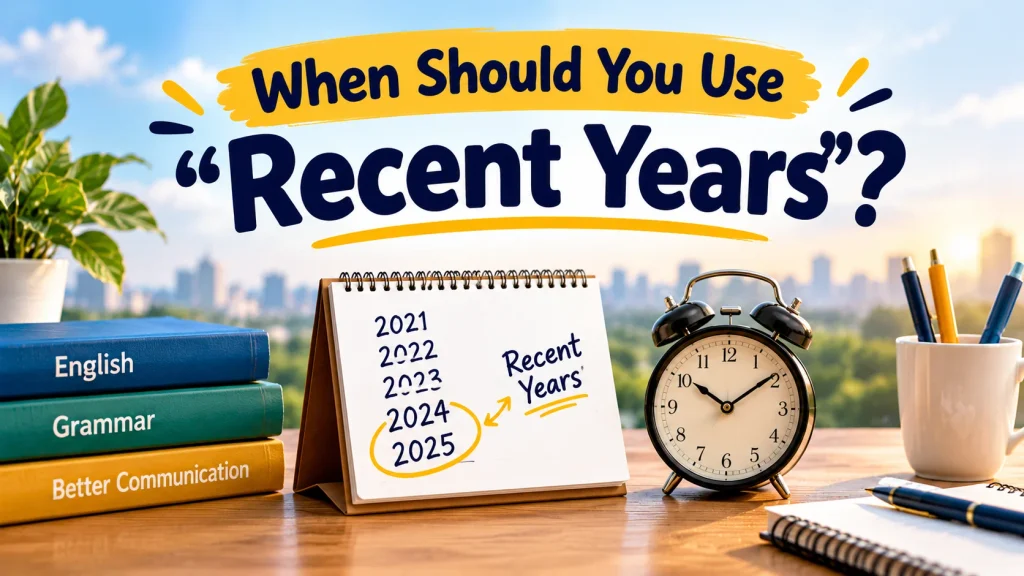
“Recent years” works especially well when you need to describe a broad trend without identifying specific dates.
Professional settings
Use it in reports, workplace documents, business presentations, market analysis, and professional articles when the exact years are not central to the point.
Example:
“Customer expectations have changed significantly in recent years.”
Casual conversations
The phrase is understandable in everyday speech, although alternatives such as “lately” or “over the past few years” may sound more conversational.
Example:
“I’ve become much more interested in photography in recent years.”
Writing and presentations
“Recent years” is particularly useful in introductions, background sections, research discussions, and presentations where you are describing a general development.
Example:
“Online learning has expanded considerably in recent years.”
Digital communication
It works naturally in LinkedIn posts, blog articles, newsletters, reports, and professional emails.
When it is especially effective
Use it when:
- The precise dates are not important.
- You are discussing a continuing trend.
- You want concise professional wording.
- The audience already understands the approximate timeframe.
- You are comparing the present with an earlier period.
If the timing affects the accuracy of your claim, give actual dates instead.
When Should You Avoid “Recent Years”?
Although “recent years” is versatile, it can be too vague in some situations.
Overly formal or precise situations
Legal documents, contracts, statistical reports, and formal research may require exact dates.
Instead of:
“The company has experienced growth in recent years.”
Consider:
“The company experienced growth between 2022 and 2026.”
Legal contexts
Legal arguments often depend on precise timelines. “Recent years” can create unnecessary ambiguity.
Academic contexts
Academic writing may benefit from specific publication dates, study periods, or historical periods when chronology is important.
Sensitive contexts
When discussing employment, finances, public policy, health, or historical events, vague timing can change how readers interpret a claim.
Situations where nuance may be lost
“Recent years” does not tell the reader whether you mean two years, five years, or ten years. If that distinction matters, use a more precise expression.
Is “Recent Years” Professional, Polite, or Casual?
“Recent years” is generally neutral and professional. It does not carry a strongly emotional or informal tone.
Its formality is moderate. It appears frequently in:
- Academic writing
- Business reports
- News writing
- Research articles
- Presentations
- Professional websites
- General conversation
The phrase is also polite because it does not make an emotional judgment. Its main weakness is vagueness, not tone.
For workplace communication, “recent years” usually sounds natural:
“The department has expanded considerably in recent years.”
For casual conversation, it can sound slightly more formal than:
“Things have changed a lot lately.”
The emotional subtext is normally minimal. However, the surrounding sentence can give it a positive, negative, or neutral meaning.
Pros and Cons of Using “Recent Years”
Advantages
- Clarity: Most readers immediately understand that you mean a relatively recent period.
- Efficiency: It avoids listing several individual years.
- Accessibility: It is familiar to native and non-native English speakers.
- Flexibility: It can describe different time periods depending on context.
- Professional tone: It fits reports, articles, presentations, and workplace communication.
Potential Drawbacks
- Oversimplification: It may combine years with very different circumstances.
- Tone mismatch: It can sound formal in highly casual conversation.
- Repetition: Frequent use can make an article feel monotonous.
- Lack of precision: Readers may not know exactly which years you mean.
- Context dependence: Its timeframe changes according to the subject.
Real Life Examples of “Recent Years” by Context
Emails
“Our customer-support process has changed significantly in recent years, so I’ve attached the updated procedure for everyone.”
Meetings
“We’ve seen a noticeable increase in online inquiries in recent years. I think we should consider adding another support channel.”
Presentations
“In recent years, remote collaboration has become an important part of how many organizations operate.”
Conversations
“I haven’t traveled much in recent years because I’ve been focused on my studies.”
Social media
“Photography has changed dramatically in recent years, especially with the rise of smartphone cameras and editing apps.”
“Recent Years” vs Similar Expressions (Key Differences)
| Phrase | Meaning Difference | Tone Difference | Best Use Scenario |
| Over the past few years | Focuses on a small number of years leading up to now | Neutral and natural | Reports, conversation, articles |
| In the past few years | Refers to several previous years | Neutral | General discussion and writing |
| In recent times | Refers broadly to the relatively recent past | Slightly formal | Articles and formal discussion |
| Lately | Refers to a recent period, often including the present | Casual | Conversations and messages |
| Recently | Usually points to something that happened not long ago | Neutral and concise | Emails, speech, everyday writing |
| In the past decade | Specifically covers approximately ten previous years | Formal and precise | Research, statistics, historical analysis |
The key distinction is time range. “Recently” may describe a single event, whereas “recent years” normally describes a broader period. “Lately” is more conversational, while “in the past decade” provides a substantially clearer timeframe.
Common Mistakes & Misuse of “Recent Years”
Overuse
Repeating “recent years” throughout an article can make the writing predictable.
Instead of writing:
“Technology has changed in recent years. Businesses have adapted in recent years. Consumers have changed in recent years.”
Vary the wording:
“Technology has changed rapidly in recent years. Businesses have adapted over the past few years, while consumer behavior has also shifted.”
Incorrect context
Avoid using “recent years” when you actually mean a specific year.
Incorrect:
“The company launched the product in recent years.”
If you mean 2025, simply say:
“The company launched the product in 2025.”
Contradictory usage
Do not combine “recent years” with a period that is clearly historical unless your context defines what “recent” means.
Cultural misunderstandings
Different audiences may interpret “recent” differently. A younger audience may understand “recent years” as a relatively short period, while a historian may use it to describe a much longer modern period.
Vague claims
If your argument depends on timing, replace the phrase with exact dates.
Psychological Reasons People Prefer “Recent Years”
People often choose “recent years” because it reduces the mental effort required to process a long timeline.
Cognitive load reduction
A phrase such as “between 2021 and 2026” requires the reader to process multiple numbers. “Recent years” communicates the general timeframe with fewer words.
Trust and authority signals
In professional writing, phrases such as “recent years” can create a concise, measured tone. However, credibility comes from evidence, not from the phrase itself.
Attention economy
Modern readers often scan rather than read every word. Short temporal expressions allow writers to communicate broad chronology efficiently.
Modern communication habits
Digital communication rewards concise language. Expressions such as “recently,” “lately,” and “over the past few years” are therefore common across emails, social platforms, reports, and online articles.
US vs UK Usage of “Recent Years”
“Recent years” is standard and widely understood in both American and British English. There is no major difference in its basic meaning.
American and British writers commonly use:
- In recent years
- Over the past few years
- In recent times
- In the last few years
- Over the last several years
The main difference is not the phrase itself but broader stylistic preferences. British writing may sometimes favor slightly more formal constructions in institutional contexts, while American professional writing often favors direct wording.
For both audiences, “recent years” is safe, natural, and internationally understandable.
“Recent Years” in Digital & Modern Communication
Emails
The phrase is useful when summarizing changes:
“Our onboarding process has evolved significantly in recent years.”
Slack and WhatsApp
It can be used, but shorter alternatives often sound more natural:
“I’ve been working remotely a lot more lately.”
Social media
It works well when discussing personal growth or broad trends:
“A lot has changed in recent years, and I’m grateful for how much I’ve learned.”
AI-generated summaries
AI-generated summaries frequently use expressions such as “in recent years,” “over the past few years,” and “recently.” Human writers should still check whether the timeframe is accurate. If a summary discusses a trend, adding exact dates can make it more trustworthy.
Linguistic & Communication Insight
Emotional weight & subtext
“Recent years” is emotionally neutral by itself. The emotional effect comes mainly from the words around it.
Compare:
“The industry has struggled in recent years.”
with:
“The industry has flourished in recent years.”
The time phrase remains neutral while the surrounding verb creates the emotional direction.
Direct vs indirect phrasing
“Recent years” is relatively indirect because it does not identify specific dates. That can be useful when the exact timeframe is not important.
More direct:
“Between 2022 and 2026, sales increased.”
Less specific:
“Sales have increased in recent years.”
The first creates stronger chronological precision; the second keeps attention on the broader trend.
Professional communication perspective
In the workplace, “recent years” can make communication efficient without sounding overly casual. It is particularly useful when discussing organizational changes, customer behavior, technology, education, or market trends.
However, experienced communicators know when to replace it with exact dates. If a manager needs to understand when a change occurred, vague wording can create unnecessary questions.
Pragmatic reasons for alternatives
Professionals may choose “over the past few years” because it sounds conversational while remaining professional. They may choose “in the past decade” when the time span matters. They may use “lately” when communicating informally.
The choice therefore signals not only time but also the writer’s desired level of precision and formality.
Social signaling
Language influences how readers perceive confidence and clarity. A precise date range can signal careful attention to evidence, while a broad phrase can signal that the exact dates are not central.
Tone & context guidance
Use “recent years” when the general trend matters more than the exact timeline. Use a more precise alternative when dates influence interpretation, credibility, or decision-making.
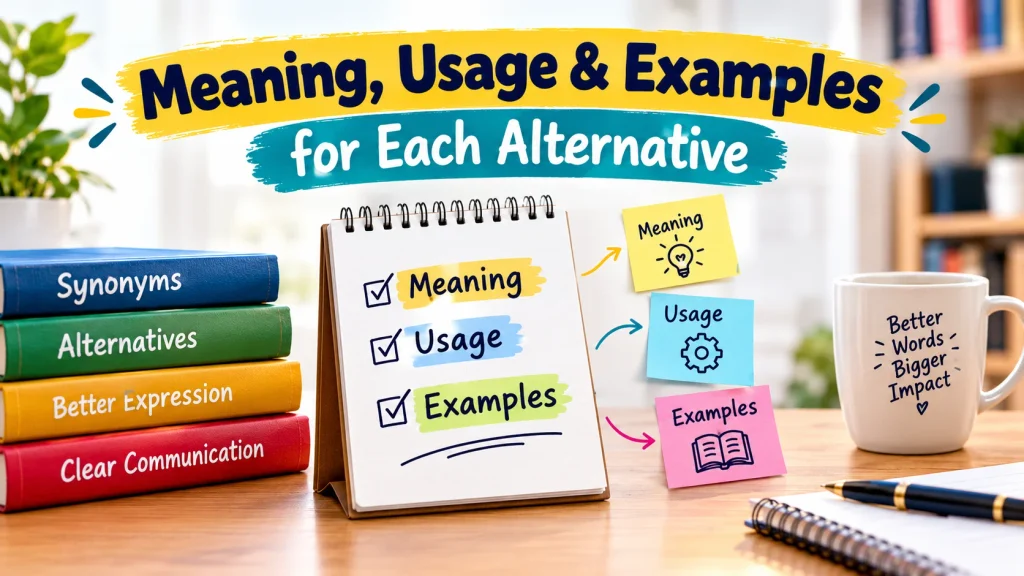
Meaning, Usage & Examples for Each Alternative
In Recent Years
Meaning: “In recent years” refers to the years relatively close to the present. It is usually used for ongoing trends, developments, or changes.
Why This Phrase Works: It is concise, familiar, and highly suitable for professional and academic writing.
Real-World Usage Insight: This is one of the closest direct alternatives to “In Contemporary Times” and often works without changing the meaning of the original sentence.
Best Use: Reports, essays, presentations, articles, and professional communication.
Avoid When: Exact dates are important.
Tone: Neutral, professional, and moderately formal.
US vs UK Usage: Common and natural in both varieties of English.
Example (Email / Message / Meeting): “Our team has adopted several new digital tools in recent years, so I’d like to review which ones are still useful.”
Over the Past Few Years
Meaning: This phrase describes a period covering several years before the present.
Why This Phrase Works: It sounds natural while making the time period feel somewhat more immediate.
Real-World Usage Insight: It is especially effective when discussing gradual change rather than one isolated event.
Best Use: Business conversations, reports, emails, articles, and presentations.
Avoid When: You need to specify an exact period.
Tone: Neutral, approachable, and professional.
US vs UK Usage: Widely used in both American and British English.
Example (Email / Message / Meeting): “Over the past few years, our clients have started asking for faster delivery options, so we’re reviewing our current process.”
In the Past Few Years
Meaning: It refers to several previous years leading up to the present.
Why This Phrase Works: It is straightforward to understand, making it useful for a broad audience.
Real-World Usage Insight: It can often replace “in recent years” without changing the sentence’s basic message.
Best Use: Everyday writing, professional communication, articles, and educational content.
Avoid When: You need a clearly defined timeframe.
Tone: Neutral and accessible.
US vs UK Usage: Common in both US and UK English.
Example (Email / Message / Meeting): “In the past few years, I’ve noticed that more students are using digital resources to prepare for exams.”
Over Recent Years
Meaning: “Over recent years” describes changes occurring throughout a relatively recent period.
Why This Phrase Works: It emphasizes gradual development across time.
Real-World Usage Insight: This construction is particularly useful when describing a process rather than a single event.
Best Use: Formal articles, reports, research-related writing, and presentations.
Avoid When: Writing a very casual message.
Tone: Formal and professional.
US vs UK Usage: Understood in both regions, though some American writers may prefer “over the past few years.”
Example (Email / Message / Meeting): “Over recent years, the department has introduced several improvements to its training program.”
In Recent Times
Meaning: “In recent times” means during a period relatively close to the present.
Why This Phrase Works: It provides a broad timeframe without requiring dates.
Real-World Usage Insight: It is useful when discussing social, cultural, technological, or economic developments.
Best Use: Articles, essays, commentary, and formal discussions.
Avoid When: A highly specific timeframe is required.
Tone: Slightly formal and polished.
US vs UK Usage: Used in both varieties, although “in In the Last Several Years” is often more direct.
Example (Email / Message / Meeting): “In recent times, online communication has become an important part of everyday professional life.”
Lately
Meaning: “Lately” refers to a period close to the present, usually including the recent past.
Why This Phrase Works: It is short and sounds natural in conversation.
Real-World Usage Insight: Unlike “recent years,” “lately” can refer to a much shorter period.
Best Use: Conversations, informal emails, chats, and social media.
Avoid When: Writing highly formal academic or legal material.
Tone: Casual and conversational.
US vs UK Usage: Very common in both American and British English.
Example (Email / Message / Meeting): “I’ve been spending more time on research lately, so I may need another day to finish the report.”
Recently
Meaning: “Recently” means not long ago or during a relatively near period before now.
Why This Phrase Works: It is concise and can describe either an event or a broader recent development.
Real-World Usage Insight: It is more flexible than “recent years” but can be less precise about duration.
Best Use: Emails, conversations, news, reports, and everyday writing.
Avoid When: Readers need to know exactly how long the period was.
Tone: Neutral and versatile.
US vs UK Usage: Equally common in US and UK English.
Example (Email / Message / Meeting): “We recently updated the client portal, so please use the new login page from today.”
Conclusion
Choosing the right alternative to “recent years” can make your English clearer, more precise, and better suited to your audience. Although “In the Current Era” is a professional and widely understood expression, it can sometimes be too vague when the exact timeframe matters. Alternatives such as “over the past few years,” “in the past few years,” “recently,” “lately,” and “in the past decade” offer different levels of precision and formality. For professional and academic writing, choose wording that accurately reflects the period you mean.
In casual conversations and digital messages, shorter expressions such as “lately” or “recently” often sound more natural. Remember that synonyms are not always exact replacements; their meaning, tone, and timeframe can vary. By considering your audience, purpose, and desired level of precision, you can avoid repetition and communicate your ideas more effectively. Ultimately, the best alternative is the one that expresses the intended timeframe naturally without creating unnecessary ambiguity.
FAQs
What does “recent years” mean?
“Recent years” refers to the years relatively close to the present. Its exact timeframe is flexible and depends on context. It may mean the last few years, several years, or sometimes a longer period. The phrase is commonly used when discussing trends, developments, changes, research, business performance, technology, education, and social issues.
What is another word for “recent years”?
Common alternatives include “over the past few years,” “in the past few years,” “in recent times,” “over the last few years,” and “in the past several years.” For informal communication, “lately” or “recently” may sound more natural. The best alternative depends on the required tone and how precisely you need to describe the timeframe.
Is “recent years” professional?
Yes. “Recent years” is a professional, neutral expression suitable for business reports, academic writing, presentations, articles, and workplace communication. However, it can be vague because it does not specify the exact years involved. If dates are important to your argument, use a specific range such as “between 2022 and 2026” instead.
Is “in recent years” grammatically correct?
Yes, “in recent years” is grammatically correct and extremely common in standard English. It is normally used to describe developments, changes, or trends that have occurred during a period close to the present. For example: “Online education has expanded significantly in recent years.” It works naturally in both American and British English.
What is the difference between “recent years” and “recently”?
“Recent years” refers to a broader period covering multiple years, while “recently” usually refers to something that happened not long ago. For example, “Technology has changed in recent years” describes a long-term trend, while “We recently updated the website” usually refers to a specific event or action.
Is “lately” a synonym for “recent years”?
“Lately” can express a recent period, but it is not always an exact synonym for “recent years.” “Lately” is more conversational and can refer to days, weeks, months, or a general period leading up to now. “Recent years” specifically suggests a timeframe measured in years, making it more appropriate for formal writing.
What is the difference between “recent years” and “the past few years”?
The two expressions are very similar, but “the past few years” often sounds slightly more conversational and may emphasize the period leading directly up to the present. “In Today’s World” is somewhat more neutral and formal. Both can describe trends or developments, but neither provides an exact number of years.
Can “recent years” be used in academic writing?
Yes, “recent years” is acceptable in academic writing, particularly when discussing broad trends or developments. However, academic writers should provide specific dates when chronology affects the argument. For example, “Research has increased in recent years” is acceptable for a general observation, while a study requiring precise analysis should identify the relevant publication or research period.
What is a more precise alternative to “recent years”?
A more precise alternative depends on the intended timeframe. “In the past decade” specifies approximately ten years, while an exact date range such as “between 2021 and 2026” provides the greatest clarity. If you know the relevant years, using them directly is usually better than relying on the flexible phrase “recent years.”
Is “over the Annual Period” the same as “recent years”?
No. “Over the years” generally describes development across an extended period and does not necessarily mean the period is recent. “Recent years” specifically focuses on years relatively close to the present. For example, “Over the years, she gained experience” could describe a long career, whereas “In recent years, she has focused on digital marketing” suggests a more current period.