
Imagine someone writing wedding vows, preparing a speech, or trying to explain a traditional expression to an English learner. The phrase “till death do us part” may be familiar, but its wording is old-fashioned and highly specific. Depending on the audience and situation, a writer may want a clearer, warmer, more modern, or more professional alternative. Understanding its meaning, tone, history, and related expressions makes it easier to choose language that communicates commitment without sounding overly formal or outdated.
In modern English, “till death do us part” expresses an intention to remain committed to another person for the rest of life. It is strongly associated with marriage vows, although similar ideas can appear in literature, speeches, entertainment, and sentimental writing. Choosing an alternative depends on whether the goal is to sound traditional, sincere, conversational, supportive, or contemporary.
What Does “Till Death Do Us Part” Mean?
“Till death do us part” means that two people intend to remain committed to each other for the rest of their lives. The expression is most commonly associated with marriage vows and wedding ceremonies. “Till death do us part” communicates a lifelong commitment and emphasizes that the relationship is intended to continue throughout both people’s lives.
Origin & History of “Till Death Do Us Part”
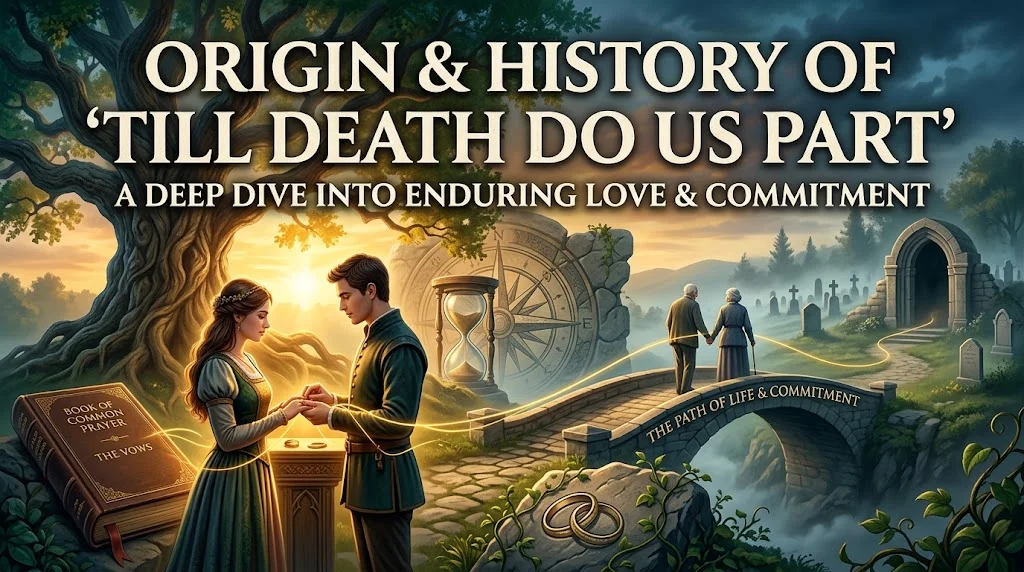
The expression has a long connection with English-language marriage ceremonies. One of its most important historical sources is the Book of Common Prayer, first published in England in 1549. Traditional Anglican marriage vows included wording expressing that asuch as spouses would remain together until death.
The familiar wording has appeared in slightly different forms over time, including “till death us do part” and “till death do us part.” The unusual word order reflects older English rather than the grammar people normally use in everyday conversation today.
The expression became widely recognized because religious wedding ceremonies repeated it across generations. As marriage vows entered popular culture, the phrase also appeared in books, films, television, speeches, and everyday references to lifelong commitment.
Today, the expression remains understandable in both British and American English, but it often sounds traditional, solemn, ceremonial, or literary. Modern speakers frequently choose simpler alternatives such as “for the rest of our lives” or “a lifelong commitment” when they want the same basic idea in contemporary language.
Synonyms & Alternatives by Tone
Professional & Neutral Alternatives
- Lifelong commitment
- A commitment for life
- Remain committed for life
- For the rest of our lives
- A lifelong promise
Polite & Supportive Alternatives
- Always stand by each other
- Remain by your side
- Support each other throughout life
- Stay together through life’s changes
- Be there for each other for life
Encouraging & Reassuring Alternatives
- No matter what life brings
- Together through every stage of life
- Committed through life’s challenges
- We will face life together
- Always be there for one another
Casual, Playful & Idiomatic Alternatives
- In it for the long haul
- Together for the long term
- Through thick and thin
- Stick together for life
- Together for the journey
When Should You Use “Till Death Do Us Part”?
“Till death do us part” works best when the context calls for a strong, traditional expression of lifelong commitment.
Professional Settings
The phrase is generally not necessary in ordinary workplace communication. A professional writer would usually say “long-term commitment,” “ongoing commitment,” or “a lasting partnership” instead.
However, it can appear in a workplace speech, creative presentation, or discussion about marriage, culture, literature, or traditional language.
Casual Conversations
Friends may use the expression jokingly or dramatically when describing a long-lasting friendship, loyalty, or humorous commitment. In casual speech, however, it can sound deliberately dramatic because of its connection with wedding vows.
Writing, Presentations, and Digital Communication
The expression can work well in wedding speeches, anniversary messages, literary writing, social media captions, and discussions of traditional marriage vows. Writers should consider whether their audience prefers traditional language or modern conversational English.
When It Is Especially Effective
Use it when you want to communicate strong permanence, seriousness, tradition, and emotional commitment. It is particularly effective when the ceremonial or literary quality of the phrase is intentional.
When Should You Avoid “Till Death Do Us Part”?
There are several situations where a different expression will communicate the intended message more effectively.
Overly Formal Situations
Although the phrase is not necessarily inappropriate, it can sound unnecessarily dramatic in everyday professional communication. “Long-term commitment” is usually more natural in business writing.
Legal, Academic, or Sensitive Contexts
In legal and academic writing, precise wording is usually preferable. A phrase associated with traditional marriage vows may introduce emotional or cultural assumptions that are unnecessary for the subject being discussed.
Situations Where Nuance May Be Lost
The expression communicates permanence very strongly. If you only mean continued support, loyalty, cooperation, or a long-term relationship, the phrase may imply more than intended.
For example, “We will work together for years to come” is more flexible than “till death do us part.”
Is “Till Death Do Us Part” Professional, Polite, or Casual?
“Till death do us part” is best described as formal, traditional, and emotionally serious rather than ordinary professional or casual language.
Its formality comes from its historical association with wedding ceremonies. Its emotional weight comes from the idea of lifelong commitment. In everyday conversation, the expression may sound poetic or intentionally dramatic.
The audience also matters. A wedding guest may perceive the phrase as familiar and ceremonial, while a business colleague could find it overly personal or theatrical.
For modern communication, alternatives such as “for the rest of our lives,” “lifelong commitment,” or “in it for the long haul” allow writers to adjust the emotional intensity without changing the central idea.
Pros and Cons of Using “Till Death Do Us Part”
Advantages
- Clarity: The phrase strongly communicates lifelong commitment.
- Efficiency: A short expression conveys a substantial idea.
- Accessibility: Many English speakers recognize it because of its connection with wedding vows.
- Cultural familiarity: It has a long history in English-speaking wedding traditions.
- Emotional strength: It can communicate seriousness and permanence effectively.
Potential Drawbacks
- Oversimplification: It presents commitment in absolute terms and leaves little room for nuance.
- Tone mismatch: It may sound too dramatic in casual or professional situations.
- Traditional wording: Some readers may consider it old-fashioned.
- Repetition: Frequent use in wedding-related writing can make content sound predictable.
- Cultural assumptions: Not every audience connects with traditional marriage language in the same way.
Real-Life Examples of “Till Death Do Us Part” by Context
Emails
In a personal wedding-related email, someone might write:
“We are grateful that you can join us as we make our vows and celebrate the promise of staying together till death do us part.”
This works because the context is ceremonial and personal.
Meetings
A meeting about traditional wedding customs might include:
“The phrase ‘till death do us part’ is one of the most recognizable examples of traditional marriage-vow language.”
Here, the phrase is being discussed rather than used as a personal promise.
Presentations
A presentation about English expressions could say:
“This expression originated in traditional marriage-vow language and has since become a familiar phrase for lifelong commitment.”
Conversations
A friend might say:
“They have been together for decades. They really seem to believe in that ‘till death do us part’ idea.”
The phrase can sound slightly humorous or affectionate in everyday conversation.
Social Media
A wedding anniversary caption might say:
“Another year together, and still grateful for every chapter we share.”
A modern caption often avoids the traditional phrase while preserving its meaning.
“Till Death Do Us Part” vs Similar Expressions (Key Differences)
| Phrase | Meaning Difference | Tone Difference | Best Use Scenario |
| For the rest of our lives | Focuses directly on lifelong duration | Warm, modern, sincere | Wedding vows, personal messages |
| Lifelong commitment | Emphasizes the commitment rather than the relationship itself | Neutral, polished | Speeches, formal writing |
| Through thick and thin | Emphasizes staying supportive during difficulties | Warm, idiomatic, conversational | Friendships, relationships |
| In it for the long haul | Means intending to continue for a long time | Casual, confident, playful | Conversations and social media |
| Always stand by each other | Focuses on loyalty and support | Supportive, reassuring | Personal messages and speeches |
| Together for life | Expresses lifelong togetherness in simple language | Direct, warm, contemporary | Cards, captions, vows |
The key distinction is intensity. “Till death do us part” communicates an absolute lifelong commitment, while expressions such as “in it for the long haul” or “through thick and thin” can communicate loyalty without sounding ceremonial.
Common Mistakes & Misuse of “Till Death Do Us Part”
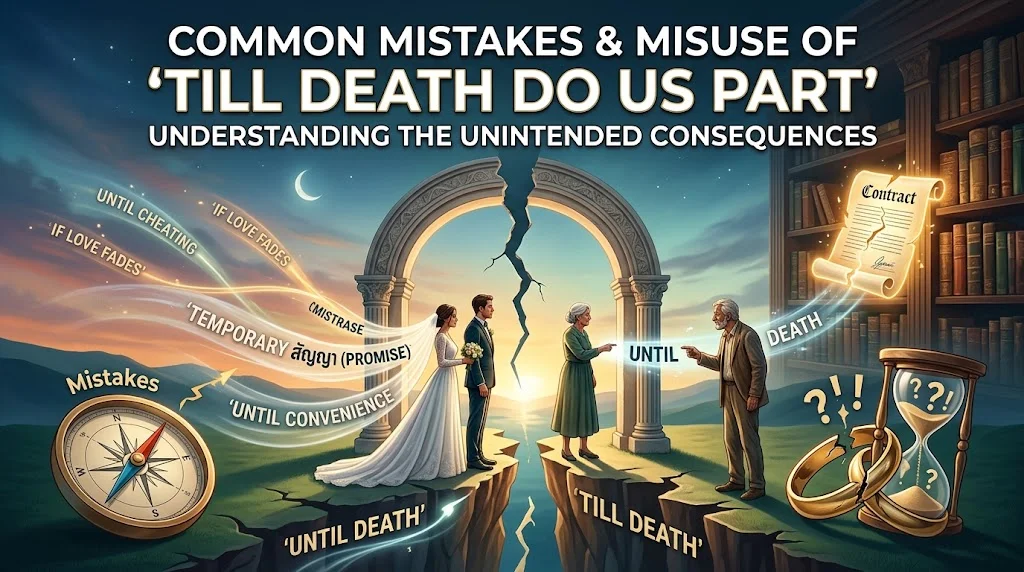
Overuse
Using the phrase repeatedly can make writing sound predictable, especially in wedding articles or sentimental content. Alternatives create variety while preserving the central meaning.
Incorrect Context
Using the phrase in a routine business email can sound strange. A sentence such as “We will manage this project till death do us part” is clearly humorous or exaggerated rather than standard professional English.
Contradictory Usage
Avoid pairing the phrase with language that communicates a temporary commitment. Saying someone is committed “till death do us part” but “only for the next few months” creates an obvious contradiction.
Cultural Misunderstandings
Because the phrase has religious and marriage-related associations, not every audience will interpret it as a neutral synonym for loyalty. Consider the cultural background and expectations of your readers.
Psychological Reason People Prefer “Till Death Do Us Part”
People often prefer familiar expressions because they communicate complex ideas quickly. “Till death do us part” immediately activates the idea of permanence and lifelong commitment without requiring a lengthy explanation.
Cognitive Load Reduction
A familiar phrase can package a larger concept into a few words. Readers who already recognize the expression do not need additional explanation.
Trust and Authority Signals
Traditional wording can create a sense of seriousness because it is associated with established ceremonies and long-standing social traditions.
Attention Economy
In short-form communication, memorable expressions can attract attention more effectively than lengthy explanations. The phrase is recognizable and emotionally distinctive.
Modern Communication Habits
At the same time, modern audiences increasingly favor plain language. This is why alternatives such as “for the rest of our lives” often feel more natural in contemporary writing.
US vs UK Usage of “Till Death Do Us Part”
The expression is understood in both American and British English, but its historical association is particularly strong with British Anglican marriage-vow tradition.
In the UK, versions such as “till death us do part” have a strong connection with traditional church language. The older word order can sound distinctly ceremonial.
In the US, “until death do us part” is also widely recognizable, particularly because of wedding ceremonies and popular culture. American speakers may be more likely to use “until” instead of “till” in modern formal writing, although both forms are understood.
The difference is primarily one of style and tradition rather than meaning.
“Till Death Do Us Part” in Digital & Modern Communication
Emails
Use the phrase mainly when discussing weddings, anniversaries, literature, or traditional vows. For everyday personal communication, a simpler alternative usually sounds more natural.
Slack / WhatsApp
It can be used playfully among friends, but it is usually too dramatic for ordinary workplace messages. “We’re in this together” is often more appropriate.
Social Media
The phrase works particularly well in wedding, anniversary, or nostalgic posts. However, modern captions often use shorter expressions such as “forever,” “together for life,” or “through every chapter.”
AI-Generated Summaries
AI-generated writing should consider context carefully. When summarizing the phrase, a clear explanation such as “a traditional expression meaning a lifelong commitment” is usually more precise than automatically repeating the original wording.
Linguistic & Communication Insight
Emotional Weight & Subtext
Native English speakers usually hear more than the literal meaning in “till death do us part.” The expression carries associations with marriage, ceremony, permanence, tradition, loyalty, and seriousness. Its emotional effect comes partly from those associations rather than from the individual words alone.
Direct vs Indirect Phrasing
“Till death do us part” is highly direct about permanence. By comparison, “I’ll always be there for you” emphasizes support, while “we’re in it for the long haul” emphasizes durability without the ceremonial seriousness.
The best choice depends on the intended message. A speaker discussing a difficult situation may prefer a softer expression because it can communicate commitment without sounding absolute.
Professional Communication Perspective
In professional environments, communicators normally separate personal commitment from business commitment. Saying “we remain committed to this partnership” sounds appropriate in a business context, whereas “till death do us part” would usually sound humorous or inappropriate unless deliberately used as an analogy.
Pragmatic Reasons for Alternatives
Experienced communicators often choose alternatives because they want to control the listener’s reaction. A less absolute expression can reduce pressure, avoid defensiveness, and leave room for changing circumstances.
For example, “we plan to support each other for years to come” communicates a positive intention without making the extreme permanence implied by the traditional phrase.
Social Signaling
Word choice tells audiences something about the speaker. Traditional wording can signal respect for ceremony or established customs. Contemporary wording can signal informality, accessibility, and a preference for plain English.
Tone & Context Guidance
Ask three questions before using the phrase:
- Who is the audience?
- How serious or emotional should the message sound?
- Do I mean lifelong commitment specifically, or simply long-term loyalty?
If the answer is specifically lifelong commitment, the phrase can be effective. If the intended meaning is broader, a more flexible alternative may be better.
For the Rest of Our Lives
Meaning: “For the rest of our lives” means that two people intend to remain together or committed throughout the remainder of their lives. It communicates essentially the same lifelong duration as “till death do us part” but uses straightforward modern English.
Why This Phrase Works: It is easy to understand and avoids archaic grammar. It sounds sincere without automatically creating a religious or ceremonial association.
Real-World Usage Insight: This wording is particularly useful when someone wants to express a lifelong promise while keeping the language conversational.
Best Use: Wedding vows, anniversary messages, personal writing, speeches, and heartfelt cards.
Avoid When: A highly formal traditional ceremony specifically requires established vow wording.
Tone: Warm, sincere, direct, contemporary.
US vs UK Usage: Natural and widely understood in both American and British English.
Example (Email / Message / Meeting): In an anniversary message, someone might write, “After everything we’ve experienced together, I’m grateful that we still get to share the rest of our lives.”
Lifelong Commitment
Meaning: “Lifelong commitment” refers to a promise, responsibility, or dedication intended to continue throughout a person’s life.
Why This Phrase Works: It focuses on commitment rather than using a dramatic reference to death. It is concise, polished, and adaptable.
Real-World Usage Insight: The expression works especially well when discussing marriage, family responsibilities, careers, causes, or long-term personal goals.
Best Use: Speeches, articles, professional writing, relationship discussions, and formal descriptions.
Avoid When: You want very casual or playful language.
Tone: Neutral, serious, professional, respectful.
US vs UK Usage: Common and natural in both varieties of English.
Example (Email / Message / Meeting): A wedding planner writing a client guide might say, “Many couples describe marriage as a lifelong commitment built on trust, communication, and mutual support.”
A Commitment for Life
Meaning: “A commitment for life” describes an intention to maintain a relationship, responsibility, or promise throughout one’s lifetime.
Why This Phrase Works: It keeps the central idea of permanence while sounding less ceremonial than the traditional expression.
Real-World Usage Insight: It is useful when a writer wants to emphasize duration without relying on religious or traditional wedding language.
Best Use: Personal writing, wedding speeches, relationship discussions, and reflective articles.
Avoid When: The situation calls for highly informal language.
Tone: Sincere, clear, moderately formal.
US vs UK Usage: Easily understood in both American and British English.
Example (Email / Message / Meeting): In a wedding speech, a sibling might say, “Marriage is not simply a celebration today; it is a commitment for life.”
Remain Committed for Life
Meaning: “Remain committed for life” means continuing to give loyalty, support, or dedication throughout one’s lifetime.
Why This Phrase Works: The wording is direct and flexible. It can describe personal relationships without depending on traditional marriage vocabulary.
Real-World Usage Insight: This phrase is especially helpful when the writer wants to emphasize an ongoing action rather than simply label something a lifelong commitment.
Best Use: Formal writing, speeches, relationship discussions, and explanatory content.
Avoid When: Writing a highly casual text message.
Tone: Serious, direct, formal-leaning.
US vs UK Usage: Natural in both regions.
Example (Email / Message / Meeting): During a presentation about long-term relationships, the speaker explained that “some people view marriage as an agreement to remain committed for life.”
A Lifelong Promise
Meaning: “A lifelong promise” refers to a promise intended to remain valid throughout a person’s entire life.
Why This Phrase Works: It preserves the emotional strength of the original phrase but removes its older grammatical structure.
Real-World Usage Insight: The expression sounds natural in wedding speeches and personal writing where emotional warmth is important.
Best Use: Weddings, anniversary cards, speeches, personal essays, and social posts.
Avoid When: Writing technical or strictly factual business material.
Tone: Emotional, warm, sincere, ceremonial.
US vs UK Usage: Widely understood in both American and British English.
Example (Email / Message / Meeting): In a wedding program, the couple described their vows as “a lifelong promise to support one another through every stage of life.”
Always Stand by Each Other
Meaning: “Always stand by each other” means consistently offering loyalty, support, and encouragement to one another.
Why This Phrase Works: It focuses on behavior and mutual support rather than simply permanence.
Real-World Usage Insight: This expression is useful when the most important idea is being dependable during difficult circumstances.
Best Use: Wedding speeches, friendship messages, relationship advice, and supportive writing.
Avoid When: You specifically need to communicate a formal lifelong vow.
Tone: Supportive, warm, conversational.
US vs UK Usage: Common in both American and British English.
Example (Email / Message / Meeting): At a family celebration, an older relative told the newlyweds, “Whatever changes come your way, always stand by each other.”
Remain by Your Side
Meaning: “Remain by your side” means continuing to provide companionship, support, or loyalty over time.
Why This Phrase Works: It is personal without being excessively dramatic. The expression emphasizes presence and support.
Real-World Usage Insight: It works particularly well when the writer wants to communicate emotional reassurance rather than a formal promise.
Best Use: Personal messages, speeches, cards, and supportive conversations.
Avoid When: You are writing a neutral workplace document.
Tone: Warm, reassuring, personal.
US vs UK Usage: Natural in both varieties.
Example (Email / Message / Meeting): In a message to a close friend going through a difficult period, someone might write, “Whatever happens next, I’ll remain by your side.”
Conclusion
Understanding “till death do us part” is useful for anyone who wants to communicate lifelong commitment clearly and appropriately. The phrase has deep historical roots in traditional marriage vows and remains recognizable in modern English, but its formal and ceremonial tone means it is not suitable for every situation. Depending on the audience and purpose, alternatives such as “for the rest of our lives,” “lifelong commitment,” “a lifelong promise,” and “through thick and thin” can express similar ideas with different emotional effects.
For professional communication, simpler and more precise wording is usually preferable, while traditional expressions can work beautifully in weddings, anniversary messages, speeches, and literary writing. ESL learners and content writers should also consider cultural expectations because familiar expressions can carry meanings beyond their literal definitions. Ultimately, the best alternative depends on whether you want to emphasize permanence, loyalty, support, partnership, or emotional connection. Choosing the right expression makes your writing sound more natural, purposeful, and appropriate for its audience.
FAQs
What does “till death do us part” mean?
“Till death do us part” means that two people intend to remain together and committed to each other for the rest of their lives. It is most strongly associated with traditional marriage vows. The phrase emphasizes permanence, loyalty, and lifelong commitment, although its traditional wording can sound formal or old-fashioned in everyday modern English.
Is “till death do us part” a synonym for lifelong commitment?
Yes. “Till death do us part” is commonly used to express the idea of a lifelong commitment. However, the two expressions differ in tone. “Till death do us part” sounds traditional and ceremonial, while “lifelong commitment” is more neutral and contemporary. The latter is generally easier to use in professional, academic, and modern explanatory writing.
What is a modern alternative to “till death do us part”?
A strong modern alternative is “for the rest of our lives.” It communicates lifelong commitment in clear, natural English without the traditional or religious associations of the original phrase. Other options include “lifelong commitment,” “together for life,” and “we will face life together,” depending on the desired tone and context.
Is “till death do us part” formal or casual?
“Till death do us part” is generally formal, traditional, and ceremonial rather than casual. Its association with wedding vows gives it a serious emotional quality. In everyday conversation, speakers may use it humorously or dramatically. For ordinary communication, phrases such as “in it for the long haul” sound considerably more relaxed.
Can “till death do us part” be used outside marriage?
Yes, but it is usually used figuratively or humorously outside marriage. Because the phrase is strongly connected with wedding vows, applying it to friendships, partnerships, or other relationships can sound dramatic. If you simply mean lasting loyalty, alternatives such as “through thick and thin” or “always stand by each other” may sound more natural.
What is the difference between “till death do us part” and “through thick and thin”?
“Till death do us part” emphasizes lifelong permanence, while “through thick and thin” emphasizes loyalty during good and difficult times. The first is more closely connected with marriage and formal vows. The second is an everyday idiom that can describe friendships, family relationships, romantic relationships, and other long-term connections.
Is “till death do us part” still commonly used today?
Yes, the phrase remains widely recognized, especially in discussions of marriage, traditional wedding vows, literature, films, and popular culture. However, many modern speakers prefer simpler alternatives in everyday communication. Expressions such as “for the rest of our lives” and “lifelong commitment” often sound more natural to contemporary audiences.
What are the best synonyms for “till death do us part”?
Useful alternatives include “for the rest of our lives,” “lifelong commitment,” “a lifelong promise,” “remain committed for life,” “always stand by each other,” “together through every stage of life,” and “through thick and thin.” The best choice depends on whether the intended meaning focuses on permanence, emotional support, loyalty, or resilience.
Is “till death do us part” appropriate in professional writing?
Usually, no. The expression is strongly emotional and associated with marriage, so it can sound inappropriate or overly dramatic in ordinary professional communication. In business writing, alternatives such as “long-term commitment,” “lasting partnership,” or “ongoing collaboration” are more precise. It can still appear professional when discussing language, culture, literature, or wedding traditions.
What is the difference between “till death do us part” and “for the rest of our lives”?
Both expressions communicate lifelong duration, but their tone differs. “Till death do us part” sounds traditional, solemn, and ceremonial because of its connection with marriage vows. “For the rest of our lives” is more direct, modern, and conversational. The second option is often preferable when clarity and natural contemporary English are priorities.