
Imagine a student waiting for an important result, a professional wondering whether a career opportunity will work out, or someone trying to make sense of an unexpected change. In these moments, people often say, “What is meant to be is meant to be.” The expression communicates acceptance of circumstances that cannot be fully controlled and suggests that some outcomes will happen regardless of uncertainty or setbacks.
In modern English, this phrase is commonly used to express acceptance, patience, trust in circumstances, and willingness to let events unfold naturally. However, it can sound philosophical or somewhat vague depending on the situation. Choosing a suitable alternative can make the message more encouraging, practical, hopeful, or casual. Understanding these differences helps professionals, students, ESL learners, and content writers choose language that matches their audience and purpose.
What Does “What Is Meant to Be Is Meant to Be” Mean?
“What is meant to be is meant to be” means that an outcome is believed to happen if it is naturally supposed to happen, even when people cannot control every circumstance. The phrase is commonly used when discussing uncertain relationships, opportunities, decisions, disappointments, or future events and expresses acceptance rather than certainty about a specific result.
Origin & History of “What Is Meant to Be Is Meant to Be”
The exact origin of “what is meant to be is meant to be” is difficult to attribute to one person or historical source. It belongs to a broad family of English expressions built around ideas of fate, destiny, acceptance, and the limits of personal control.
The wording is closely related to the much more established expression “what will be, will be.” That phrase became especially recognizable through the popular song “Que Sera, Sera (Whatever Will Be, Will Be)”, written by Jay Livingston and Ray Evans for the 1956 film The Man Who Knew Too Much. The song helped make the underlying idea familiar to generations of English speakers.
The broader concept, however, is much older than the song. Similar ideas appear in philosophical, religious, and literary traditions that encourage people to accept circumstances they cannot change.
Over time, everyday English developed many variations, including “what’s meant to happen will happen,” “let things unfold,” “everything happens for a reason,” and “whatever will be, will be.” These expressions overlap, but they are not identical. Some emphasize fate, some acceptance, and others optimism or patience.
Today, “what is meant to be is meant to be” is generally understood as an informal, reflective expression of acceptance rather than a statement that a particular future event is guaranteed.
Synonyms & Alternatives by Tone
Professional & Neutral Alternatives
- What will happen will happen
- Let things unfold naturally
- The outcome will become clear
- We will see how things develop
- Whatever happens, we can adapt
Polite & Supportive Alternatives
- Trust that things will work out
- Give it time and see what happens
- Let’s take things one step at a time
- Things will become clearer with time
- We can only do our best
Encouraging & Reassuring Alternatives
- Everything will work out in time
- What’s meant to happen will happen
- The right path will become clear
- Have faith in the process
- Sometimes things happen for a reason
Casual, Playful & Idiomatic Alternatives
- Whatever will be, will be
- Que sera, sera
- Let’s see what happens
- Go with the flow
- It is what it is
When Should You Use “What Is Meant to Be Is Meant to Be”?
The phrase is most effective when someone is dealing with uncertainty and wants to communicate acceptance rather than excessive worry.
Professional Settings
Use it carefully in professional settings. It may be appropriate in an informal conversation with a colleague about a career decision, application, promotion, or uncertain outcome. However, it is usually too vague for formal business writing.
For example, instead of saying this phrase in a project report, a professional could write, “We will evaluate the outcome once the results are available.”
Casual Conversations
This is where the expression sounds most natural. Friends and family members may use it when discussing relationships, exams, job applications, travel plans, or unexpected changes.
Writing, Presentations, and Digital Communication
The phrase can work in personal blogs, social media posts, reflective essays, motivational content, and informal presentations. In formal academic writing, a more precise statement is generally preferable.
When It Is Especially Effective
It works particularly well when someone has already taken reasonable action but cannot control the outcome. In that situation, the expression can communicate emotional acceptance and reduce unnecessary worry.
When Should You Avoid “What Is Meant to Be Is Meant to Be”?
Overly Formal Situations
Avoid it in official reports, formal business documents, legal correspondence, and technical explanations. The phrase is subjective and does not communicate measurable information.
Legal, Academic, or Sensitive Contexts
In academic or legal contexts, claims about what is “meant to be” can be too vague. Writers should explain actual circumstances, evidence, decisions, or possible outcomes instead.
Situations Where Nuance May Be Lost
The phrase can sometimes sound as though a person should simply accept a problem rather than take action. If someone needs practical advice, saying “what is meant to be is meant to be” may feel dismissive.
For example, someone facing an important decision may need a plan rather than reassurance alone.
Is “What Is Meant to Be Is Meant to Be” Professional, Polite, or Casual?
“What is meant to be is meant to be” is generally casual to moderately reflective, rather than strongly professional. It is polite in most personal conversations, but its philosophical tone makes it less suitable for precise workplace communication.
The expression also carries emotional subtext. Depending on context, it can sound hopeful, calm, resigned, philosophical, or even slightly passive.
Audience perception matters. A close friend may hear reassurance, while a colleague may hear uncertainty. A person who says it after an unsuccessful job application may be communicating, “I cannot control the decision, so I will accept the result.”
For professional audiences, alternatives such as “we will see how things develop” or “we can adapt as the situation changes” often sound more practical.
Pros and Cons of Using “What Is Meant to Be Is Meant to Be”
Advantages
- Clarity: It quickly communicates acceptance of uncertainty.
- Efficiency: A familiar expression conveys a complete attitude in a few words.
- Accessibility: Most English speakers can understand its general meaning.
- Emotional reassurance: It can help make uncertainty feel less overwhelming.
- Conversational value: It sounds natural in personal discussions.
Potential Drawbacks
- Oversimplification: Complex situations may require more practical explanation.
- Tone mismatch: It can sound passive when action is still necessary.
- Ambiguity: The phrase does not identify what outcome is actually expected.
- Repetition: Similar expressions can become clichés when overused.
- Cultural interpretation: Some audiences may interpret it as belief in fate rather than simple acceptance.
Real-Life Examples of “What Is Meant to Be Is Meant to Be” by Context
Emails
In a personal email, someone might write:
“I’ve submitted the application and prepared as much as I can. Now I’m trying not to overthink the result. What is meant to be is meant to be.”
Meetings
During an informal workplace discussion, a colleague might say:
“We’ve presented our proposal and answered all their questions. Now we’ll have to wait and see. What is meant to be is meant to be.”
Presentations
In a presentation about resilience, the speaker might explain:
“When an outcome is outside your control, acceptance can help you focus on the next step instead of worrying about every possible result.”
Conversations
A friend might say:
“If the opportunity works out, great. If it doesn’t, I’ll look for something else. What is meant to be is meant to be.”
Social Media
A person waiting for an uncertain life decision might post:
“I’ve done my part, and now I’m letting the future unfold. What is meant to be is meant to be.”
“What Is Meant to Be Is Meant to Be” vs Similar Expressions
| Phrase | Meaning Difference | Tone Difference | Best Use Scenario |
| Whatever will be, will be | Accepts that the future cannot be controlled | Philosophical, traditional | Uncertain future outcomes |
| Everything happens for a reason | Suggests events have an underlying purpose | Optimistic, reassuring | Comforting someone |
| Let things unfold naturally | Encourages patience without asserting fate | Calm, practical | Relationships and decisions |
| Go with the flow | Suggests adapting easily to circumstances | Casual, relaxed | Everyday conversations |
| It is what it is | Accepts an existing situation as unavoidable | Casual, sometimes resigned | Dealing with an unpleasant reality |
| Trust the process | Encourages patience and confidence in gradual progress | Motivational, modern | Study, work, personal goals |
The main difference is what each expression emphasizes. “What is meant to be is meant to be” leans toward fate or natural outcomes. “Let things unfold naturally” emphasizes patience. “Trust the process” emphasizes continued effort, while “it is what it is” focuses more directly on accepting an existing situation.
Common Mistakes & Misuse of “What Is Meant to Be Is Meant to Be”
Overuse
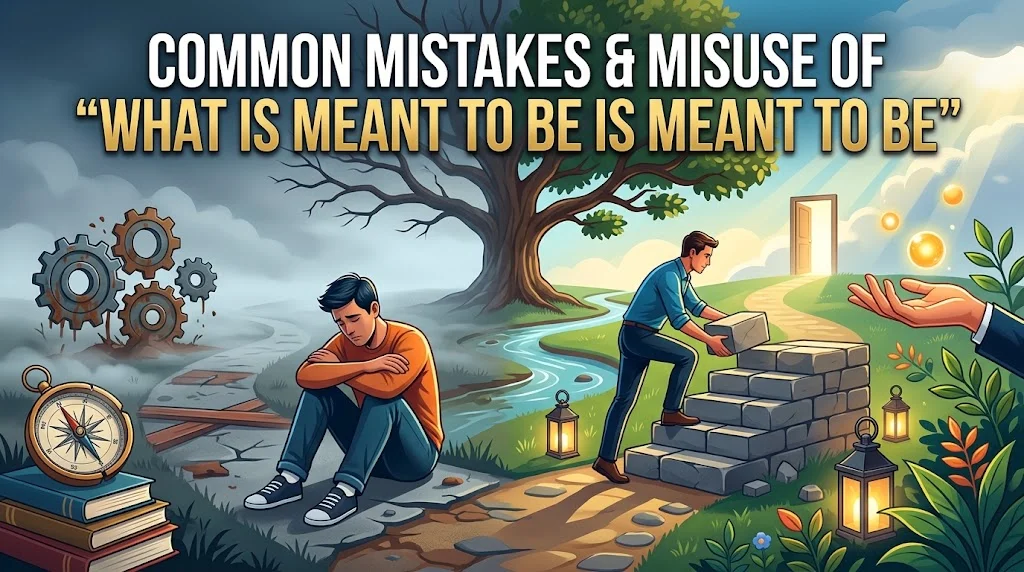
Repeating the phrase whenever something goes wrong can make it sound like a cliché. It is more meaningful when used selectively.
Incorrect Context
The phrase is not a substitute for practical planning. If an outcome can be influenced through preparation, communication, or action, simply saying “what is meant to be is meant to be” may discourage useful effort.
Contradictory Usage
Avoid pairing it with language that claims complete certainty. The expression is generally about accepting uncertainty, not proving that a particular future outcome will happen.
Cultural Misunderstandings
Some people interpret the phrase as a statement about fate, destiny, spirituality, or divine planning. Others use it simply to mean, “I cannot control everything.” Clarifying your intended meaning may be useful with diverse audiences.
Psychological Reason People Prefer “What Is Meant to Be Is Meant to Be”
People often use expressions like this because they provide a simple way to handle uncertainty.
Cognitive Load Reduction
Uncertain situations can require considerable mental effort. A familiar phrase gives people a concise way to acknowledge that not every variable can be controlled.
Trust and Authority Signals
Traditional expressions can sound familiar and socially accepted. Because many people have heard similar ideas before, the phrase can feel reassuring without requiring a lengthy explanation.
Attention Economy
Modern communication often rewards short, memorable statements. A compact expression can communicate an attitude toward uncertainty faster than a long explanation.
Modern Communication Habits
Texting, messaging, and social media have encouraged shorter forms of emotional communication. Expressions such as “let’s see what happens,” “go with the flow,” and “it is what it is” are particularly common because they are easy to understand and share.
US vs UK Usage of “What Is Meant to Be Is Meant to Be”
The phrase is understandable in both American and British English. There is no major difference in its basic meaning.
In the United States, speakers may use it in informal conversations about relationships, careers, education, and personal decisions. It can sound reassuring or philosophical depending on context.
In the United Kingdom, the expression is also understood, although speakers may choose shorter alternatives such as “whatever will be, will be” or “we’ll see what happens.”
The main variation is therefore stylistic rather than grammatical. Both American and British audiences generally understand the phrase without difficulty.
“What Is Meant to Be Is Meant to Be” in Digital & Modern Communication
Emails
In personal emails, the expression can provide emotional closure after discussing an uncertain decision. In professional emails, more precise wording is usually better.
Slack / WhatsApp
The phrase can work naturally in informal chats:
“We’ve done everything we can. Now we just wait and see what happens.”
It may also be shortened to “what’s meant to be, will be.”
Social Media
The expression is common in reflective captions about relationships, career changes, missed opportunities, and new beginnings. However, using a more specific statement often creates stronger and more authentic content.
AI-Generated Summaries
When AI tools summarize the phrase, the clearest explanation is usually “an expression of accepting an uncertain outcome that cannot be completely controlled.” This avoids incorrectly presenting the phrase as a factual claim that destiny guarantees a particular result.
Linguistic & Communication Insight
Emotional Weight & Subtext
Native speakers may hear several meanings beneath the literal wording. The phrase can signal acceptance, hope, resignation, patience, or belief in fate. The surrounding conversation determines which interpretation is strongest.
For example, after someone loses an opportunity, the expression can sound comforting. After someone refuses to take reasonable action, the same phrase may sound passive.
Direct vs Indirect Phrasing
“What is meant to be is meant to be” is indirect because it does not identify the specific outcome or explain why it might occur. It focuses on accepting uncertainty.
By contrast, “I’ve done everything I can, so now I’ll wait for the result” is direct and practical. “Let’s give it some time” is softer and more collaborative.
Professional Communication Perspective
In professional communication, precision usually matters more than philosophical reassurance. If a team is waiting for a client decision, saying “we will review the client’s response and adjust our plan accordingly” gives useful information.
The original phrase may still work in a friendly conversation between colleagues, but it should not replace concrete planning.
Pragmatic Reasons for Alternatives
Experienced communicators choose alternatives when they need to control how their message is received. A phrase such as “we can adapt as things develop” communicates flexibility and personal responsibility rather than passive acceptance.
Likewise, “let’s take it one step at a time” can reassure someone while encouraging continued action.
Social Signaling
Language choices can signal personality and attitude. Fate-oriented expressions may make someone sound philosophical or accepting. Practical alternatives can make them sound organized and proactive. Casual idioms may create familiarity and reduce emotional distance.
Tone & Context Guidance
Before using the phrase, consider whether the listener needs reassurance, practical advice, encouragement, or simple acceptance. If reassurance is the goal, the expression can work well. If action is required, pair acceptance with a concrete next step.
What Will Happen Will Happen
Meaning: “What will happen will happen” expresses acceptance that the future cannot always be controlled or predicted.
Why This Phrase Works: It is shorter and more direct than the original phrase while preserving its central idea of uncertainty and acceptance.
Real-World Usage Insight: It works naturally when someone has already made a decision and must now wait for the result.
Best Use: Casual conversations, personal writing, reflective messages.
Avoid When: You need to provide a detailed plan or factual explanation.
Tone: Neutral, reflective, slightly resigned.
US vs UK Usage: Easily understood in both American and British English.
Example (Email / Message / Meeting): In a message to a friend waiting for university admission, someone might write, “You’ve submitted everything and done your best. What will happen will happen, so try to enjoy the rest of the week.”
Let Things Unfold Naturally
Meaning: “Let things unfold naturally” means allowing a situation to develop without forcing an immediate outcome.
Why This Phrase Works: It emphasizes patience rather than directly claiming that fate controls the result.
Real-World Usage Insight: This is particularly useful when circumstances are still developing, and premature decisions could create unnecessary pressure.
Best Use: Relationships, career decisions, creative projects, personal conversations.
Avoid When: Immediate action or a firm deadline is required.
Tone: Calm, thoughtful, gentle.
US vs UK Usage: Natural in both varieties of English.
Example (Email / Message / Meeting): During a conversation about a new project, a colleague said, “We don’t need to decide everything today. Let’s let things unfold naturally and see what the customer needs.”
Trust That Things Will Work Out
Meaning: “Trust that things will work out” expresses confidence that a difficult or uncertain situation will eventually reach a positive or manageable outcome.
Why This Phrase Works: It provides reassurance and sounds more hopeful than the original expression.
Real-World Usage Insight: The phrase is useful when someone needs encouragement rather than an explanation of fate.
Best Use: Supportive messages, conversations, personal writing.
Avoid When: The situation requires realistic risk assessment rather than reassurance alone.
Tone: Positive, encouraging, supportive.
US vs UK Usage: Common in both American and British English.
Example (Email / Message / Meeting): In a supportive message to a friend who had applied for several jobs, someone wrote, “Keep going and trust that things will work out. You’re building experience with every interview.”
Give It Time and See What Happens
Meaning: “Give it time and see what happens” recommends patience before making a judgment or decision.
Why This Phrase Works: It is practical and avoids making a definite claim about destiny.
Real-World Usage Insight: Native speakers often use this wording when a situation is too new to evaluate accurately.
Best Use: Relationships, work decisions, projects, and everyday conversations.
Avoid When: A decision must be made immediately.
Tone: Casual, practical, patient.
US vs UK Usage: Widely understood in both regions.
Example (Email / Message / Meeting): In a meeting about a new marketing campaign, the manager said, “The numbers are still early. Let’s give it time and see what happens before changing the strategy.”
Take Things One Step at a Time
Meaning: “Take things one step at a time” means focusing on the immediate task instead of becoming overwhelmed by future possibilities.
Why This Phrase Works: It encourages action while reducing unnecessary concern about the outcome.
Real-World Usage Insight: It is more proactive than “what is meant to be is meant to be” because it encourages people to keep moving forward.
Best Use: Study, work, personal challenges, planning, and supportive conversations.
Avoid When: A complete long-term strategy is specifically required.
Tone: Reassuring, practical, encouraging.
US vs UK Usage: Common in both American and British English.
Example (Email / Message / Meeting): A supervisor reassuring a new employee said, “You don’t need to master everything this week. Take things one step at a time, and ask questions whenever you need help.”
Everything Will Work Out in Time
Meaning: “Everything will work out in time” expresses confidence that a difficult or uncertain situation will eventually become manageable or successful.
Why This Phrase Works: It provides reassurance while acknowledging that positive outcomes may require patience.
Real-World Usage Insight: This wording is particularly natural when comforting someone worried about the future.
Best Use: Personal messages, encouragement, supportive conversations.
Avoid When: There is no reasonable basis for promising a positive outcome.
Tone: Hopeful, reassuring, warm.
US vs UK Usage: Natural in both regions.
Example (Email / Message / Meeting): In a message after a disappointing exam result, a friend might write, “One result doesn’t define everything. Keep working and remember that everything will work out in time.”
Conclusion
“What is meant to be is meant to be” is a familiar expression used to communicate acceptance when the future is uncertain or outside a person’s complete control. It can suggest patience, trust, optimism, or belief in fate, depending on the speaker and context. While the phrase works naturally in personal conversations, social media, reflective writing, and supportive messages, it may sound too vague or philosophical for formal professional, academic, or legal communication. Modern alternatives such as “let things unfold naturally,” “take things one step at a time,” “let’s see what happens,” and “trust that things will work out” allow writers to express similar ideas with different levels of optimism and practicality. Choosing the right expression depends on the intended message, audience, and emotional tone. Understanding these differences helps students, professionals, ESL learners, and content writers communicate uncertainty more naturally
FAQs
What does “what is meant to be is meant to be” mean?
“What is meant to be is meant to be” means that an outcome will happen if it is naturally supposed to happen, even when people cannot control every circumstance. It is commonly used to express acceptance of uncertainty, particularly in conversations about relationships, career opportunities, important decisions, disappointments, and future events.
Is “what is meant to be is meant to be” a positive phrase?
It can be positive, but its meaning depends heavily on context. The expression may communicate hope, patience, acceptance, or trust in the future. However, it can sometimes sound resigned or passive if used when a person still has meaningful actions available. The surrounding conversation determines whether listeners perceive it as reassuring or dismissive.
What is a modern alternative to “what is meant to be is meant to be”?
Good modern alternatives include “let’s see what happens,” “let things unfold naturally,” “take things one step at a time,” and “trust that things will work out.” These expressions preserve the general idea of accepting uncertainty while sounding more natural in contemporary English. The best option depends on whether you want reassurance, patience, or practical flexibility.
Is “what is meant to be is meant to be” professional?
Generally, it is not ideal for formal professional communication because it is vague and philosophical. In workplace writing, expressions such as “we will see how things develop,” “we can adapt as needed,” or “the outcome will become clearer with time” are usually more precise. The original phrase can still work in informal conversations between colleagues.
Is “what is meant to be is meant to be” the same as “whatever will be, will be”?
The expressions have very similar meanings, but their wording and cultural associations differ. “Whatever will be, will be” is an established idiomatic expression associated with accepting an uncontrollable future. “What is meant to be is meant to be” places slightly more emphasis on the idea that certain outcomes are destined or naturally intended.
What does “let things unfold naturally” mean?
“Let things unfold naturally” means allowing a situation to develop over time without trying to force an immediate outcome. It is a useful alternative when someone wants to express patience without explicitly referring to fate. The phrase works particularly well for relationships, career decisions, creative projects, and circumstances where more information is needed.
What is the difference between “what is meant to be” and “it is what it is”?
“What is meant to be” generally focuses on future outcomes and acceptance of uncertainty, while “it is what it is” focuses on accepting an existing situation. The first can sound hopeful or philosophical; the second often sounds practical or resigned. Neither expression necessarily provides a solution, so context determines whether either is appropriate.
Can “what is meant to be is meant to be” be used in relationships?
Yes. It is frequently used when discussing uncertain romantic relationships, breakups, reconciliation, or future possibilities. Someone might use it to communicate that they do not want to force a relationship or predict its outcome. However, the phrase can sound passive if a relationship requires honest communication, boundaries, or deliberate effort.
Is “what is meant to be is meant to be” an idiom?
It is commonly treated as an idiomatic or proverbial expression because its overall meaning is understood beyond the literal wording. These communicates acceptance of an uncertain or apparently predetermined outcome. It belongs to a wider group of expressions about fate, destiny, patience, and accepting circumstances that cannot be completely controlled.
What are the best synonyms for “what is meant to be is meant to be”?
Some of the most useful alternatives are “whatever will be, will be,” “let things unfold naturally,” “trust that things will work out,” “take things one step at a time,” “go with the flow,” “the right path will become clear,” and “let’s see what happens.” Each has a slightly different tone, so choose according to your audience and purpose.