
Imagine arriving at a meeting expecting a simple discussion, only to discover that your colleague has prepared a difficult question specifically for you. You might laugh and say, “You set me up!” Depending on the situation, this phrase can mean that someone deliberately arranged circumstances to produce a particular result, tricked you into a situation, or prepared something that made you look unprepared.
The expression is highly dependent on context. In a friendly conversation, “You got me” may communicate playful surprise. In a serious situation, “You deliberately put me in that position” can express a much stronger accusation. Understanding these differences matters because choosing the wrong synonym can change the emotional force of your message.
This guide explains 20 other terms for “you set me up,” including professional, polite, casual, playful, and more serious alternatives. It also covers meaning, tone, usage, regional differences, common mistakes, and realistic examples for students, professionals, ESL learners, and content writers.
What Does “You Set Me Up” Mean?
“You set me up” means that someone deliberately arranged a situation, opportunity, or circumstance involving the speaker, often to produce a particular result. It can describe helping someone succeed, preparing a situation for them, or tricking them into a difficult or embarrassing position. The expression is common in conversations, jokes, workplace situations, and informal communication.
Origin & History of “You Set Me Up”
The expression “set up” comes from the broader English verb set, which has long been used to describe placing, arranging, or establishing something. The addition of “up” developed into a highly productive phrasal verb with several meanings, including arranging something, preparing something, establishing something, or putting someone into a particular situation.
The phrase “set someone up” eventually developed several related meanings. A person can set someone up for success by creating favorable conditions. Someone can also set someone up as part of a joke or trick, placing them in circumstances where a predictable reaction is likely.
In more serious contexts, “set someone up” can suggest deliberate deception or manipulation. For example, someone might claim that another person set them up by making them appear responsible for something they did not do.
This range of meanings explains why context is essential. The same phrase can be positive, humorous, neutral, or accusatory.
Modern digital communication has expanded its use. People now commonly use the expression in group chats, social media conversations, gaming communities, workplace messages, and online discussions. The underlying idea remains the same: someone intentionally arranged circumstances around another person.
Synonyms & Alternatives by Tone
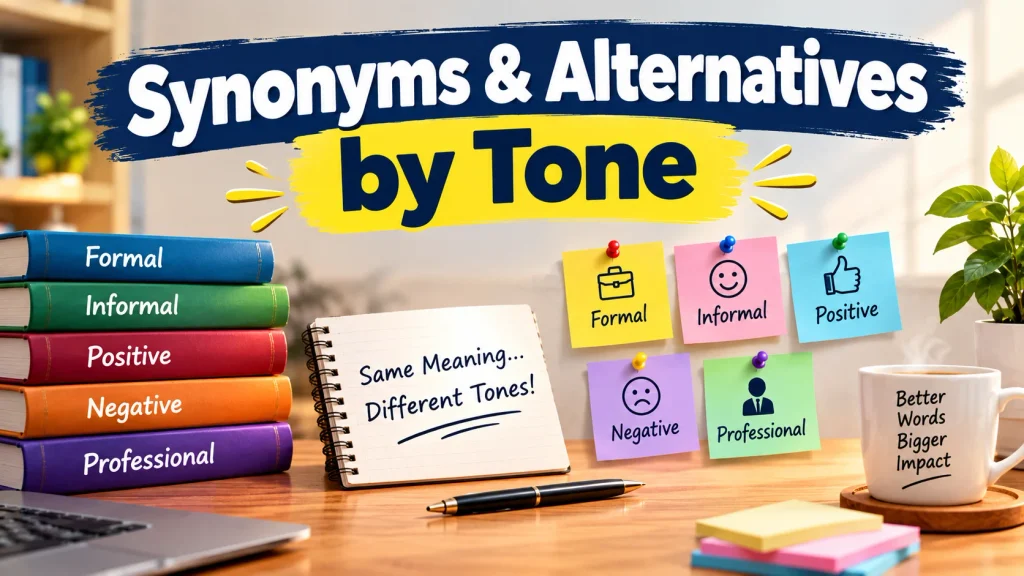
Professional & Neutral Alternatives
- You put me in that position.
- You arranged this situation.
- You prepared me for this.
- You positioned me for this.
- You deliberately arranged this.
- You planned this.
- You engineered the situation.
Polite & Supportive Alternatives
- You helped set this up for me.
- You prepared the situation for me.
- You arranged this for me.
- You gave me an opportunity.
- You made this possible.
Encouraging & Reassuring Alternatives
- You gave me a good opportunity.
- You put me in a strong position.
- You helped me succeed.
- You created the opportunity for me.
Casual, Playful & Idiomatic Alternatives
- You got me.
- You caught me.
- You tricked me.
- You played me.
- You walked me right into that one.
- You pulled a fast one on me.
When Should You Use “You Set Me Up”?
The phrase is most effective when you want to communicate that someone intentionally created or arranged a situation involving you.
Professional settings
In professional communication, use the phrase carefully. If a coworker arranged a useful opportunity, saying:
“You really set me up for success.”
is positive.
However, saying:
“You set me up.”
can sound accusatory if the context involves blame or embarrassment.
Casual conversations
The expression is extremely natural among friends and classmates. If someone creates a joke that causes you to give an obvious answer, you might say:
“You set me up perfectly for that one.”
Here, the meaning is playful rather than hostile.
Writing, presentations, and digital communication
In writing, context should make the intended meaning clear. If there is a possibility of misunderstanding, use a more specific alternative such as “You put me in that position” or “You deliberately arranged this situation.”
When it is especially effective
Use “you set me up” when:
- Someone intentionally arranged circumstances.
- A person prepared an opportunity for you.
- Someone created a situation that led to a predictable response.
- You are joking about being tricked.
- You want to suggest that an outcome was deliberately planned.
When Should You Avoid “You Set Me Up”?
Overly formal situations
The phrase can sound conversational and ambiguous in highly formal writing. A precise description is usually better.
Instead of:
“You set me up.”
consider:
“You deliberately arranged the circumstances.”
Legal, academic, or sensitive contexts
In serious situations, the phrase may imply intentional wrongdoing without explaining exactly what happened. If the distinction matters, describe the specific action instead.
Situations where nuance may be lost
Avoid the phrase when the listener may not know whether you mean helping you, tricking you, or blaming you.
For example, “You set me up for this” could mean either:
- “You prepared me well for this challenge,” or
- “You deliberately created this difficult situation.”
A more precise alternative prevents confusion.
Is “You Set Me Up” Professional, Polite, or Casual?
“You set me up” is primarily conversational and context-dependent. It can be friendly, humorous, appreciative, suspicious, or accusatory.
Its tone depends heavily on the surrounding situation.
Positive:
“You set me up for success.”
Playful:
“You totally set me up with that question!”
Accusatory:
“You set me up to take the blame.”
Neutral:
“You set me up with everything I needed before the presentation.”
The phrase itself is not automatically rude. The emotional meaning comes from why the situation was arranged and how the speaker interprets the other person’s intention.
Pros and Cons of Using “You Set Me Up”
Advantages
Clarity: It can quickly communicate that circumstances were deliberately arranged.
Efficiency: The phrase is short and natural in conversation.
Accessibility: Most English speakers understand the common meanings.
Expressiveness: It can communicate humor, appreciation, surprise, or suspicion depending on context.
Potential Drawbacks
Ambiguity: The listener may not know which meaning you intend.
Tone mismatch: It can sound accusatory in professional or sensitive situations.
Oversimplification: It may hide important details about what actually happened.
Cultural differences: ESL learners may interpret the phrase too literally because phrasal verbs often have several meanings.
Real-Life Examples of “You Set Me Up” by Context
Emails
“Thanks for sending the background information before the presentation. You really set me up for success.”
Here, the phrase is positive and means that someone prepared the speaker well.
Meetings
“You asked me about the sales figures right after I said I hadn’t checked them. You set me up!”
This example has a playful, slightly accusatory tone.
Presentations
“The team gave me all the research I needed, so they really set me up to deliver a strong presentation.”
Here, the expression is clearly positive.
Conversations
“You knew I was going to say yes when you asked it that way. You set me up!”
The phrase suggests that someone deliberately created a situation to obtain a predictable response.
Social media
“I walked straight into that joke. You set me up perfectly.”
This is a casual and humorous use.
“You Set Me Up” vs Similar Expressions (Key Differences)
| Phrase | Meaning Difference | Tone Difference | Best Use Scenario |
| You put me in that position | Focuses on creating circumstances that required a particular response. | Neutral to serious. | Workplace or sensitive discussions. |
| You got me | Usually means someone successfully fooled or caught you. | Casual, playful. | Jokes and friendly teasing. |
| You tricked me | Clearly states that someone deceived you. | Casual, direct. | Light deception or practical jokes. |
| You played me | Suggests someone manipulated or outsmarted you. | Casual and stronger. | Informal conversations. |
| You caught me | Means someone exposed, surprised, or found you. | Casual, light. | Jokes, mistakes, or surprises. |
| You walked me right into that one. | Means someone deliberately created an easy opportunity for a joke or response. | Playful, idiomatic. | Friendly teasing and humor. |
The biggest distinction is intention. “You put me in that position” focuses on circumstances, while “you tricked me” directly emphasizes deception. “You got me” is generally lighter and often implies that the speaker accepts the joke.
Common Mistakes & Misuse of “You Set Me Up”
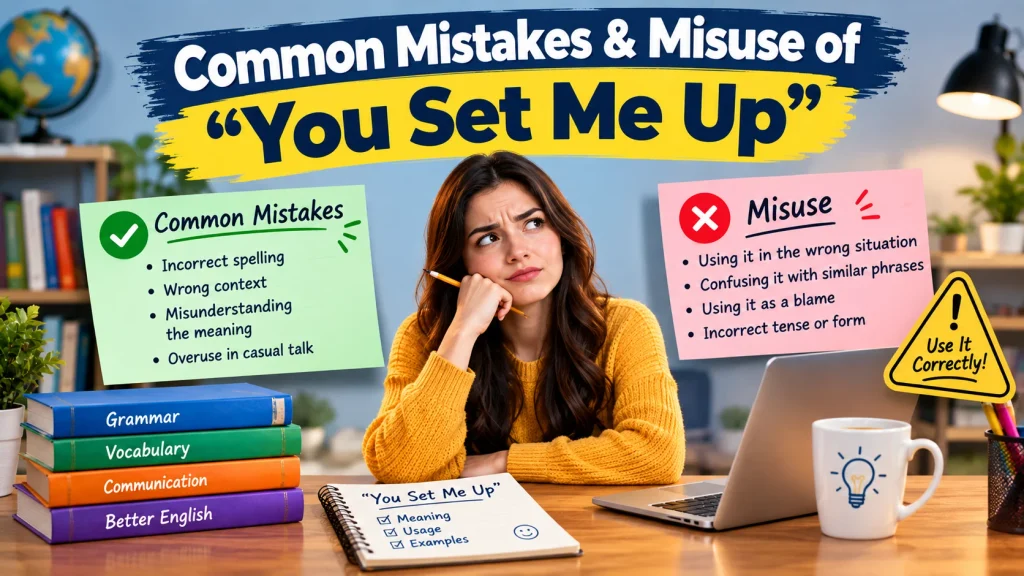
Overuse
Using “you set me up” for every unexpected situation can make your meaning unclear. The phrase is strongest when there is some evidence that another person deliberately arranged circumstances.
Incorrect context
Do not automatically use it when something simply went wrong. A bad outcome does not necessarily mean someone set you up.
Contradictory usage
If you say someone “set you up for success,” you are describing helpful preparation. If you say “you set me up,” you may be accusing them of creating a problem. Adding context avoids confusion.
Cultural misunderstandings
Phrasal verbs can be difficult for ESL learners because “set up” has many meanings. Someone learning English should pay attention to the object and context rather than interpreting “set” and “up” separately.
Psychological Reason People Prefer “You Set Me Up”
Cognitive load reduction
The expression summarizes a complex idea in just a few words: someone arranged circumstances that affected your position or response.
Trust and authority signals
The phrase can communicate that the speaker has recognized another person’s intention. In positive contexts, it can also acknowledge that someone prepared them effectively.
Attention economy
Modern communication favors short, expressive phrases. “You set me up!” quickly communicates surprise or recognition without requiring a lengthy explanation.
Modern communication habits
Group chats, social media, gaming, and workplace messaging encourage compact expressions. Phrases such as “You got me” and “You set me up” work particularly well because their emotional meaning can be understood quickly from context.
US vs UK Usage of “You Set Me Up”
“You set me up” is understood in both American and British English. The main meanings are broadly shared, including arranging circumstances, preparing someone for something, and tricking someone.
American speakers frequently use casual alternatives such as:
- “You got me.”
- “You played me.”
- “You totally set me up.”
British speakers may also use:
- “You set me up.”
- “You caught me out.”
- “You walked me right into that one.”
Regional preference varies by speaker and context, so these are tendencies rather than strict rules.
The phrase itself does not require a special American or British interpretation. Context determines whether it sounds appreciative, humorous, or accusatory.
“You Set Me Up” in Digital & Modern Communication
Emails
Professional writers often add context:
“Thanks for preparing the briefing notes. You really set me up for a productive meeting.”
Slack / WhatsApp
The expression becomes shorter and more playful:
“Okay, you totally set me up 😂”
Social media
People frequently use it when someone creates an obvious joke or opportunity:
“I knew that question was a trap. You set me up.”
AI-generated summaries
AI-generated text may replace ambiguous wording with more precise alternatives such as “arranged the situation,” “prepared me,” or “created the opportunity.” Human writers should still consider the intended emotional meaning because the same phrase can indicate support or accusation.
Linguistic & Communication Insight
Emotional weight & subtext
Native speakers usually understand “you set me up” through context rather than the words alone. A smile can turn the phrase into a joke, while a serious tone can make it sound like an accusation.
Compare:
“You set me up!”
with:
“You set me up for success.”
The first may suggest trickery. The second clearly suggests preparation and support.
Direct vs indirect phrasing
The expression is fairly direct because it attributes intention to another person.
A softer alternative is:
“I think you put me in a difficult position.”
This focuses on the speaker’s experience instead of directly accusing the other person.
A more direct version is:
“You deliberately arranged this situation.”
This removes much of the ambiguity but increases the seriousness of the statement.
Professional communication perspective
At work, the safest approach is to specify the intended meaning. If someone prepared you well, say:
“You gave me everything I needed to succeed.”
If someone placed you in an uncomfortable position, say:
“I felt like I was put in a difficult position.”
These alternatives make the communication easier to interpret.
Pragmatic reasons for alternatives
Experienced communicators often choose alternatives based on their desired interpersonal effect. “You set me up” can assign responsibility.It emphasizes appreciation.Its put me in that position” focuses on circumstances. “You tricked me” emphasizes deception.
The best expression is therefore not simply the closest synonym. It is the phrase that accurately communicates intention, emotion, and responsibility.
Social signaling
Language choices influence whether listeners perceive a message as collaborative or confrontational. Saying “You really set me up for success” builds appreciation. Saying “You deliberately set me up” signals serious criticism.
Tone & context guidance
Before using the phrase, ask:
- Did the person intentionally arrange the situation?
- Am I describing support, humor, or deception?
- Could the listener interpret my words as an accusation?
- Would a more specific expression communicate my meaning better?
These questions help prevent unnecessary misunderstandings.
You Put Me in That Position
Meaning: “You put me in that position” means that another person created circumstances that required the speaker to respond or act in a particular way.
Why This Phrase Works: It is more specific and less ambiguous than “you set me up.” It focuses on the circumstances rather than automatically suggesting deception.
Real-World Usage Insight: This phrase is useful when discussing workplace decisions, difficult conversations, or situations where another person’s actions affected your choices.
Best Use: Professional discussions, conflict resolution, and serious conversations.
Avoid When: You are simply joking with a friend.
Tone: Neutral to serious.
US vs UK Usage: Common in both American and British English.
Example (Meeting):
“I understand why you asked, but you put me in that position during the meeting, so I had to explain the issue in front of everyone.”
You Arranged This Situation
Meaning: “You arranged this situation” directly states that another person organized the circumstances being discussed.
Why This Phrase Works: It removes much of the ambiguity associated with “set up.”
Real-World Usage Insight: This wording works when you want to describe deliberate planning without necessarily accusing someone of wrongdoing.
Best Use: Professional or factual communication.
Avoid When: You want a relaxed or humorous tone.
Tone: Neutral, factual, formal.
US vs UK Usage: Natural in both regions.
Example (Email):
“I appreciate the preparation, but I understand that you arranged this situation so we could test the new process.”
You Prepared Me for This
Meaning: “You prepared me for this” means that someone gave you information, skills, resources, or practice that helped you handle a situation.
Why This Phrase Works: It creates a clearly positive interpretation of the original expression.
Real-World Usage Insight: This is an excellent choice when you want to recognize another person’s support.
Best Use: Mentoring, training, presentations, interviews, and professional development.
Avoid When: The person actually deceived you.
Tone: Positive, appreciative, professional.
US vs UK Usage: Common in both varieties.
Example (Meeting):
“Those practice questions were tough, but you prepared me for this. I knew exactly how to answer when the client asked.”
You Positioned Me for This
Meaning: “You positioned me for this” means that someone placed you in circumstances that made a particular outcome or opportunity possible.
Why This Phrase Works: It emphasizes strategy and preparation rather than deception.
Real-World Usage Insight: The expression is particularly useful when discussing career opportunities, presentations, projects, or competitive situations.
Best Use: Professional communication and strategic discussions.
Avoid When: Talking about a simple joke or casual prank.
Tone: Professional, strategic.
US vs UK Usage: Understood in both, with a somewhat business-oriented feel.
Example (Email):
“Your introduction to the client really positioned me for this opportunity, so I appreciate your support.”
You Deliberately Arranged This
Meaning: “You deliberately arranged this” means that the speaker believes another person intentionally organized the situation.
Why This Phrase Works: It clearly communicates intentionality without relying on the multiple meanings of “set up.”
Real-World Usage Insight: This expression is appropriate when intention is important to the message.
Best Use: Serious workplace discussions, formal explanations, and sensitive situations.
Avoid When: You do not have enough evidence to conclude that the arrangement was intentional.
Tone: Serious, direct, formal.
US vs UK Usage: Natural in both regions.
Example (Meeting):
“I understand the schedule was difficult, but you deliberately arranged this meeting after the deadline had passed.”
You Gave Me an Opportunity
Meaning: “You gave me an opportunity” means that someone created a useful chance for you to do, achieve, or experience something.
Why This Phrase Works: It transforms the potentially negative idea of “setting someone up” into a clearly positive expression.
Real-World Usage Insight: It is especially useful when expressing gratitude for someone’s help.
Best Use: Career discussions, mentoring, professional networking, and education.
Avoid When: The situation involves deception or manipulation.
Tone: Positive, appreciative, professional.
US vs UK Usage: Widely used in both American and British English.
Example (Email):
“Thank you for allowing me to lead the client presentation. It was a valuable experience.”
You Made This Possible
Meaning: “You made this possible” means that another person’s actions were an important reason an achievement or outcome happened.
Why This Phrase Works: It clearly communicates appreciation and avoids the ambiguity of “set me up.”
Real-World Usage Insight: This phrase is especially natural when acknowledging someone’s contribution.
Best Use: Thank-you messages, professional recognition, presentations, and personal conversations.
Avoid When: You are trying to accuse someone of manipulation.
Tone: Warm, appreciative, positive.
US vs UK Usage: Common in both regions.
Example (Social Media):
“I finally presented my project today. My mentor gave me the confidence and feedback that made this possible.”
Conclusion
Understanding “you set me up” is important because this common English expression can carry several meanings depending on context and tone. It may describe helpful preparation, a carefully arranged opportunity, a playful trick, or a situation in which someone feels deliberately placed at a disadvantage.
For professional communication, clearer alternatives such as “you prepared me for this,” “you gave me an opportunityy,” or “you put me in that position” can prevent misunderstandings. In casual conversations, expressions such as “you got me,” “you tricked me,” or “you walked me right into that one” may sound more natural. The key is to consider what you actually want to communicate: appreciation, flexibility, surprise, humor, or criticism.
FAQs
What does “you set me up” mean?
“You set me up” means that someone deliberately arranged a situation involving another person. Depending on context, it can mean preparing someone for success, creating an opportunity, tricking someone, or putting them in a difficult position. The phrase can therefore sound positive, playful, or accusatory depending on the speaker’s intention and tone.
Is “you set me up” a negative phrase?
Not necessarily. “You set me up” can be positive, neutral, playful, or negative. For example, “You set me up for success” is clearly positive, while “You set me up to take the blame” is negative. In casual conversations, it can also describe being humorously tricked into saying or doing something.
Is “you set me up” professional?
The phrase is understandable in professional English, but it can be ambiguous. In formal communication, specify your meaning instead. “You prepared me for this” works for positive support, while “You put me in that position” is better for a serious concern. Clear wording reduces the chance that your message will sound accusatory.
What is a professional alternative to “you set me up”?
Professional alternatives include “you prepared me for this,” “you gave me an opportunity,” “you put me in a strong position,” and “you created the opportunity for me.” These phrases are more precise because they show whether you are describing preparation, support, opportunity, or a specific situation rather than relying on the broad meaning of “set up.”
What does “you set me up for success” mean?
“You set me up for success” means that someone provided the preparation, resources, information, or circumstances needed to succeed. It is a positive expression and is common in workplaces, education, mentoring, and teamwork. For example, a manager who gives an employee useful information before a presentation may have set them up for success.
What is the difference between “you set me up” and “you tricked me”?
“You tricked me” specifically means that someone deceived you, while “you set me up” has several possible meanings. A person can set you up for success, arrange an opportunity, or create a situation for a joke. Therefore, “you tricked me” is more precise when deception is definitely the intended meaning.
What is a casual way to say “you set me up”?
Common casual alternatives include “you got me,” “you caught me,” “you played me,” and “you walked me right into that one.” The best choice depends on the situation. “You got me” is usually playful, “you caught me” suggests being discovered, and “you played me” can imply stronger manipulation.
What does “you walked me right into that one” mean?
“You walked me right into that one” is a playful expression meaning someone cleverly created an opportunity for a joke or predictable response. It is often used when a person asks a question that makes another person give an obvious answer. The phrase is informal and works best among friends, classmates, or familiar colleagues.
Is “you set me up” common in American and British English?
Yes. “You set me up” is widely understood in both American and British English. The core meanings are similar in both varieties. However, some casual alternatives may vary in popularity. American speakers commonly use “you got me,” while British speakers may also use expressions such as “you caught me out,” depending on the context.
What is the best synonym for “you set me up”?
There is no single best synonym because “you set me up” has multiple meanings.They professional preparation, use “you prepared me for this.” For deception, use “you tricked me.” For playful teasing, “you got me” or “you walked me right into that one” works well.