
When discussing recent events, sharing personal experiences, or providing workplace updates, choosing the right time expression can make your message clearer and more natural. Although “past few days” is common in everyday English, repeating it can make your writing feel predictable. Using suitable alternatives helps you express the same idea with a more appropriate tone.
This guide explores 20 alternatives with their meanings, subtle differences, and practical examples. You’ll also learn which expressions work best in casual conversations, professional emails, and everyday writing.
Special Tip: Before choosing an alternative, consider your audience and context. For professional communication, phrases like “over the last several days” often sound more polished, while “lately” feels more natural in casual conversations.
What Does “Past Few Days” Mean?
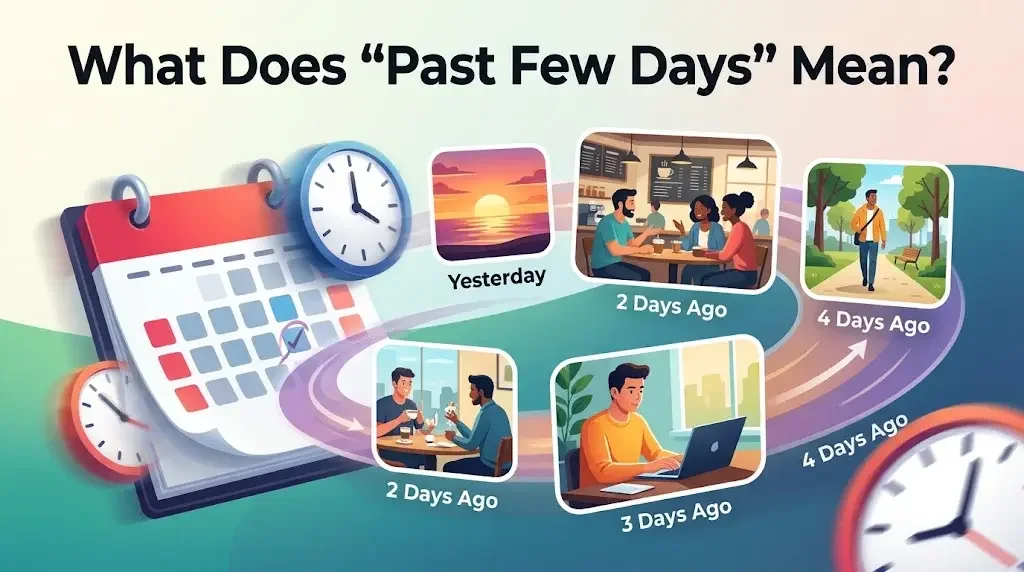
The expression “past few days” describes a short period of time that began several days ago and continues up to the present. It usually refers to a small number of recent days, but it does not identify an exact duration.
For example, someone might say, “I’ve been very busy over the past few days.” This tells the listener that the person has had a busy schedule recently, without explaining exactly when the busy period started or how many days it lasted.
The phrase is useful when the general timeframe matters more than the precise dates. People commonly use it to discuss work progress, personal experiences, recent developments, changing circumstances, daily activities, and events that have happened shortly before now.
Its meaning can also depend on the sentence. In “We’ve received several complaints over the past few days,” the expression describes a period during which multiple events occurred. In “I’ve felt tired for the past few days,” it suggests that a condition began earlier and has continued into the present.
Find the Perfect Time Expression
Choose your situation and discover a natural way to describe recent events.
Origin & History of “Past Few Days”
“Past few days” is a straightforward combination of three familiar English words rather than a fixed idiom with a single documented origin. Its meaning comes from the individual roles of “past,” “few,” and “days.”
The word past refers to a time that has already happened. It is also used in expressions that connect an earlier period with the present, such as “the past week” and “the past year.” The word few indicates a small number, while days identifies the period being discussed.
Together, these words create a convenient expression for referring to a limited stretch of recent time. It allows speakers to describe something that happened shortly before now without listing individual dates.
Similar constructions include “past few weeks,” “past few months,” and “last few days.” These expressions follow the same general pattern but describe different lengths of time.
The phrase remains useful in modern English because it fits many situations. It can appear in a personal message, a business update, a news report, or an everyday conversation without sounding unusually formal or informal.
20 Synonyms & Alternatives by Tone
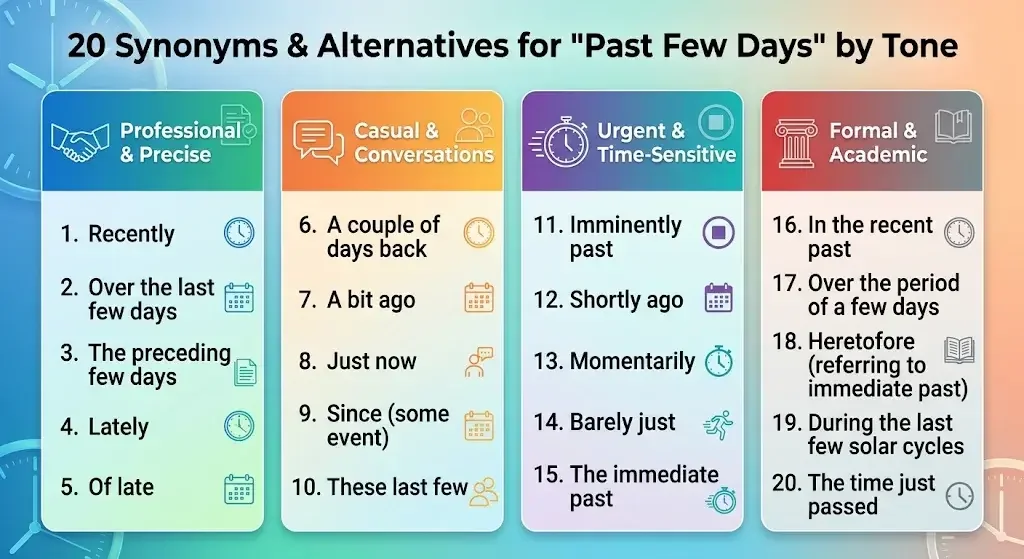
Different alternatives work better in different situations. Some are close replacements, while others describe a broader or more specific period.
Professional & Neutral Alternatives
These expressions are suitable for workplace communication, reports, presentations, and general writing:
- Last few days – A natural, direct alternative.
- Recent days – A concise option often used in written communication.
- In recent days – Useful when discussing recent events or developments.
- Over the last several days – Emphasizes activity across a recent period.
- Over the past several days – Suitable for describing gradual changes.
- During the last few days – Highlights when an activity or event took place.
- In the last few days – A flexible expression for everyday and professional writing.
Personal & Reflective Alternatives
These expressions can make a sentence feel more connected to someone’s current experience:
- These past few days – Gives a personal and immediate feeling.
- These last few days – Connects the timeframe to the speaker’s present situation.
- Over the course of the last few days – Emphasizes gradual progress or change.
- For the last few days – Often suggests that something has continued throughout the period.
Casual & Conversational Alternatives
These options are useful in messages, informal discussions, and everyday speech:
- Lately – Refers broadly to a recent period.
- Recently – A short and versatile alternative.
- The last couple of days – Usually suggests approximately two days.
- The past couple of days – Another conversational expression for a short period.
- The last little while – Refers to an undefined recent period that may be longer than a few days.
More Specific or Formal Alternatives
These expressions can be useful when the context calls for a more particular style or timeframe:
- In the days leading up to now – Explains a sequence of events before the present.
- In the preceding days – A more formal way to refer to days before a particular point.
- Throughout the last few days – Emphasizes something happening repeatedly or continuously during the period.
Not every alternative is interchangeable in every sentence. For instance, “the last couple of days” usually suggests approximately two days, while “lately” can refer to a longer and less clearly defined period.
When Should You Use “Past Few Days”?

This expression works best when you want to discuss recent activity without identifying exact dates. It is flexible enough for personal conversations, professional communication, and general writing.
1. When Giving Workplace Updates
Employees and managers often need to describe recent progress, changes, or completed tasks. The phrase provides a convenient way to summarize activity without listing every date.
Example:
“We have resolved several technical issues over the past few days and are now preparing for the next testing phase.”
It is particularly useful when the exact start date is not important to the reader.
2. When Discussing Personal Experiences
In everyday conversations, people often use the expression to explain how they have been feeling or what they have been doing recently.
Example:
“I’ve been spending more time with my family over the past few days.”
The wording sounds natural because it connects a recent experience with the speaker’s present situation.
3. When Describing Recent Changes
The phrase can help explain developments that have occurred over a short period.
Example:
“Customer interest has increased over the past few days, and more people are visiting the website.”
This type of sentence is useful in business discussions, project updates, and informal progress reports.
4. When Writing Emails and Messages
It can provide context when explaining a delay, sharing an update, or referring to recent communication.
Example:
“Thank you for your patience. I’ve been reviewing the documents over the past few days and will send my feedback shortly.”
For a shorter message, “recently” or “in the last few days” may work just as well.
Past Few Days: Test Your Knowledge
Can you choose the correct expression in each situation?
5. When Exact Dates Are Not Necessary
Sometimes, the reader only needs to understand that something happened recently. In those situations, giving a precise date may add unnecessary detail.
Example:
“We’ve noticed a few changes in the team’s schedule over the past few days.”
If the reader needs to know exactly when those changes occurred, use dates or a defined timeframe instead.
When Should You Avoid “Past Few Days”?
Although the phrase is widely understood, its approximate meaning is not suitable for every situation. When accuracy, accountability, or a clearly defined timeline matters, a more specific expression is often better.
- Legal documents: Use exact dates or clearly defined periods when the timing may affect a legal decision or record.
- Academic research: Identify the dates or study period when readers need to understand when observations were collected.
- Medical or health records: Avoid vague timing when describing the onset or duration of symptoms. A specific number of days or date may be more useful.
- Historical writing: The expression normally refers to time close to the present, so it is unsuitable for describing events from distant historical periods.
- Project deadlines: If a task was completed within a specific timeframe, state the number of days or dates rather than leaving the duration open to interpretation.
- Financial reporting: Use defined reporting periods when discussing transactions, performance, or changes that must be measured accurately.
For example, “The payment was received over the past few days” may be acceptable in a casual update. However, an official financial record should identify the actual date of receipt.
Is “Past Few Days” Professional, Polite, or Casual?
“Past few days” is a neutral expression. It is suitable for both professional and informal communication because it does not sound overly technical, overly casual, or emotionally strong.
In a workplace email, someone might write, “We’ve received several updates over the past few days.” The same expression can appear in a personal conversation: “I’ve been feeling a little tired over the past few days.”
Its tone depends more on the surrounding sentence than on the phrase itself. A formal report can use it naturally, but a report that requires exact documentation may need specific dates instead.
The expression is also polite because it does not sound demanding or judgmental. It simply provides information about a recent timeframe. However, it should not be used to avoid giving important details when another person needs a clear explanation.
Real-Life Examples of “Past Few Days” by Context
Seeing the expression in different situations makes it easier to understand how it works in natural communication.
Emails
“We’ve received several suggestions from the marketing team over the past few days, and I’ve included the most useful ones in the revised proposal.”
This example gives the recipient a brief update without listing the dates of every suggestion.
Meetings
“Over the past few days, we’ve noticed a drop in customer support requests.”
The phrase helps summarize a recent trend that can be discussed further during the meeting.
Presentations
“Website traffic has increased over the past few days, particularly among visitors using mobile devices.”
This wording is useful when explaining a recent pattern in a presentation.
Personal Conversations
“I haven’t had much free time over the past few days because I’ve been helping my family move.”
The expression sounds relaxed and natural in an everyday conversation.
Social Media
“The past few days have been full of surprises, but I’m grateful for every moment.”
Here, the phrase introduces a short reflection on recent experiences.
Project Updates
“We’ve completed the initial design changes over the past few days and are now waiting for final approval.”
This example shows how the phrase can connect recent work with the next stage of a project.
“Past Few Days” vs. Similar Expressions: Key Differences
Some alternatives have almost the same meaning, while others suggest a different duration or tone. Understanding these distinctions helps prevent awkward substitutions.
| Expression | Main Difference | Tone | Best Use |
| Last few days | Very close in meaning to the original phrase | Neutral | General communication |
| Recent days | Refers generally to days that occurred recently | Slightly formal | Reports and articles |
| In recent days | Often highlights recent events or developments | Professional | News and updates |
| Over the last several days | Emphasizes activity across several days | Neutral | Workplace reports |
| Over the past several days | Often describes gradual change | Professional | Project updates |
| Lately | Can refer to a broader recent period | Conversational | Personal discussions |
| Recently | Does not specify a duration | Neutral | General writing |
| The last couple of days | Usually suggests approximately two days | Casual | Everyday conversations |
| For the last few days | Often suggests an activity continuing throughout the period | Neutral | Ongoing situations |
| In the preceding days | Refers to days before a particular event or point | Formal | Timelines and reports |
The main difference is the level of precision. “Last few days” is usually a direct substitute, whereas “recently” and “lately” can cover a broader period. “The last couple of days” is more specific because it normally suggests around two days.
Common Mistakes & Misuse of “Past Few Days”
The expression is easy to understand, but using it carelessly can make a sentence vague or unnatural. The following mistakes are worth avoiding.
1. Repeating the Same Expression Too Often
Using “past few days” repeatedly in a paragraph can make writing monotonous.
Repetitive:
“We’ve been busy over the past few days. Several tasks were completed over the past few days, and the team has learned a lot over the past few days.”
Improved:
“We’ve been busy over the past few days. Several tasks have been completed recently, and the team has learned a lot during this period.”
Changing the wording where appropriate makes the paragraph easier to read.
2. Using It for a Distant Period
The phrase normally refers to a short period close to the present. It should not be used when discussing events from centuries ago or a distant historical period.
Awkward: “The Roman Empire changed over the past few days.”
Better: “The Roman Empire changed over several centuries.”
The replacement should match the actual length of time being discussed.
3. Confusing “Few” With an Exact Number
The word “few” does not establish a fixed duration. It generally suggests a small number, but the exact interpretation depends on context.
If you mean exactly three days, write “the past three days.” If you mean approximately two, “the last couple of days” may be more suitable.
4. Combining It With Conflicting Time Information
Avoid using a vague expression when the same sentence already provides a conflicting exact timeframe.
Unclear: “The issue started exactly two days ago during the past five days.”
Clearer: “The issue started two days ago.”
A sentence should make the timeframe easy to understand.
5. Choosing an Alternative That Changes the Meaning
Not every synonym communicates precisely the same period. “Lately” can cover a longer timeframe, while “the last couple of days” generally suggests around two days.
Before replacing the original expression, check whether the alternative still communicates the intended duration.
Past Few Days: Phrase Challenge
Match each situation with the most appropriate time expression.
US vs. UK Usage of “Past Few Days”
“Past few days” is standard English in both the United States and the United Kingdom. There is no major difference in its basic meaning, grammar, or everyday use.
Meaning and Popularity
Speakers in both varieties use the expression to describe a short period immediately before the present. It can refer to personal experiences, work activities, recent events, or ongoing situations.
Tone and Formality
The phrase generally sounds neutral in American and British English. It is suitable for everyday speech and many forms of professional writing.
Alternative Expressions
Some speakers may prefer particular alternatives based on personal habits or the surrounding sentence. For example, “the last couple of days” sounds conversational, while “in recent days” is often more suitable for formal written communication.
These preferences do not create a major difference in meaning between the two varieties.
Which Version Should You Choose?
You can use “past few days” confidently when writing for either American or British readers. If your audience needs exact timing, provide dates or a specific number of days rather than relying on regional wording.
“Past Few Days” in Digital & Modern Communication
Digital communication often requires short, clear updates. This expression is useful when summarizing recent activity without explaining every detail.
Emails and Workplace Platforms
In professional messages, it can introduce a brief update about completed work, feedback, or a developing issue.
Example:
“I’ve reviewed the feedback received over the past few days and added the necessary changes to the shared document.”
Slack and WhatsApp Messages
Short messaging platforms encourage direct language. The expression works well when someone needs to explain an absence, delay, or recent activity.
Example:
“I’ve been away from my laptop for the past few days, so I’m catching up on the messages now.”
Social Media Captions
People often use the phrase when reflecting on recent experiences or sharing a short update.
Example:
“The past few days have been busy, but I’m finally making time to relax.”
Newsletters and Online Updates
Writers can use it to summarize recent developments for readers.
Example:
“Over the past few days, our team has introduced several improvements to the website.”
When a digital update concerns an important deadline, announcement, or measurable event, exact dates are more informative than a general time expression.
AI-Generated Summaries
AI-generated summaries may use phrases such as “over the past few days” when describing recent developments. However, summaries should not rely on vague timing if the original information includes specific dates. Keeping the timeframe accurate helps readers understand when an event actually occurred.
Meaning, Usage & Examples for Each Alternative
The following alternatives offer different ways to describe a recent period. Some are direct replacements, while others work best in particular contexts.
1. Last Few Days
Meaning: “Last few days” refers to several days immediately before the present. It is one of the closest alternatives to the original expression.
Why This Phrase Works: It communicates almost the same idea without changing the general timeframe. It also fits naturally into many sentence structures.
Best Use: Everyday conversations, workplace emails, project updates, and general writing.
Avoid When: The reader needs exact dates or a clearly defined number of days.
Tone: Neutral and natural.
Example (Email): “I’ve reviewed the comments from the last few days and added the most important changes to the document.”
2. Recent Days
Meaning: “Recent days” refers to days that occurred shortly before the present. It describes a recent period without specifying its exact length.
Why This Phrase Works: It is concise and often gives written communication a slightly more formal tone.
Best Use: Reports, articles, professional updates, and descriptions of recent developments.
Avoid When: A relaxed conversation would sound more natural with a simpler expression such as “lately.”
Tone: Neutral to slightly formal.
Example (Report): “Recent days have brought several changes to the company’s customer support process.”
3. In Recent Days
Meaning: “In recent days” refers to events, activities, or developments that have taken place shortly before now.
Why This Phrase Works: It is particularly effective when introducing a recent change or trend.
Best Use: News-style writing, reports, presentations, and professional communication.
Avoid When: You are trying to create a very casual or personal tone.
Tone: Professional and neutral.
Example (News Update): “In recent days, several local businesses have announced changes to their opening hours.”
4. Over the Last Several Days
Meaning: This expression describes a period covering several days immediately before the present.
Why This Phrase Works: The word “several” can make the timeframe sound slightly more substantial than “few.”
Best Use: Workplace updates, project reports, meetings, and descriptions of ongoing developments.
Avoid When: The exact duration is already known and should be stated clearly.
Tone: Neutral and professional.
Example (Meeting): “Over the last several days, the support team has noticed fewer technical complaints.”
5. Over the Past Several Days
Meaning: This phrase describes events or activities taking place across several recent days.
Why This Phrase Works: The word “over” emphasizes a period during which something has happened or developed.
Best Use: Reports, business communication, project updates, and presentations.
Avoid When: You are referring to a single event that happened at one specific moment.
Tone: Neutral and professional.
Example (Email): “Over the past several days, we’ve received helpful feedback from early users.”
6. During the Last Few Days
Meaning: “During the last few days” identifies a recent period in which an event or activity occurred.
Why This Phrase Works: It places emphasis on the timeframe in which something happened.
Best Use: Explanations, reports, workplace discussions, and descriptions of recent activities.
Avoid When: A shorter expression would make an informal message sound more natural.
Tone: Neutral.
Example (Meeting): “During the last few days, the team has focused on resolving the remaining technical issues.”
7. These Past Few Days
Meaning: “These past few days” refers to several recent days connected to the speaker’s current situation or experience.
Why This Phrase Works: The word “these” makes the period feel more immediate and personal.
Best Use: Conversations, personal writing, reflective messages, and social media captions.
Avoid When: A highly formal document requires a precisely defined timeframe.
Tone: Conversational and personal.
Example (Personal Message): “These past few days have been hectic, but I’m finally getting back into a normal routine.”
8. In the Last Few Days
Meaning: This expression refers to events or activities that have happened within the short period immediately before now.
Why This Phrase Works: It is a simple and natural alternative that fits many sentence structures.
Best Use: Emails, everyday conversations, reports, and general updates.
Avoid When: Exact dates are necessary to explain when something happened.
Tone: Neutral and versatile.
Example (Work Update): “We’ve received several new applications in the last few days.”
9. Over the Course of the Last Few Days
Meaning: This phrase describes something that has developed or happened throughout a recent period.
Why This Phrase Works: “Over the course of” emphasizes progression rather than simply identifying when an event occurred.
Best Use: Reports, presentations, articles, and explanations of gradual change.
Avoid When: Brevity is important, or the sentence is already long.
Tone: Neutral and moderately formal.
Example (Report): “Over the course of the last few days, response times have improved considerably.”
10. Lately
Meaning: “Lately” means recently or during a period close to the present. It does not specify how many days have passed.
Why This Phrase Works: It is short, familiar, and easy to use in everyday English.
Best Use: Personal conversations, informal messages, and general descriptions of recent experiences.
Avoid When: The timeframe must be limited specifically to several days.
Tone: Casual and natural.
Example (Conversation): “I’ve been really busy lately, so I haven’t had much time to catch up with friends.”
11. Recently
Meaning: “Recently” refers to something that happened not long before the present. It can describe a single event or a broader recent period.
Why This Phrase Works: It is flexible and works in both formal and informal communication.
Best Use: Emails, articles, reports, conversations, and general writing.
Avoid When: The reader needs to know the exact length of the period.
Tone: Neutral and versatile.
Example (Email): “We recently updated the project schedule to reflect the revised deadline.”
12. In Recent Times
Meaning: “In recent times” refers to a period that is relatively close to the present but does not identify a specific number of days.
Why This Phrase Works: It is more suitable for discussing broader developments than a very short recent period.
Best Use: Essays, articles, and discussions about changing habits, trends, or circumstances.
Avoid When: You are specifically referring to the last two or three days.
Tone: Formal and broad.
Example (Article): “In recent times, remote collaboration has become an important part of workplace communication.”
13. The Last Couple of Days
Meaning: “The last couple of days” usually refers to approximately two days immediately before the present.
Why This Phrase Works: It gives a more specific impression than “past few days” while remaining natural in conversation.
Best Use: Everyday speech, informal messages, and short personal updates.
Avoid When: The timeframe covers significantly more than two days or requires exact numerical accuracy.
Tone: Casual and natural.
Example (Message): “I’ve been working from home for the last couple of days because the office has been unusually busy.”
14. The Past Couple of Days
Meaning: This phrase generally refers to approximately two recent days.
Why This Phrase Works: It communicates a short timeframe and can suggest that something has happened or continued during that period.
Best Use: Conversations, emails, informal updates, and personal writing.
Avoid When: The intended period is longer than approximately two days.
Tone: Casual to neutral.
Example (Email): “The past couple of days have been productive, and we’re now ready for the next stage.”
15. These Last Few Days
Meaning: “These last few days” refers to several recent days that are connected to the speaker’s present circumstances.
Why This Phrase Works: It creates a personal and immediate feeling, especially when describing experiences or changes.
Best Use: Personal conversations, informal writing, and reflective messages.
Avoid When: A technical, legal, or highly formal document requires precise dates.
Tone: Conversational.
Example (Social Media): “These last few days have been full of unexpected changes, but things are finally settling down.”
16. For the Last Few Days
Meaning: “For the last few days” often describes an activity, condition, or situation that started earlier and has continued up to the present.
Why This Phrase Works: The word “for” is useful when emphasizing duration rather than simply identifying when something happened.
Best Use: Describing ongoing activities, feelings, conditions, and situations.
Avoid When: You are referring to a single event that happened once during the period.
Tone: Neutral and natural.
Example (Conversation): “I’ve been working on this presentation for the last few days, and I’m almost finished.”
17. The Last Little While
Meaning: “The last little while” refers to an undefined period shortly before the present. Depending on context, it may mean days, weeks, or even longer.
Why This Phrase Works: It sounds relaxed and avoids committing to an exact duration.
Best Use: Casual conversations, personal messages, and informal explanations.
Avoid When: The reader needs a specific timeframe or a measurable duration.
Tone: Informal and conversational.
Example (Conversation): “I haven’t been sleeping well for the last little while, so I’m trying to slow down my schedule.”
18. Over the Last Few Days
Meaning: This expression describes something that has happened or developed throughout several days immediately before the present.
Why This Phrase Works: It is one of the most natural and flexible alternatives, particularly when discussing gradual progress or repeated activity.
Best Use: Emails, meetings, reports, presentations, and everyday conversation.
Avoid When: You need to identify an exact date or numerical timeframe.
Tone: Neutral and versatile.
Example (Meeting): “Over the last few days, we’ve received enough feedback to make a few changes to the launch plan.”
19. In the Preceding Days
Meaning: “In the preceding days” refers to the days that came before a particular event, date, or point in time. Unlike some alternatives, it does not necessarily mean the days immediately before today.
Why This Phrase Works: It is useful when a sentence needs to connect earlier events with a later event.
Best Use: Formal reports, timelines, historical explanations, and detailed descriptions of events.
Avoid When: You are having a casual conversation or simply describing what happened recently.
Tone: Formal and explanatory.
Example (Report): “In the preceding days, the research team had collected additional information before publishing its findings.”
20. Throughout the Last Few Days
Meaning: This phrase emphasizes that an activity, condition, or pattern has continued or occurred repeatedly during several recent days.
Why This Phrase Works: “Throughout” gives greater emphasis to the duration or repeated nature of an activity.
Best Use: Progress reports, descriptions of ongoing situations, workplace updates, and explanations of repeated events.
Avoid When: Something happened only once, and the duration is not relevant.
Tone: Neutral and slightly formal.
Example (Project Update): “Throughout the last few days, the development team has been testing the updated features and fixing minor errors.”
Comparison Table of 10 Best Alternatives
The following table highlights ten useful options and explains how they differ in meaning, tone, and suitability.
| Phrase | Meaning | Best Use | Tone |
| Last few days | Several days immediately before now | Everyday and professional writing | Neutral |
| Recent days | Days that occurred recently | Reports and articles | Slightly formal |
| In recent days | Recent events or developments | News and professional updates | Professional |
| Over the last several days | Activity across several recent days | Reports and meetings | Neutral-professional |
| Over the past several days | Events throughout a recent period | Workplace updates | Professional |
| Lately | A recent but undefined period | Casual conversations | Casual |
| Recently | At a time not long before now | General communication | Neutral |
| The last couple of days | Usually approximately two days | Informal messages | Casual |
| For the last few days | An activity continuing over a recent period | Ongoing situations | Neutral |
| These past few days | Recent days connected to the present experience | Personal communication | Conversational |
When choosing between these expressions, consider whether you are describing a single event, an ongoing activity, or a general recent trend. The closest alternative is usually “last few days,” while “lately” and “recently” are broader.
Conclusion
In everyday English, “past few days” is a useful expression for describing recent experiences, ongoing activities, and changes without mentioning exact dates. Whether you’re writing an email, sharing a personal update, or discussing workplace progress, it helps communicate a general timeframe clearly. Alternatives such as “last few days,” “in recent days,” and “over the past several days” offer different ways to express the same general idea while keeping your writing varied and natural.
The right expression depends on the timeframe, tone, and message you want to convey. While “the last couple of days” suggests a shorter period, “lately” covers a broader stretch of time, and “for the last few days” often highlights an ongoing situation. By understanding these subtle differences, you can choose words that fit your context, avoid unnecessary repetition, and make your English sound more precise, fluent, and confident.
FAQs
What does “past few days” mean?
“Past few days” refers to several days immediately before the present. It describes a short recent period without specifying an exact number of days. People commonly use it when discussing activities, experiences, changes, or developments that have happened shortly before now.
Is “past few days” grammatically correct?
Yes, “past few days” is grammatically correct when used in an appropriate sentence structure. It commonly appears in expressions such as “over the past few days,” “during the past few days,” and “for the past few days.” For example, “We’ve received several updates over the past few days” is natural English.
What is another way to say “past few days”?
Common alternatives include “last few days,” “recent days,” “in recent days,” “over the last several days,” “recently,” “lately,” and “these past few days.” The best option depends on the context. Some alternatives are more conversational, while others are better suited to professional writing.
Is “past few days” the same as “last few days”?
In most everyday situations, “past few days” and “last few days” have essentially the same meaning. Both describe several days immediately before the present. The difference is mainly stylistic, and both expressions are widely understood in American and British English.
How many days does “few” mean in “past few days”?
There is no fixed number. “Few” generally suggests a small number of days, often around three or slightly more depending on the context. If the exact duration matters, use a specific expression such as “the past three days” or “the previous five days.”
What is the difference between “past few days” and “recently”?
“Past few days” suggests a short period measured in days, while “recently” is broader. Recently can describe something that happened yesterday, last week, or at another relatively recent time. The original expression therefore gives a more specific sense of duration.
Is “past few days” formal or informal?
“Past few days” is neutral, which makes it suitable for both formal and informal communication. It can appear in workplace emails, reports, presentations, personal conversations, and social media posts. The surrounding sentence usually determines how formal the overall message sounds.
Can I use “past few days” in professional writing?
Yes. It is appropriate for professional writing when an approximate recent timeframe is sufficient. For example, “We have received several inquiries over the past few days” sounds natural in a workplace update. If precise documentation is required, use exact dates or a defined number of days.
What is a more formal synonym for “past few days”?
Useful formal alternatives include “in recent days,” “over the past several days,” “over the last several days,” and “in the preceding days.” Choose according to the sentence: “in recent days” works well for developments, while “in the preceding days” is useful when referring to events before another point in time.
What is the difference between “past few days” and “past couple of days”?
“Past few days” refers to a small number of recent days without giving an exact quantity. “Past couple of days” usually suggests approximately two days. The second expression is therefore narrower and should not be used when the period covers significantly more than two days.